Country:

 City:
City:


Park in the large car park on Route d’Eyguières, at the corner of Allée du Château.
(S/E) Walk up the Allée du Château. On the right, in a private park, you can admire a remarkable tree, a 240-year-old plane tree. At the roundabout, turn left. Take the path on the right, just in front of a public bench. Follow the Sentier des Forêts Pédagogiques through the woodland, marked by information boards, ignoring the various other trailheads.
(1) Leave the main path and take a track that climbs slightly to the right over a rocky outcrop. At the next junction, continue straight ahead. Ignore the paths branching off to the right and left.
(2) At cistern No. 8, keep left. At the junction of tracks, continue straight ahead. At the next Fork in the road, keep left. Ignore the path climbing to the right towards a pylon.
(3) Then turn right onto the track leading into the Vallon de la Redaresse (DFCI barrier). At the junction, continue straight ahead. Stay on this main track, where hunting posts are dotted here and there. The track climbs towards the cliffs bordering the valley, takes a left-hand bend and then a wide curve.
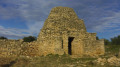
(4) In the bend, turn right onto a path that climbs towards the cliffs for a return trip to the private site of the "Mur des Abeilles". At the Fork in the road, follow the blue markers to the left. You will reach the site’s information board. Take the time to explore the restored 19th-century bee hives.
(5) Turn back.
(4) Continue right along the track to return to the “Route du Défens”, at the fork past the lane.
(3) Turn right. Ignore the four DFCI track junctions on the right.
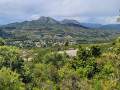
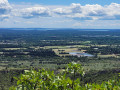
(6) Turn right at the barrier onto the5th track "DFCI A 179 c". Then head straight up to the left. Follow the track, which climbs steadily to above the "Cirque de Borme", where there are pylons. Panoramic views open up to the left over the town of Eyguières and Les Opies (the highest point of the Alpilles massif at an altitude of 496 m) and to the right over the “Cirque de Borme”, which you overlook from the cliffs that border it. From the top of the Cirque, atthe first pylon, the view opens out towards Salon-de-Provence and as far as the Étang de Berre.
(7) Shortly after the first pylon, a barely visible path on the left leads to a viewpoint offering a panoramic view to the north of the Défens massif, encompassing Les Opies and the Alpilles, Roquemartine Castle, Sénas and the Durance valley, as well as the Petit Luberon.
(8) Turn back.
(7) Turn left and, at the next junction, continue straight ahead onto the AL 141.
(9) Leave the track and turn right onto a path marked GR® (red and white) and PR® (yellow). Follow this double-marked path, which avoids the DFCI track whilst running parallel to it, allowing you to stay on the edge of the Cirque and then pass over the Vallon de la Redaresse (path visible on OSM and OSM Rando maps).
(10) At the track junction where there is a water tank and a signpost, continue along the same path running parallel to the track towards Lamanon. When the track curves to the left, continue along the path which leads through the undergrowth between large rocks. After a wide bend to the right, stay on the marked path, which will move away from the track and enter denser woodland. At the junction, continue straight ahead, passing to the left of the cistern. At the next junction, turn left. Then follow the wide marked path, ignoring any other trails. You will reach a gate.
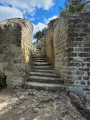
(11) Before continuing straight ahead (Red Cross and White Cross) and thus leaving the marked route, look to the right to discover the remains of a troglodytic dwelling featuring a gutter carved into the rock as well as notches for beams that supported a roof. At thesecond gate, climb up to a paved slanting street. Turn left onto this street, which leads to the medieval ruins alongside caves carved into the rock. You’ll reach the steps at the north gate of the castle ramparts. Climb up to the statue of the Virgin Mary, then head back down. Enjoy a magnificent panoramic view of the Calès site, in fact an ancient fortress occupied from the 12th to the 15th century, whose eastern and western sides are natural rock and the southern and northern sides, built ramparts. Descend beneath the kitchens (where there are reinforcements with props), passing in front of the castle’s cistern protected by a grille, and reach the remains of the castle ramparts, then a flat area containing two silos dug out in front of an arch. Descend to the southern enclosure wall.
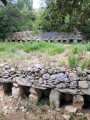
(12) Pass through the southern gate of the enclosure, walk straight on to the northern gate of the enclosure in the “Cirque de Calès”, then take the time to return and walk along the base of the eastern cliff to admire the remains of the dwellings and excavated structures. Don’t forget to visit the communal hall with its benches and the block of vats. The caves in the western cliff face are not accessible. Less well-oriented, they were likely used to house livestock. Overgrown with vegetation, they were not included in the site’s recent restoration. Exit through the southern gate of the enclosure and admire, on the left, the troglodytic islet featuring four caves with remarkable domestic fittings. Then walk down the paved slanting street, passing the ruts carved into the rock for Roman carts in the 5th century, before reaching the old water-collection channels which helped to protect the hill and the paved slanting street from erosion whilst channelling water towards the crops. Reach the church square, go down the steps to the Grand Rue and return to the car park where you started. (S/E)

 Visorando Member

 Difficult
 Easy
Easy  Association / Club / Walk leader