Country:
 City:
City:


Follow the red markings (formerly green, which can still be seen in some places).
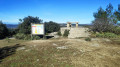
(S/E) Leave the car park and take the Haut Chemin du Talagard, then turn right at the DFCI barrier onto the tarmac road RO102 which climbs uphill. When you reach the "Patrimoine agro-pastoral" sign
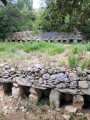
(1) The interpretive trail begins when you leave the paved road on the left. Follow the path to a wall with protruding stones that serve as supports for crop stakes. Continue along the trail, making a loop to the right to reach the "Puits et abreuvoir" (Well and watering trough) sign. Take the leftmost path heading west (marked on a tree after 20 metres) to discover the second well and then arrive at La Pastorale. This is a former17th-century farmhouse with a sheepfold (jasse in Provençal) in the lower part.
(2) Make a short return trip from the information sign for the "Escaliers volants" (flying stairs), which allow you to pass from one cultivated terrace to another (bancau). Then resume the path towards the east, from the sign opposite. Signs at the site of an old paved slanting street and cultivated terraces. Follow the large wall and, at the end, turn right, overlooking the path you have just taken. Then join the wide DFCI track on the left and take the first path on the left to reach the orientation table.
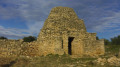
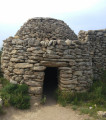
(3) View of the Alpilles to the north-west with the Tour des Opies. Continue along the path to cross the DFCI track and discover the first hut (drystone shelter) heading west. On the path, turn right to discover a double drystone shelter consisting of two communicating huts. Continue to find the "Borie et son mur" (drystone shelter and wall) to the north (cagnard: wall in the sun). Take the small path to the west which leads back to the DFCI track, and follow it downhill. Take the wide path on the left. There is a large wall, partly restored. You will come to a three-tiered drystone shelter, a type of shelter specific to Salon-de-Provence.
(4) Follow the path downhill towards the south, then turn west to find the "Borie conique", a simpler drystone shelter.
Continue along the path without taking the first path on your right. There is a circular drystone shelter with steps and a round drystone shelter with three steps.
Go back up the path towards the north to reach a double drystone shelter: a small shelter next to a larger one.
(5) Continue along the path and descend on the left to reach the drainage gallery (unfortunately blocked by a grille), a horizontal well dug into the rock to collect runoff water. Continue downhill towards the west between the reservoirs to reach a hunting lodge (dating fromthe 15th or16th century). This lodge, known as the "hunting lodge of the bailiff of Sufren", has a cellar with a beautiful key-holed vault and a mullioned corner window.
(6) Return to the information board at the start of the trail.
(1) Then head left to the car park (S/E) by following the same route you took on the way there.
 Visorando Member

 Moderate