Country:

 City:
City:


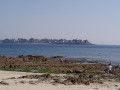
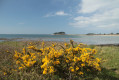
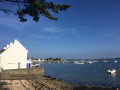
Parking is available at the chapel in the village of Saint-Pierre Lopérec.
(S/E) At the chapel, keep it on your left and take the small road until you reach the Saint-Pierre road. Turn left and follow this road for about 600 m, then take the path that branches off to the right between two hedges. Follow it to the village of Kerhel.
(1) In this village, there are beautiful stone farmhouses and a covered well built into a boundary wall. Turn right at the crossroads and follow the road to the end of the village. It continues along a pleasant lane lined with hedges that winds through the countryside. At the first crossroads, turn left and continue to the edge of the sports complex.
(2) Turn right and cross the road leading to the village of Locmariaquer to reach the Table des Marchands site. You can visit, but it is recommended to do so at another time as the museum requires time to explore and could extend your trip.
The tour continues along the road that runs alongside the site. Turn right at the first street, Rue du Bronzo, and continue until you see the sign for the covered alleyway of Mané Réthual, another important megalithic monument.
A hundred-metre-long alley on the right leads you through gardens.
(3) Retrace your steps, turn right and then immediately left to reach the church, which you should go around on the left. After passing the post office, turn left into Rue de l'Yser, which leads to the port.
(4) Take the time to admire the view of the Gulf of Morbihan, then continue your walk along the alleyway that starts between the first two houses, south of the harbour esplanade. Reach the water's edge and continue along the houses facing the sea. At one point, take a lane that separates the houses from their private gardens, intruding slightly into their not-so-private space.
Walking along the seafront, you will reach the landing stage for Port Navalo
(5). From Pointe du Guilvin, follow the coastal path that runs along the stone wall protecting the riverside properties from high water. These defences seem very fragile, but "the little sea" (Mor bihan in Breton) is a place where the waves don't really get angry.
Return to the road and turn left, following it. A few dozen metres away is the Mané-er-Hroueg tumulus (the Woman's Mound), which covers another megalithic burial site.
(6) At the crossroads with Rue Henri Ezan, turn left onto the road leading to Pointe de Kerpenhir (popular in fine weather), then left again onto the path after the last houses. This follows the coastline again to the point. On your right, a menhir stands in the middle of the meadow, guarding the entrance to the Gulf.
(7) Pointe de Kerpenhir faces Port Navalo, and both points watch the tumultuous waves of the rising and falling tides. Depending on the time of day, it is either the Mor Braz (the open sea between the coast and Belle-Ile) that flows into the Gulf, or the Gulf that empties out. At high tide, this ebb and flow is impressive.
From this point onwards, the trail stays close to the coast, but the variety of places you pass through makes this part particularly attractive. The coastline is sufficiently rugged to offer a new landscape at every turn of the dunes or rocky point. And if you feel like it, don't forget your swimsuit, as the beaches are very inviting.
(8) At the end of the large beach at Locmariaquer, the Pierres Plates dolmen marks the entrance to the Brénéguy cove. Go around it completely. At the small beach of Kerhéré, continue straight ahead towards an old shellfish farm, then join theGR®34via the coastal path. At high tide, a detour via Kerlud may be necessary. Turn left onto the GR®.
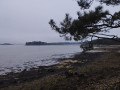
(9) After the Brennegi sea wall, turn left immediately after the entrance to the manor house and go around the meadow, following the beach along the channel. This will bring you back to Pointe d'er Hourél, a particularly photogenic spot with its cluster of pine trees standing on this piece of land in the middle of the sea.
(10) Pass the point and continue along Saint-Pierre Beach
(11) Return to the village of Saint-Pierre via the dunes, following the sea. Depending on the tide, the water and sandbanks shape the landscape as far as Pointe de Men er Bellec, on the other side of the Saint-Philibert river. They take on the appearance of incongruous lagoons in these somewhat cold seas. After the first houses, turn right to return to the starting point (S/E).



 Visorando Member

 Easy
Easy