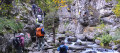
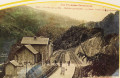
(S) If all the spaces in the car park at the start are full – particularly in July and August – (or if you wish to avoid crossing the RN at this point), continue for 400 m, enter the village of Thuès-Entre-Valls and look for the car park (sometimes subject to a charge) for the Gorges de la Carançà. Then make your way to the old railway station, just past the waypoint (1), via the village’s narrow streets, Rue de Carança and Rue du Village de l’Eglise; an IGN map is essential to avoid getting lost.
Details of the main path between (1) and (4)
Whilst the historic trail is the one shown on maps as the ‘Chemin de Las Ayguès Calentes’, in practice there are several possible routes.
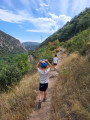
On this particular route, we’ll opt for the “Sentier des Electriciens”, which runs from one high-voltage pylon to another, following ÉNEDIS paths and sections of local council land. It is partially signposted with red markings on a White Rectangle. This is the busiest path and therefore the best marked. The others are sometimes overgrown with vegetation or are simply the tops of terraces, rather than proper, passable paths.
On the main path, you’ll find numerous side paths branching off to the left or right. Do not take these; stay as close as possible beneath the high-voltage line.
The distance is short and appears straight on the map, but on the ground there are S-bends and several small inclines.
If, at the end of the route, you come across masonry structures on the ground filled with water, you have taken a wrong turn at point (3) by straying from the direct line of the high-voltage power line. You are now on private property (not signposted). Either turn back, or continue along the path which leads directly to the natural pools at (5), without passing through (4). Progressing along this section requires you to ‘get your hands dirty’; it is not a route suitable for the general public.
Duration
I completed this route in barely 20 minutes on the way there and the same on the way back, making a total of 40 minutes. Allow three-quarters of an hour each way to be on the safe side, not including time spent at the site.
Once there, there are a few very simple rules to follow.
The beauty of the site alone warrants the utmost respect for the surroundings!
- Here, silence is key (keep conversations quiet, no music without headphones, listen to nature, feel your body relax, etc.);
- don’t do anything here that you wouldn’t tolerate on your own street at home, as this may disturb the locals who live and work in the area all year round. Avoiding walking around with your eyes glued to your smartphone is a nice, sensible thing to do!
- keep the area clean (take all your rubbish, bottles, tins, cigarette ends, packaging, etc. with you when you leave);
- at the pools, show the utmost respect for other people (undress out of sight, ignore differences (young/old, rich/poor, white/black/…), make way for newcomers, stay calm, adopt a relaxed attitude, speak from the heart, avoid naturism if other bathers do not practise it, do not smoke in the pools, etc.);
- eat away from the pools,
* generally speaking, demonstrate that a ‘visorandonneur’ behaves impeccably and that no criticism can be levelled at them!
The site is quite busy all year round, including at night, because, on my visits, the surrounding area was sometimes littered with rubbish of all kinds, particularly cigarette ends, tea-light holders, partially charred wood, empty bottles, … It can sometimes take half an hour to clean the place from top to bottom before a swim. It’s certainly much nicer to have your ‘bathroom’ nice and clean, though! So please be considerate and civilised – do the same when you visit (bring a small bin bag with you).
The spring and the pools
On site, access to the hot spring and the natural pools is completely free; this is public land.
The spring gives off a faint smell of sulphur, characteristic of sulphurous water, sometimes referred to as sulphur water. This water contains a sulphur compound, hydrogen sulphide, which gives it the smell of rotten eggs. Owing to its composition, it is one of the waters used in hydrotherapy, particularly for its beneficial effects on skin and lung conditions. Source: Wikipedia
Water temperatures
Let’s talk about bathing: the first pool is around 50°, the second 45° and the last 40°. So you start by getting into the last one first… Gradually, your body gets used to this slightly high temperature. After 5 minutes, it’s bliss! The bravest move from the first pool to the second, then on to the third, which is the hottest.
In the end, we spent an hour and a half in the water… And you quickly get used to the heat and the sulphurous smells.
Even in the middle of August (we’ve been several times), visitor numbers are often modest. There are never more than six or seven of us on site. Yet there’s easily room for five or six in each pool.
The areas immediately around the pools are quite spacious, making it very comfortable to get changed and dry off – provided you’re not too fussy.
Make sure you bring a swimsuit that isn’t too trendy – it’ll suffer a bit from the heat and the sulphur…
Drinking water
There are no fresh drinking water points along the route. Nor is there any shelter in case of bad weather.
Equipment
It’s best to wear proper hiking boots, though proper trainers may also be suitable. It’s worth noting that trainers and flip-flops do not fall into these categories…
Bring a small kit suitable for mid-mountain hiking.
Safety recommendations and warnings
Regarding the RN116:
As this is a very popular route, it is essential to reiterate the basic safety rules for such areas:
- everyone must wear a high-visibility vest when walking on the hard shoulder or on the road, due to very heavy traffic that often fails to observe speed limits
- be extra vigilant +++
- pay particular attention to children
- walking at night is strongly discouraged
- walking is at the hiker’s own risk, having been made fully aware of these recommendations
Regarding crossing the Train Jaune railway line at Thuès-Carançà station (or Thuès-les-Bains):
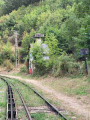
Warning: the railway track to be crossed has athird, electrified side rail, about 20 cm above the ground, which powers the electric locomotive. It is extremely dangerous.
This rail ends a few metres before the station (1) and resumes a few metres beyond it (to avoid having to step over it whilst crossing).
- Please follow the posted instructions from the SNCF (crossing the tracks is, of course, permitted, but caution must be exercised).
- Obviously, do not walk on the railway track itself, but only on the designated crossing points within the station (1) and on the footpath.
Regarding your personal abilities
Natural and wild areas present real risks, as with any hike in the great outdoors. It is up to each hiker to assess these risks; the warnings provided for this route are not intended to be exhaustive but merely indicative – do not ignore them!
In any case, do not overestimate your strength or your ability to undertake the route described or the variations on this short section of the walk, as several walkers have failed to find the pools despite this description. Before setting off, read all the forum discussions carefully (see the link below), print out the photos if necessary, and study the map at maximum zoom on Visorando.com for PC or on the Visorando app for smartphones; take screenshots to view on your smartphone.
Finally, do not undertake this walk at night, or whilst under the influence of alcohol or illegal substances, as you would be putting your own life, that of your walking companions and that of any potential rescuers at risk.
Alternatives
To reach the start of the walk, you can avoid driving and take the Train Jaune from Villefranche-de-Conflent, alighting at Thuès-Carançà station (in season).
For the sake of completeness, there are several alternative routes to reach the spring and the pools on foot.
I have listed here only three that are completely safe. Other routes are strongly discouraged, as they contravene the law or regulations:
ALTERNATIVE ROUTE 1 (easy) starting from
(S) and (1) Particularly outside the tourist season, it is possible to avoid crossing the RN116 and save 50 metres of walking by parking your car on the concrete platform of the old Thuès-Caranca station.
To avoid climbing for nothing and having to turn back, send someone ahead on foot to check the route!
ALTERNATIVE ROUTE 2 (easy)
Get dropped off by car in front of the entrance to the MAS des Sources. Do not drive into the grounds – it is strictly forbidden!
Enter the centre’s grounds on foot. You are on private property; there is a right of way for pedestrians, so please be courteous, discreet and move quickly as you cross.
Just before the centre’s upper car park (there is also another car park further down), take a well-maintained, stone-paved stepped path on the right which winds its way up the slope in several hairpin bends towards the Train Jaune station at Thuès-les-Bains. This path is bordered at ground level by a metal pipe used to collect water from the hot springs. Caution: it is very hot (>60°C).
Shortly after the start of the straight climb, the pipe on the ground forms an ‘S’ shape. Immediately turn right onto the path above a low dry-stone wall and go through a green metal gate. You will leave the Centre’s grounds.
This is the start (or end) of the Las Aygues Calentes (Chaudes Aygues) path, which leads to the car park at the Thuès-Entre-Valls bridge (and the Gorges de la Carança) as described in the main route.
We will therefore be following it in the opposite direction on this alternative route. It is about 900 m to the reservoirs.
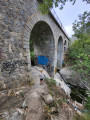
Stay on this path. It is flanked by the same metal pipes, sometimes lying on the ground, sometimes at about waist height. Pass under the large multi-arched stone viaduct (known as the Pont du Torrent de Faget) over which the Train Jaune railway line runs and beneath which the Torrent de Faget flows. On your right, below you, is the large natural pool of warm water from this same torrent, which is also freely accessible and often used for swimming.
NB: even at this point, the water temperature is very pleasant, a mixture of the cold water from the torrent and the warm water from the springs.
The path passes under the first arch of the bridge.
Continue on to the spring (5).
ALTERNATIVE ROUTE 3 (easy)
Take the Train Jaune from Villefranche-de-Conflent and get off at Thuès-les-Bains. Take the path leading down towards the centre, reach the green gate and continue as described in VARIANT 2.
ROUTE 4 (moderate difficulty)
Take the Train Jaune from Villefranche-de-Conflent and get off at Thuès-les-Bains. Cross the tracks opposite the station, go through the SNCF wire-mesh gate and take the narrow path on the right (not shown on IGN maps) until you reach the Torrent de Faget canyon through fairly dense vegetation.
Head down the right bank until you reach the spring (5).
This alternative route requires a good sense of direction, equipment suitable for mid-mountain hiking, and particular vigilance regarding the various hazards along the approach path (dense vegetation, stones in or around the stream, and water collection pipes that must be protected from damage). It is intended for experienced, cautious hikers only, and is not suitable for casual walkers.



 Country:

 City:
City:






 Visorando Member

 Difficult