Country:

 City:
City:


This route requires you to leave one vehicle at the finish (E) (Peyras, Monastère de Béthléem, in Saint Pé-de-Bigorre) whilst the other takes you to the starting point (S).
For the starting point, take the road leading from Nay to the Col du Soulor. After Arthez-d’Asson, head for the hamlet of Les Aoules.
Park near the houses in the hamlet known as l’Arriou-Sec.
(S) Take the path, marked in yellow, which follows the course of the Arriou Sec stream upstream. The climb is gentle.
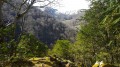
(1) At the Ravin de Castéra, take a dip in the spring of the same name (marked by a sign and several markers in the trees).
(2) Pass through the Ravin du Monbula, which is more striking than the others.
(3) At the 812 m mark, fords the Arriou Sec and begins a steeper climb towards the summer pastures.
Depending on your pace, 1½–2 hours after setting off, you’ll reach the first mountain pastures at an altitude of around 1,000 m.
(4) You’ll soon find yourself back in the woods for a short while.
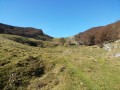
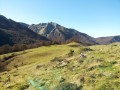
(5) A quarter of an hour later, you’ll emerge onto the large mountain pastures.
From there, progress may be hampered by ferns and brambles in the middle of the path.
It is the outcrop of the Sainte-Suzanne marl (black, schistose rock, often yellow on the surface due to weathering) that encourages the growth of grasses particularly favoured by livestock.
You will then reach the stream bed, which you cross and follow until you turn off towards the Cabane de Yerse, situated on the left-hand side.
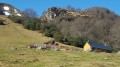
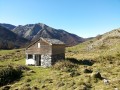
(6) The Cabane de Yerse nestles on the heights of the valley of the same name, right in the heart of the mountain pastures at an altitude of 1,275 metres, overlooked by the Pic d’Estibette (1,851 m). It has been beautifully renovated in true mountain style, although an attic floor has been added, which does not detract from the overall appearance.
It is open all year round to walkers, cavers, photographers and herders.
After a well-deserved break of a good quarter of an hour, it’s time to set off again, as it’s a long way to go – this isn’t the place for a midday snack!
You have the choice of heading back down into the valley floor or staying on the contour line to reach the Col d’Espadres, which can be seen to the east.
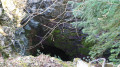
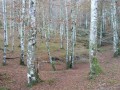
This unmarked route largely follows the contour line, taking us through the young beech forest that stretches across a magnificent and vast sharp limestone pavement. This marks the boundary between the limestone rocks of the karst landscape and the marl of Sainte Suzanne. It is along this boundary that the most remarkable cavities (chasms, etc.) are generally found; the route passes close to several of them.
(7) 25 minutes after the Cabane de Yerse, you reach the Col d’Espadres.
Whether to the east, towards the Aguée, or to the west, towards the Yerse, the view is magnificent and the place is steeped in mystery. Herds of horses are often found here, and sometimes with donkeys.
In winter, a snowfield blocks the eastern face of the pass, hindering the descent towards the Aguée. But in summer or autumn, there’s no problem at all!
So continue the route by descending the pass towards the head of the Aguée valley, either passing north of the ruined Espadres hut or to the south amongst the sinkholes, several of which have collapsed or are flooded by the numerous nearby springs.
Descend at a leisurely pace through the entire Aguée valley, along unmarked paths or cattle tracks, through an area with little or no woodland. Find a lovely, lush meadow to enjoy your long-awaited snack.
Then resume the path, passing close to old shepherds’ huts (ruins or traces) and reaching a large clearing at 960 m, with a grassy area sloping up the southern hillside of Sarro Pourcou (Serre Pourcou), the mountainous ridge that overlooks the Aguée to the north and ends at Cap des Litas (1,300 m) to the east.
(8) Continue eastwards until you reach the edge of the forest at a place known as ‘Cul de l’Aguée’.
(9) Of the various streams in the Aguée, one of them disappears into a small sinkhole in the middle of a large pool covering a few square metres beneath the beech forest.
A path leads off from here to the Picharrot waterfalls, but as it is difficult to follow in this direction, it is best to avoid it.
Including breaks, it took me 5 hours to get there from Arriou Sec.
Turn back to the large clearing you crossed shortly before.
(8) Head up to the right, through woods and bushes, climbing almost 300 metres in altitude to Cap des Litas. Avoid getting too close to the edge of the State Forest (green line on the map), as a few rocky outcrops make progress difficult.
(10) Descend the opposite slope through fairly sparse woodland and head towards the bottom of the valley, known as Bat Séco or Cabane des Italiens (names not shown on the IGN map).
At the 1,130-metre mark, in the middle of a vast beech forest, you reach the bed of the Ruisseau de la Fontaine d’Ariails (not shown on the IGN map); the path then branches off eastwards, joining the bank of the Ruisseau de la Gargante at the 969-metre mark.
Here, amidst the beech trees, it is the bed of a small, gentle stream, but further downstream it becomes a deep, impenetrable and treacherous ravine flowing into the Génie Longue!
Here you’ll find the yellow markings (wide and quite old) for the Nature Reserve and a blue marking (recent) for the Saint-Pé Integral Biological Reserve (RBI).
(11) Here you have the choice of heading back into the valley via the Tachouères (badgers) path on the right, which seems quicker in terms of time but is an infinitely longer route, or the Aülhet path, which involves a slight climb. This particular walk favours the latter.
So turn left, carefully following the yellow markings clearly marked on the trees.
The route passes south of the Soum de l’Artigue, at a clearing with a watering trough, at a place known as Hount-Débat.
(12) You’ll reach the Cabane d’Aülhet without any difficulty; it has been clad in new timber panelling (since October 2016).
Then take the yellow-marked path (recent but very narrow) which descends from the mountain pastures to Peyras, via an ancient pastoral track that is quite steep and very slippery in wet weather. If the weather is dry, runners will be able to give it their all.
At the Pla dé Bers junction, at an altitude of 824, leave the Tachouères path on your right and continue straight up the slope to reach the car you left there that morning or the kind soul who has come to collect you (S/E).


 Visorando Member
 Moderate
  Difficult