Country:

 City:
City:


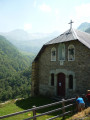
The start at the foot of the Eylie stopover lodge on theGR®®10route is obvious and well signposted. Cars can be parked at this point, or a little lower down in a circular section of the road.
(S/E) Then, with your rucksack on your back, simply take the well-markedGR®®10. The climb is immediately steep, and the slope leaves no room for compromise: it's a tough climb! The forest is dense, providing shade on hot days. Walk at a mountain pace so you don't tire yourself out too quickly.
(1) The forest opens up, the slope becomes less steep, and at the edge of the undergrowth, a little higher up, you will see the Rouge Station, a relay point for the descent of the ore-filled skips.
You can take shelter in these ruins, but be careful: they are ruins, not a refuge! There are water sources everywhere, but they are not springs in the strict sense of the word, so the water needs to be purified.
(2) As you continue your climb, you will find some old buildings below the path, a little further on your right (the walls are still standing), as well as rails, the entrance to a mine, in short, the remains of an old mining operation.
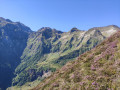
The scenery changes, with grass all around you. The valley rises and the path traces a steep incline in its centre, reminding you that the climb is not over yet.
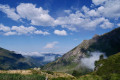
The view from the pass is magnificent and shows you the way to the Bentaillou mines. The hardest part is over.
(3) The path joins a wider track following the contour line. On your right, this track leads to a station from which two penstocks plunge down into the valley. Turn left and follow the track gently down to the mines and Narbonne station.
(4) Although the mines are actually higher up, the Narbonne station was the most important place of activity in the past. There are workshops, with a few machine tools still standing the test of time, residential buildings, some taken over by EDF, and others by shepherds.
It is worth noting that the large prefabricated building is the best place to spend the night: it is clean, spacious and dry, and you will sleep very well there! However, it is forbidden to light fires, and in any case, it is difficult to find wood in the vicinity. The higher refuge next to the shepherd's hut is generally unusable (it is used for storing equipment).
(5) TheGR®®10trail is always clearly visible and constantly passes through ruins and other remains of mines, whose entrances are also clearly visible and closed, of course!
At this point, you can turn right towards a pumping station (you will see a clearly marked grassy ramp on the mountainside).
Alternative: You can also continue climbing towards the Étang de Chichoué, nestled in the middle of a sort of cirque covered with meadows.
(6) TheGR®® splits in two. Leave the right fork towards Étang d'Araing, on the Tour du Biros route, and continue left towards Étang de Chichoué.
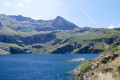
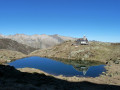
(7) Continue towards Port de la Hourquette at around 2,450 m. Go around the lake: crossing the dam is prohibited.
(8) When you start to descend, after passing the pumping station, be careful not to take the wrong path and take the path that descends to the left: the one on the right leads to the entrance of a mine, but has some dangerous sections. The descent is a bit of a guess, as there are no longer any markings and the path merges with the tracks left by cattle, sheep and other animals living in these mountains. Keep your eyes on the Cabane de Sans, which is clearly visible in the middle of a clearing on the right side of the valley.
(9) From the Cabane de Sans, things get a little more complicated: you have to follow the cairns and the edge of the forest. Once you have passed a stream nestled in a hollow valley, the path becomes visible when you move aside a few branches, just on the hillock before plunging down towards a torrent that can be heard in the distance.
(10) The path is well hidden, unmarked and the cairns are either completely absent or very discreet, but it is there and once found, it is easy to follow as it winds its way down through the forest. The cairns gradually become more frequent... and more reassuring.
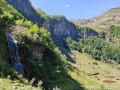
(11) You come out onto an avalanche corridor that you have to cross. The path remains easy to follow for a while, then, depending on the season, you will enter dense vegetation of ferns and nettles, reaching above waist height, but leaving the path still identifiable under the abundant foliage. The descent itself ends when you reach the magnificent waterfall on your left.
All you have to do is leave the slope, scree and lush vegetation behind and walk onto a lawn that will gently lead you to the road (a carriageway that comes from Eylie and goes up to the left to the Narbonne station), which you simply follow until you leave it just before the buildings of the old factory.
(12) At a footbridge, take a path on your left (GR®®10) which will take you back up to Eylie, passing by its magnificent barns (S/E).

 .
.
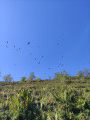
 , as well as numerous griffon vultures and even a bearded vulture. A very beautiful circular route completed in 6½ hours, including a lunch break.

 Visorando Member
 Moderate
 Very difficult