The heights of Blotzheim via the snail hills

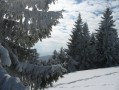
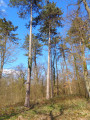
On the heights of Blotzheim, the Grand and Petit Schneckenberg (snail hills) form a wooded area close to its natural state, criss-crossed by streams and surrounded by fields, copses and a few vineyards.
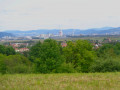
A multitude of trails and paths offer beautiful walks in the hills, where you can enjoy the peace and quiet and a few views of the neighbouring mountain ranges, the Vosges, the Black Forest and the Jura.
Two versions are available, 10 or 13 km long.

Please note (November 2026): a tree is blocking the path just before the point (2), which is difficult to get past. You will need to go straight ahead to (14) and turn left towards (4) to continue the route.

Details

3079821
Creation:
Last update:
Last review:
  • Walking
    Activity: Walking
  • ↔
    Distance: 13.10 km
  • ◔
    Average duration: 4h 20 
  • ▲
    Difficulty: Moderate

  • ⚐
    Back to start: Yes
  • ↗
    Ascent: + 193 m
  • ↘
    Descent: - 187 m

  • ▲
    Highest point: 316 m
  • ▼
    Lowest point: 263 m

Photos

Description of the walk

Parking on Rue des Acacias (next to the Institut Médico Éducatif) in Bartenheim.
Please note that the hills are a maze of paths with virtually no signposting. If you do not have the app (or a GPS) to follow the route, pay close attention to the description and the map.

(S/E) Walk down Rue des Acacias towards the crossroads, turn right onto the pavement alongside the IME, go around the roundabout, stay on the right-hand pavement until you leave Bartenheim, continue for about 30 metres between the field and the ditch that runs alongside the road, until you reach the start of a path.
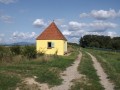
Note the Notre-Dame des Champs Chapel on the other side of the road. See practical information.

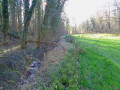
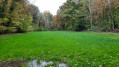
(1) Turn right towards the forest and follow the wooded Wurmbach valley. After several hundred metres, the path opens onto a clearing and a field. Leave the wide path and turn left to cross the valley at the edge, then climb back up into the forest to meet the Grand Schneckenberg ridge path.

(2) Take it to the right, ignoring the multiple logging paths on the left and right. The forest is divided into plots numbered in red on the trees. After about 300m, at plots 7 on the left and 14 on the right, you will come to a crossroads.

(3) There are two options:
1) Option chosen on the map: between plots 7 and 8 (opposite plot 14), turn left downhill towards a crossroads with a wide path; this is the option chosen on the map.
2) If you miss the crossroads: continue straight ahead to point (13) and descend to the left, see practical information.

(4) Cross the path and the Lutterbach stream. After the stream, leave the Petit Schneckenberg path (the return path) on your right. Continue straight ahead, exit the forest between a field and a row of trees, then turn left at the first path. It climbs to the top of the Buckenrain hill.

(5) Enjoy the view of the Black Forest. At the crossroads, near two fruit trees, head south. The view is unobstructed. Pass between a large cherry tree and a vineyard, then descend into a sunken path. A path climbs the embankment on the left for a round trip that offers a view of the airport and also a rudimentary shelter in case of rain.
Return to the sunken path. It reaches a tarmac crossroads; continue straight ahead to join a cross path.

(6) Head right towards the west, ignore a path on the left, then, at the next bend, turn left and immediately right. The ball visible on the left contains an air traffic radar, and further on is the city of Basel. At the next crossroads, go down to the left and reach a wide path near the Thurbach stream.

(7) There are two options:
1) Short version: turn right, heading north-west along the path marked with a red disc. It joins the long route after crossing the Lutterbach stream and reaches the point (11). This version is 10.2 km long with a 153 m elevation gain.
2) Long version shown on the map: turn left, heading south-east. Follow this path, marked with a red disc, which descends between two tree-covered embankments. At the edge of the forest, it arrives near thefirst houses of Blotzheim and reaches a crossroads with a Club Vosgien sign.

(8) Keep to the far right on the red disc path towards Michelbach/Bas. Ignore the path on the left (calvary route) and continue westwards across fields dotted with copses, enjoying beautiful views of the Jura mountains. On the outskirts of Michelbach-le-Bas, you will come to a tarmac crossroads.

(9) Leave the red disc markings, turn right, pass a row of containers and then a crucifix, and head north. The path passes afirst valley and then the Thurbach valley. At the entrance to the forest, go straight up and reach a crossroads after a crucifix, the highest point of the Roggenberg. Continue straight ahead and exit the forest onto a remarkable landscaped area.
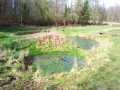
Enjoy this spot with its ponds, pontoon, benches and picnic table.

(10) Resume the path by turning right at the edge of the forest. Turn left along the field and stay at the edge. At the northern end of the field, turn right to find a wider path that joins the Red Disc marked path (and the short version). Follow it to the left, then continue along the edge, turn right and continue to the start of a path just after a left-hand bend.

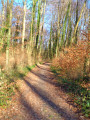
(11) Leave the marked trail for this beautiful path that leads into the forest. This is the Petit Schneckenberg ridge trail. Continue straight ahead, ignoring the paths branching off to the right and left. Just after a path branching off to the left, descend slightly to the right and arrive at the fork with another path ascending from the right.

(12) Turn left. The path descends towards the Lutterbach stream, joins a path coming from the left and eventually rejoins the path taken on the way out. Turn left at the next crossroads.

(4) Turn left, leaving the path you took on the way up. After about 200 metres, climb up a wide bend to the right. Ignore a path branching off to the right towards a hunting shelter and arrive at the end of the Grand Schneckenberg ridge path coming from the right.

(13) Continue to the left as you approach a clearing. Continue straight ahead, then follow the edge of a field on your left until you reach a crossroads marked by a sign (Eiffelewag), just before the end of the field.

(14) Take the path on the right that leads into the forest. After a left-hand bend and crossing a stream, leave the path on the right and start the fairly steep climb up the Brestenberg. As you leave the forest, on the ridge, there is a beautiful view of the Vosges peaks dominated by the Grand Ballon.

(15) Turn right and note the summit of the Blauen in the Black Forest in the distance. After a short stretch through the forest, begin the descent towards a crossroads, cross it and continue slightly downhill to the right until you reach the end of Rue des Acacias (S/E).

Waypoints

  1. S/E : km 0 - alt. 265 m - Car park Rue des Acacias
  2. 1 : km 0.41 - alt. 263 m - Start of the trail - Chapelle Notre-Dame des Champs
  3. 2 : km 1.51 - alt. 300 m - Path on the right
  4. 3 : km 1.79 - alt. 308 m - Crossroads - Marking 7 on the left, 14 on the right
  5. 4 : km 1.96 - alt. 283 m - Lutterbach crossroads
  6. 5 : km 2.77 - alt. 310 m - Summit - Site du Buckenrain
  7. 6 : km 3.5 - alt. 303 m - Turn right at the fork.
  8. 7 : km 4.56 - alt. 282 m - Thurbach crossroads
  9. 8 : km 5.19 - alt. 283 m - Blotzheim crossroads
  10. 9 : km 7.15 - alt. 308 m - Michelbach-le-Bas crossroads
  11. 10 : km 8.31 - alt. 298 m - Le Roggenberg
  12. 11 : km 9.13 - alt. 309 m - Petit Schneckenberg ridge trail
  13. 12 : km 9.84 - alt. 304 m - Y-shaped crossroads
  14. 13 : km 11.02 - alt. 305 m - Crossroads of the Grand Schneckenberg trail
  15. 14 : km 11.48 - alt. 287 m - Eiffelewag crossroads
  16. 15 : km 11.9 - alt. 306 m - Brestenberg crossroads
  17. S/E : km 13.1 - alt. 265 m - Car park Rue des Acacias

Notes

(3) If you miss the path down from the ridge of the Grand Schneckenberg (between plots 7 and 8), continue straight on to the point (13) and then turn left. You will then come to the crossroads (4) and turn right. The route will be extended by 500 m, with no change in elevation.

(1) If you want to see the Notre-Dame des Champs chapel near point (1), cross the road with caution as traffic is heavy during rush hour.

During the wet season, the paths are often muddy or even rutted due to agricultural and forestry activity.

To avoid having to turn back, check the hunting dates.

The numerous streams, ditches and wet meadows provide an ideal habitat for many amphibians, while the Schneckenberg forest, with its abundance of stumps and dead wood, is home to six species of woodpecker. You are sure to hear them drumming on the tree trunks (especially in late winter and spring). The open landscape is also a popular stopover for migratory birds, and it is not uncommon to encounter deer or wild boar here.

The few vineyards you will see are the remains of wine-growing activity dating back to Roman times.

Reviews and comments

4.1 / 5
Based on 5 reviews

Reliability of the description
4.2 / 5
Ease of following the route
4.2 / 5
Route interest
4 / 5
dbaegser
dbaegser

Overall rating : 4.3 / 5

Date of your route : Mar 09, 2025
Reliability of the description : ★★★★☆ Good
Ease of following the route : ★★★★☆ Good
Route interest : ★★★★★ Very good
Very busy route : Yes

Beautiful walks and accessible trails

Machine-translated

CHOQUET
CHOQUET

Overall rating : 4.7 / 5

Date of your route : Feb 20, 2023
Reliability of the description : ★★★★★ Very good
Ease of following the route : ★★★★★ Very good
Route interest : ★★★★☆ Good
Very busy route : No

Nice walk.

Machine-translated

FJ6888
FJ6888 ★
• Edited:

Thank you for your feedback.
The calculation of elevation differences depends greatly on the devices used to measure the altitude of points along the route, the number of points, and the calculation method.

Visorando uses a digital terrain model (DTM) provided by the IGN, which consists of projecting the GPS survey points onto a grid at ground level formed of "meshes" measuring a few dozen metres across.
The position of the vertices of each mesh and, above all, their altitudes are known with precision. An interpolation calculation is then used to find the altitude of each projected point (from the GPS) based on the known points surrounding it. To do this, use the "recalculate altitude" function.

Raw GPS data is subject to errors of several metres depending on the number of satellites and, above all, obstacles between the satellites and the GPS receiver, which can lead to deviations of several hundred metres in elevation.

You can find more information on this forum topic. I also recommend reading this article, which is a little old but very well written.

Machine-translated

81wi0834
81wi0834

Overall rating : 4 / 5

Date of your route : Sep 06, 2020
Reliability of the description : ★★★★☆ Good
Ease of following the route : ★★★★☆ Good
Route interest : ★★★★☆ Good
Very busy route : No

A lovely morning walk. It took us 2 hours and 45 minutes, walking at an average speed of 4.7 km/h. The route is well described, but it's easier to follow with a GPS. However, I recorded an elevation gain of 276 m and an elevation loss of 288 m, compared to 172 m and 167 m in the description... strange, isn't it?

Machine-translated

Randofamille68
Randofamille68

Hello again,
And thank you for your feedback.
We do indeed think that the expression "stream crossing" would be more appropriate than "bridge".
We are not seasoned hikers, but we do go hiking regularly (often using routes found on this site), armed only with the description, and have never had any difficulty completing our circular hikes.
It is true that there are no signposts on this route, so it is relatively difficult to describe it accurately. What may seem obvious to you is not necessarily so for others...
Nevertheless, we had a lovely walk.
Best regards.

Machine-translated

FJ6888
FJ6888 ★

Hello

Thank you for your feedback. It is not always easy to be precise and concise.
As mentioned in the introduction, the area is a maze of paths, most of which are unmarked. Without a GPS, you need to be familiar with the terrain and take the time to study the map and description carefully. I will add this warning to the text.
As for the "bridge" after point 3, this is indeed the most concise way of saying that it is "a small stream crossing through a buried culvert". The word is probably not very appropriate, so I will replace it with "stream crossing".
Thank you for your constructive comments, which help to improve the description.

Machine-translated

Randofamille68
Randofamille68

Overall rating : 3 / 5

Date of your route : Jun 21, 2020
Reliability of the description : ★★★☆☆ Average
Ease of following the route : ★★★☆☆ Average
Route interest : ★★★☆☆ Average
Very busy route : No

Hello,
It's impossible to complete this circular hike with just the description and paper map, especially from point 10 onwards. It's already difficult to find the "beautiful path that leads into the forest" mentioned in point 10. After that, it's a nightmare: too many paths and trails leading off to the left, right and straight ahead, and no signposts.
Turn left, turn right... it's far too vague, at least for us.
What's more, we never found the bridge you mention at point 3 (are you referring to the crossing of a small "stream" through a buried manhole)?

Machine-translated

danlutterrando
danlutterrando

Overall rating : 4.7 / 5

Date of your route : Jun 08, 2020
Reliability of the description : ★★★★★ Very good
Ease of following the route : ★★★★★ Very good
Route interest : ★★★★☆ Good
Very busy route : Yes

Fine

Machine-translated

23011939
23011939
• Edited:

Hello,
another wonderful discovery in our country. We are adding this hike to our 2021 programme and will keep you updated
about our discoveries.
Thank you
Michel

Machine-translated

Other walks in the area

For more walks, use our search engine .

The GPS track and description are the property of this route's author. Please do not copy them without permission.