Les Encanaux via the Coutronne and Infernets ravines

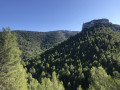
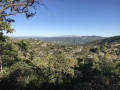
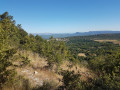
This is a short, challenging hike, which could be described as "ravine hiking", in the steep, arid ravines of the Coutronne (now a dry river) and the Infernets to the Encanaux. There, the latter flows into the Vède in a charming, shady and fairly wide spot, which is popular with walkers at the weekend.
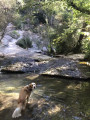
The hike takes you through the potholes (giant's kettles) of the two rivers, in truly wild surroundings.
The first ravine is very rarely visited.

Details

111689
Creation:
Last update:
Last review:
  • Walking
    Activity: Walking
  • ↔
    Distance: 7.77 km
  • ◔
    Average duration: 3h 20 
  • ▲
    Difficulty: Moderate

  • ⚐
    Back to start: Yes
  • ↗
    Ascent: + 387 m
  • ↘
    Descent: - 393 m

  • ▲
    Highest point: 617 m
  • ▼
    Lowest point: 242 m

Photos

Description of the walk

Park your car near La Coutronne, on the D45A, known as the Sainte-Baume road. There are several small parking areas for 1 or 2 cars where you can park safely.

(S/E) The hike begins shortly after a left turn on the road. The trail heads east for a few dozen metres, then north.

(1) At the first fork, turn right towards the east, heading towards an isolated farm and a few buildings north of La Coutronne.
When you reach a fence, go around it on the left, descending slightly.

(2) After a few dozen metres, the path crosses an old small bridge (low wall on the left). Immediately turn left into the old bed of the Source de la Coutronne.
You will come to another low wall, then a path (marked with a dotted line on the IGN map) that heads west.

(3) The junction to the Ravin de la Coutronne is not obvious. Don't miss the start, which begins with an old waterfall on a smooth wall that cannot be crossed without climbing equipment. You will therefore have to go around it quite a long way off the path to the north (right bank) through a pile of rocks and a small, fairly steep scree slope.
You will quickly reach the bottom of the waterfall and a few pools with some aquatic vegetation. This will be one of only two signs of water in this ravine (as of April 2015).

Do not take the clearly visible path that goes up towards the woods, but descend straight into the ravine bed and stay there. The only other exception is another waterfall that cannot be crossed without equipment, which must be bypassed, again to the north (right bank).

Progressing through the ravine is not easy, but it is fun. There are no markings, no paths, and the vegetation is quite dense, even in the middle of the riverbed. Some of the pools and waterfalls are truly majestic. However, moss and lichens have covered most of the rocks, shrubs are growing in the riverbed, and humus and leaves clutter all the holes due to the absence of water. Is there water here on days when there are heavy storms?

There are also several metal carcasses of old charcoal kilns and wood-burning furnaces, some of which were swept away on a day of strong currents and are now stuck in trees or rocks.
This unmarked section of the ravine stretches for just over a kilometre, with a 75-metre drop.

(4) Still in the ravine bed, but calmer, we join the yellow-marked trail, which leads to the Ravin des Infernets. At the junction, in the bed of the Coutronne itself, a low dry stone structure was probably a sheep pen.

We continue our descent, sometimes in the ravine, sometimes on its slopes, but always on an excellent path (marked in dotted purple on the IGN map), sometimes lined with beautiful dry stone walls built by our ancestors; this path is always marked in yellow.
The Coutronne river joins the Infernets river (which descends from the Dents de Roque Forcade), a river that is always very active, but sometimes above ground and sometimes underground.

(5) The trail splits in two at a fork in the dry riverbed. On the left, a yellow cross indicates the trail not to take (we will return this way on the way back). Continue to the right, staying as close as possible to the bed of the Infernets, rather than on the trail that runs alongside it. This makes the hike more challenging and enjoyable.
The water in the river, while not abundant, becomes much more noticeable as you descend.

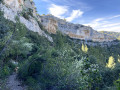
(6) You will arrive at Les Encanaux, leaving the double-arched stone bridge on your right, with a track leading to Les Héliantes and the Bois de la Lare. Keep left on the track that leads to the vast flat area of Les Encanaux, following a beautiful vertical cliff covered with vegetation. Do not cross the Vède bridge (which leads to the Encanaux car park).

(7) This is the end of the hike.

The return journey is a loop via the Balcon des Infernets, an old mule track connecting the Glacière des Encanaux to the roads leading to towns, particularly Marseille.
On the esplanade, before crossing the Vède bridge, look for the wooden steps that climb steeply to the left and mark the start of the blue-marked trail.

You will soon reach the old Glacière des Encanaux, a ruined building on the right.
Continue climbing, ignoring the numerous paths that branch off to the left or right.
Take thesecond path on the right, marked by a red mark on a tree.
Then follow the red marks for a short while, then occasional yellow markings.
A few cairns also mark the main trail.

Reach the ridge or small pass of Les Infernets, which overlooks the Ravin des Infernets at an altitude of 380 metres, via this north face.
The path here is perfectly marked and well signposted in yellow. Pass close to the Abri du Figuier, then just below the Grotte des Infernets and the Grotte des Morts (mistakenly marked simply as "Grte" on the map), then under the Gouffre des Morts (mistakenly marked as "Grotte des Morts" on the map).

After an easy 400m climb on virtually the same contour line, the trail finally descends towards the ravine, which you overlooked from the 380m contour line.

(5) This brings you to the bed of the Infernets, which you already passed on the way there.

Then follow the same route as on the way there, on the path still marked in yellow.

(4) You will reach the sheep park. Leave the ravine bed and take the path on the right that climbs up the north side of the Coutronne ravine, moving away from the river bed you took on the way up. The trail is still marked in yellow. Do not stray from this marked path.
Then return to the starting point (S/E).

Waypoints

  1. S/E : km 0 - alt. 617 m - La Coutronne, D45A, Rte de la Ste Baume
  2. 1 : km 0.1 - alt. 615 m - Fourche de la Coutronne - Turn right on the way there
  3. 2 : km 0.44 - alt. 590 m - Ferme de la Coutronne - Turn left
  4. 3 : km 0.58 - alt. 584 m - la Coutronne waterfall - Turn right
  5. 4 : km 1.93 - alt. 485 m - Sheep park crossroads - Turn right
  6. 5 : km 2.58 - alt. 402 m - Crossroads at the Infernets riverbed - Turn right
  7. 6 : km 3.82 - alt. 270 m - Turn left - Pont des Encanaux
  8. 7 : km 4.43 - alt. 243 m - Pont de la Vède/Chem des Encanaux - Turn left
  9. S/E : km 7.77 - alt. 617 m - La Coutronne, D45A, Rte de la Ste Baume

Notes

The route is mapped using the GPS tracker on the Visorando smartphone app. There is good GPS coverage in the area, so reliability is guaranteed!
This loop starts from La Coutronne rather than Les Encanaux, as parking is much easier there. At Les Encanaux, there is often a lot of traffic and people in the car park. These walkers often stay around Les Encanaux, the picnic tables and the playgrounds, and this overcrowding is not representative of the rest of the hike.
I recommend this direction for the loop to stay in the spirit of the wilderness. However, you can also do it in the other direction!
There are no drinking water sources on the circuit, so bring enough water with you.
The caves can be used as shelters in case of storms, so keep that in mind!
Bring standard hiking equipment: shoes, appropriate clothing that protects your arms and legs, headgear, etc.

Worth a visit

Things to see during the hike:
Several cavities, caves and chasms:
- Abri du Figuier, which can be visited safely. This cave is marked from the trail by a large yellow arrow and the letter "G" painted on a rock on the ground, which are clearly visible.

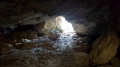
- Grotte des Infernets (or Grotte des Charbonniers), which can be visited safely up to the tunnel, but with a torch. After that, it is best to be accompanied by experienced people to enter the tunnel and reach the underground chamber; at the end there is a chasm. This cave is not very well marked from the trail. Look for it through the vegetation.
Approximately 120 metres deep, it was discovered in 1895 during work on the future road linking Auriol to Plan d'Aups and Gémenos. Neolithic remains have been found there (axes, scrapers, etc.), attesting to prehistoric human occupation.

- Grotte des Morts cave can be visited safely for the first few metres, but you will need a torch. Do not venture beyond 4 or 5 metres without experienced people. The entrance is marked by handwritten letters engraved on a vertical rock along the main path.

- Gouffre des Morts(Cave of the Dead), not open to visitors. Do not attempt to lean over the edge. There is no sign marking the entrance. It can be reached by pushing through dense vegetation from the path and walking to the cliff. Climb over a rocky outcrop. The cave is hidden in a short gap behind a natural rock wall. You will need to use your hands to climb 1.5 metres to see its narrow entrance.

Other points of interest:
- Glacière des Encanaux, with information boards explaining how it works and its history.

- Source des Encanaux, this is more of a resurgence, but easily accessible via a ten-minute walk from the Pont des Encanaux.
It is a bucolic spot where the river flows under a canopy of trees in a surprisingly cool setting, with a succession of waterfalls and cascades, like a small mountain torrent. Well worth a visit!

- Ravin des Encanaux is another long and challenging hike to take after the Source des Encanaux.

- The Charbonnières de la Coutronne can be found all along the Coutronne ravine. See photos.
These are probably Moreau devices.
The Moreau apparatus was developed around 1875: "it consists of a dome-shaped cage made of thick metal plates mounted on a cast iron frame. The upper part ends in a chimney with a movable cover; the lower part is open and the cage is simply placed on a prepared area as for an ordinary charcoal kiln".
Historically, in Europe, carbonisation was carried out by charcoal burners (or charcoal makers) directly in the forest, as close as possible to the wood resource. The places where this activity was carried out were called charcoal kilns or charcoal yards and, after being abandoned, became charcoal yards or faulde areas (in the north).
Source: Wikipedia.

Reviews and comments

4.3 / 5
Based on 21 reviews

Reliability of the description
4 / 5
Ease of following the route
4.2 / 5
Route interest
4.7 / 5
Moustache 13
Moustache 13

Overall rating : 4 / 5

Date of your route : Oct 26, 2023
Reliability of the description : ★★★★☆ Good
Ease of following the route : ★★★★☆ Good
Route interest : ★★★★☆ Good
Very busy route : No

The descent was difficult because I often had to go around small steep sections caused by water erosion. As these sections were not equipped with carabiners, I was unable to descend them. Furthermore, after this tiring descent, we had to climb back up the rocky path of the old ice house to the plateau to return to the starting point. Not recommended for beginners..

Machine-translated

evasion
evasion

Overall rating : 4 / 5

Date of your route : Sep 01, 2023
Reliability of the description : ★★★★☆ Good
Ease of following the route : ★★★☆☆ Average
Route interest : ★★★★★ Very good
Very busy route : No

We did this hike starting at point 7 in order to begin with the climb. From 7 to 1, the route is pleasant and easy to find with points of interest (ice house, caves), as well as from 4 to 7 on the way back.
However, we had a lot of difficulty at point 3 and lost over an hour looking for the path. It seems that the vegetation has grown a lot (since the last comment two years ago), as it was impossible to find the first downhill detour, which was completely overgrown. After searching and hesitating, we followed the cairns, climbing the large rock slabs on the right, then following the ridge to the left before descending via a small steep path and a climb down to reach the river bed (which corresponds to the map, but not to the description), so a very difficult and practically invisible passage. The path along the Coutronne riverbed is quite overgrown, but original.
Apart from this route, we appreciate the directions provided by Visorando, which we use often.

Machine-translated

charles013
charles013

Overall rating : 4 / 5

Date of your route : Jul 14, 2021
Reliability of the description : ★★★☆☆ Average
Ease of following the route : ★★★★☆ Good
Route interest : ★★★★★ Very good
Very busy route : No

Hello everyone,
I also found this hike difficult, given the route through the Coutronne ravine, which has no markings and a detour that makes you wonder if you're going the right way, as some parts are very steep or overgrown with vegetation. Fortunately, the GPS track provides reassurance. In any case, this part of the walk is, in my opinion, recommended for sporty types who like surprises.
Once you reach the Ravine des Infernets, it is easier to follow the path. Another difficult spot to find is just after the Glacière des Encaneaux, after about a hundred metres. You have to take the second path on the right, marked by a red mark on a tree, except that the red mark is very pale and hidden behind vegetation, so it's not easy to spot. Here too, the GPS track is indispensable.
Nevertheless, I really enjoyed this hike, as the discoveries and beautiful views are interesting.

Machine-translated

malko_linge
malko_linge

Overall rating : 4 / 5

Date of your route : Oct 12, 2020
Reliability of the description : ★★★☆☆ Average
Ease of following the route : ★★★★★ Very good
Route interest : ★★★★☆ Good
Very busy route : No

Hello,

It's probably just my level, but I found it rather difficult. Hats off to those who do it with children; mine wouldn't have been able to keep up... I accidentally did it backwards, from point 1 to 4, then 5, 6, 7 and 5, 4, 3, 2, and 1. In terms of physical difficulty, it's fine. Expect a steady descent (in the direction taken) from 1 to 7. Obviously, you have to climb back up from 7 to 1... I particularly struggled between 4 and 2, in the riverbed and especially when bypassing the (dry) waterfalls. Fortunately, I had the GPS track. But by following it exactly, I had to go through places that were almost inaccessible because they were either steep or overgrown with vegetation. For me, it's impossible with young children. Unless I'm mistaken, but my GPS tracks match those provided. It may be easier in the intended direction... But there are some nice views, and the Encanals River is a pleasant place to stop for a bite to eat. And, best of all, there wasn't a soul in sight that day. I would say that the most enjoyable part can be done from the Encanaux car park, doing the 7-5-6 loop. It's much shorter, but I think the interest of this circuit lies in this section, with 1/3 on the side of the ravine (with the view that goes with it), 1/3 at the bottom of the ravine, and 1/3 in the forest.

For the record, I did it with my dog, who had less trouble than I did in the riverbed ;-)

Enjoy your walk!

Machine-translated

DEG13
DEG13

Overall rating : 5 / 5

Date of your route : Dec 05, 2019
Reliability of the description : ★★★★★ Very good
Ease of following the route : ★★★★★ Very good
Route interest : ★★★★★ Very good

hike done last week after heavy rains, lots of water at the bottom of the circuit, the riverbed was very wet and slippery, but a very pleasant hike. My starting point was point 7, climbing up the trail and descending via the riverbed except for the bottom, which had too much water

Machine-translated

henri57
henri57 ★

Hello,

Thank you for taking the time to give your opinion.

In short, I couldn't find the right passage.

Have you seen the additional information dated Monday, 1 October 2018 at 5:49 p.m. from the author of the hike?

I might go back one of these days to see if I can find that darn passage.

Or try the hike in the opposite direction

See you soon!

Machine-translated

Jipivi
Jipivi

Overall rating : 3.7 / 5

Date of your route : Jul 19, 2019
Reliability of the description : ★★★☆☆ Average
Ease of following the route : ★★★☆☆ Average
Route interest : ★★★★★ Very good

I really must not be very good at this.

I couldn't find the junction of the ravine at point (3). I had downloaded the GPX file and I don't usually have any problems following the route using my positioning app.

I climbed up the right bank. I struggled a lot and only managed to come across rocky outcrops that were impossible to cross without equipment. In short, I couldn't find the right passage. After searching for a good hour, I finally took the same route back as I had taken on the way there.

So I didn't do a circuit but a round trip.

The walk was still enjoyable with the visit to the caves. But I'm still disappointed that I didn't find the passage through the first ravine.

Thank you for sharing this hike.
I might go back one of these days to see if I can find that damn passage.

Machine-translated

wiwirider
wiwirider

Overall rating : 4.7 / 5

Date of your route : Jul 29, 2019
Reliability of the description : ★★★★☆ Good
Ease of following the route : ★★★★★ Very good
Route interest : ★★★★★ Very good

a very pleasant short hike. There is quite a lot to see, and the path along the river is original and enjoyable. It is never dull. We had a lovely time.

Machine-translated

MCTOUL
MCTOUL

Thank you lylymarseille, marc gillet, deus, nono3084, PUShAUNE!
I'm glad you enjoyed the tour.

Machine-translated

lylymarseille
lylymarseille

Overall rating : 4.7 / 5

Date of your route : Mar 24, 2019
Reliability of the description : ★★★★★ Very good
Ease of following the route : ★★★★★ Very good
Route interest : ★★★★☆ Good

I did this hike with GPS, but the description was perfect! Thank you

the first part is magnificent! However, as soon as you reach the drivable section, there are vehicles all along the way, the path is bumpy, it's very difficult... there's a beautiful view because it's high up, but...It's still tedious... I'm going to do it again with friends... because the first part is worth it, but without completing the whole route... I'm going to retrace my steps.

Machine-translated

marc gillet
marc gillet

Overall rating : 4.7 / 5

Date of your route : Jan 13, 2019
Reliability of the description : ★★★★★ Very good
Ease of following the route : ★★★★☆ Good
Route interest : ★★★★★ Very good

Hello everyone
i did this hike on 13 January 2019. I started from the Encanaux car park (point 7), and I can confirm that it's not easy to find parking there on a Sunday morning. But I prefer to descend at the end...
A very beautiful hike, quite surprising with views you wouldn't expect in advance! there are many cultural points of interest (ice house, charcoal kilns, etc.) for those interested in the history of the area, and geological curiosities for others (caves, viewpoints, cliffs, rivers and streams, etc.). Note that a visit to the Infernets cave can be fun for children.
I would also confirm that you mustn't miss the second path after the ice house, otherwise you'll end up back at the Encanaux bridge! This path is marked by a sign that is more orange than red (I think) on a pine tree: it should be pointed out that it is on the steep climb, and if you come to flat ground, you've missed the turn!
I can confirm that the wild, off-trail part of the hike, at the top of the Coutronne ravine, is the highlight of the walk, but it does contain a tricky section for beginners: you have to go around the first "waterfall" quite a long way via the north-east ridge, and be careful not to miss a "step" on the descent down the small cliff, which is a bit of a climb down. It's easy for those who are used to walking, but it can be worrying for children or people who are not very experienced.
Overall, it's easy for those with a good sense of direction, but can be difficult for those without. That's part of the fun of the walk, though, so allow four hours rather than three...

Machine-translated

amihiere
amihiere

Good evening, Marc
Far be it from me to judge the work done by the hikers who make this site such a success. Nor yours, for that matter, if you are the administrator.
I was just saying that at (3) the detour around the waterfall is not a path and that you have to scramble over rocks and through bushes, straying from the red trail. On the other hand, well-marked paths can be misleading. Access is not easy to find, especially with children who are not very adventurous...
Kind regards
Anthony

Machine-translated

MCTOUL
MCTOUL
• Edited:

Dear friend,
It's a shame that this route didn't meet your expectations... However, it has delighted many other hikers...
The route is a GPS track, so you'll need to check your device (as others have followed the track with satisfaction) and, above all, learn to moderate your comments, as this route – like all the others – was written by a volunteer hiker who is simply passionate about sharing!
To get around the first potholes and the dry waterfall, you definitely don't need a rope, since by definition, you're going around them. The route actually follows this detour, but for various reasons, you didn't find it.
I don't want to be too harsh, but common sense can sometimes make up for technical shortcomings.
A ravine goes downhill, so you just need to find an alternative to free-falling down the waterfall. That's what I did when – knowing absolutely nothing about the route – I looked for a passage and found it, not without difficulty, as I indicate in the comments.

Can you see this detour to the right on the route just after the WP (3)? Where exactly did you lose track? Did you keep a record of your route?

I encourage you to persevere and return to this circuit (in the direction I recommend, or in the other direction as others prefer). You'll see, it's really nice, even if it's not very long!
I look forward to meeting you in the mountains or online!
Best regards
Marc

Machine-translated

amihiere
amihiere

Overall rating : 2.5 / 5

Date of your route : Oct 01, 2018
Reliability of the description : ★★★☆☆ Average
Ease of following the route : ★★☆☆☆ Disappointing
Route interest : Not used / Not applicable

We walked for an hour and a half before finally finding the right path after only 500 metres... We had to postpone the hike. We'll come back to it...
In fact, from the very first few metres, the directions no longer follow the red route given by the app. To get around the first potholes and the dry waterfall, you do need a rope. But why not mark out the path to get around the obstacle? It's very hard to find, especially as there are paths going off in all directions. We couldn't find the right one...
Very good in principle and usually flawless, Visorando remains a very good app. Except on this circuit...

Machine-translated

deus
deus

Overall rating : 4.3 / 5

Date of your route : May 28, 2018
Reliability of the description : ★★★★☆ Good
Ease of following the route : ★★★★☆ Good
Route interest : ★★★★★ Very good

The hike is superb. I did it with my two children, aged 5 and 8. The fact that the hike goes downhill, uphill, downhill and then uphill again was a bit hard on their morale. But they loved visiting the cave and having a picnic by the water, building dams. However, for the walk between 1 and 4, we took the same route back. The other route seemed too steep for the children.

Machine-translated

Other walks in the area

For more walks, use our search engine .

The GPS track and description are the property of this route's author. Please do not copy them without permission.