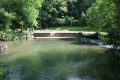
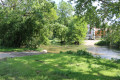
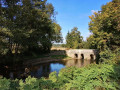
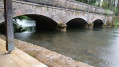
The banks of the Sèvre Niortaise from Le Défens

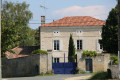
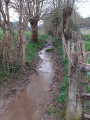
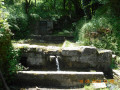
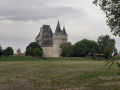
A pleasant hike in the Sèvre Niortaise Valley, on the outskirts of Niort. Despite the city being quite close, this route allows you to discover a preserved natural area with good paths. The alternating passage between small hills and valley bottoms offers beautiful landscapes. Along the way, you will get a beautiful view of the Château de Vandelaigne and a few other architectural gems.

Details

3193545
Creation:
Last update:
Last review:
  • Walking
    Activity: Walking
  • ↔
    Distance: 11.02 km
  • ◔
    Average duration: 3h 15 
  • ▲
    Difficulty: Moderate

  • ⚐
    Back to start: Yes
  • ↗
    Ascent: + 32 m
  • ↘
    Descent: - 30 m

  • ▲
    Highest point: 64 m
  • ▼
    Lowest point: 31 m
  • ⚐ Country: France
  • ⚐ District: Chauray (79180)
  • ⚑
    Start/End: N 46.366007° / W 0.365977°
  • ❏
    IGN map(s): Ref. 1628SB
  • Hour-by-hour weather

Photos

Description of the walk

(S/E) Head to the right and take a path that runs along a branch of the Sèvre Niortaise on your left (do not go back over the barrier that limits access to the car park). Cross the stream via a footbridge and now follow it on your right. Further on, the path follows the edge of a small wood, moving away from the branch of the river. Take a footbridge and first turn right then left to follow (north-north-west) a path through a wooded area.

(1) When you reach the edge of the Sèvre Niortaise (main channel), turn right and follow the river on your left. Cross a first small branch of the river, continue eastwards and cross a second branch of the river.

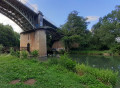
(2) At the T-junction at the end of the footbridge, turn left. Continue along the Sèvre Niortaise on your left. Pass under the A83 motorway viaduct.

(3) At the T-junction, turn left and immediately cross the Sèvre Niortaise. Now follow the river on your right.

(4) Just after a sharp left turn, turn right onto a path. Continue straight ahead (east-southeast) until you reach the D142. Follow the road to the left and uphill.

(5) At the crossroads, turn left onto Route de Saint-Gelais and continue straight ahead. At the crossroads (elevation 62), continue straight ahead and pass under a high-voltage power line.

(6) At the fork, take the road on the right and descend towards the Prieuré d'Availles. Cross the hamlet with the priory on your left, admiring the beautiful houses and barns. Cross a river and you will immediately come to a crossroads.

(7) Follow the road to the left and pass under the A83 motorway again. Continue straight ahead, following the course of the Musson river, and ignore the turnings on the right. At the end of the road called Rue du Prieuré d'Availles, turn right.

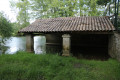
(8) At the crossroads in the hamlet of Quéray, make a quick detour to the right twice to see an old shed with chestnut cladding, four cut stone pillars and a well. Return to the crossroads.

(8) Continue by turning right (south-west) onto Rue de Quéray. The street curves to the right and heads north-north-west. At the next intersection, turn left onto Route de la Roulerie, which descends at the beginning to reach the bottom of the valley.

(9) At the next crossroads, take a path on the left that runs between two fenced-in fields. Cross the Sèvre Niortaise river via a footbridge. Continue along Impasse de la Petite Isle.

(10) At the end, turn left and carefully follow Rue des Isles (pavements). Continue along Rue de Rhé, which extends Rue des Isles, and go to the crossroads near a mill.

(11) Turn left onto Rue de la Vallée. After passing a section of small gardens and other fenced-in lawns, cross to the left across an open space to reach the banks of the Sèvre Niortaise. Walk along the river on your left. Pass under a high-voltage power line and you will reach a crossroads with Rue de Gondin.

(12) Continue straight ahead along the path to the left of Rue de la Vallée (east-south-east). Then turn left to cross the Sèvre Niortaise. Follow the river on your right. Ignore thefirst footbridge and take the second one to cross the river again. Then turn left to return to the starting point (S/E).


Waypoints

  1. S/E : km 0 - alt. 36 m - Le Défens - Car park in the developed area
  2. 1 : km 0.66 - alt. 35 m - Sèvre Niortaise (fleuve)
  3. 2 : km 1.06 - alt. 35 m - Crossroads
  4. 3 : km 2.09 - alt. 35 m - T-junction
  5. 4 : km 2.66 - alt. 36 m - Intersection, leading to the D14, near the - Chambon (rivière)
  6. 5 : km 4.24 - alt. 60 m - Crossroads D142 - Saint-Gelais road
  7. 6 : km 5.46 - alt. 61 m - Fork
  8. 7 : km 6.11 - alt. 38 m - Crossroads after the Priory of Availles - Marcusson (cours d'eau) - Affluent de la Sèvre Niortaise
  9. 8 : km 7.3 - alt. 40 m - Quéray
  10. 9 : km 8.1 - alt. 33 m - Brigeon
  11. 10 : km 8.65 - alt. 37 m - Rue des Isles
  12. 11 : km 9.37 - alt. 35 m - Rhé
  13. 12 : km 10.32 - alt. 35 m - Crossroads
  14. S/E : km 11.02 - alt. 36 m - Le Défens - Car park in the developed area

Notes

The parking area is located in a car park in a developed area called Le Défens (on the right just before crossing the bridge). Access is limited to a height of 2 metres.
This hike covers varied terrain and requires sturdy footwear.

This route is marked in orange almost throughout - in the form of small arrows - as it corresponds to the "La Vallée de la Sèvre Niortaise" route proposed by the Saint Gelais town hall, and in yellow on a small section of the "Les trois vallées" route published by the Deux-Sèvres Departmental Committee for Hiking, which is marked in yellow.

Hike completed by the author on 15 May 2020.

Worth a visit

François
Notre Dame Church
François is first mentioned in texts in 1244.
The parish depended on the Abbey of Canons Regular of Saint Augustine in Nieul-sur-l'Autize. Until the Revolution, the parish priest was appointed alternately by the Abbot of Nieul and the Bishop of Maillezais, then of La Rochelle. During the Revolution, the Romanesque parish church was sold as national property and the parish priest of François and
Chauray resided in La Crèche. In 1825, the municipality gave its approval for the construction of a place of worship on land donated by Mrs. Emilie Hocard, owner of La Brissonne. The church was built around 1826, below and to the right of an old cemetery where a grave dating from 1718 was found.

The church is very modest and was built in poor conditions, on unstable ground (river alluvium), with inadequate foundations and defective masonry. It was also not isolated from the cemetery that overlooked it. However, it was not tall and had thick walls (70 cm). The collapse of a beam in 1992 necessitated a complete rebuild of the roof structure and ceiling.
Above the western gable, a small bell tower houses a small bell. The layout is very simple, as it is rectangular. Lighting is provided by a window on the north and south sides and an oculus on the west and east sides. The ceiling is made of wood. The sacristy is located behind the right wall of the choir, under the eastern oculus.
The two doors in the eastern wall, which lead to the sacristy, are fine antique doors (16th-17th century
), particularly the one on the left, which is decorated with a chalice at the top; the one on the right is decorated with a sheaf at the top. These doors clearly come from an old church.

The old convent
Opposite the church, on the other side of the street, stands the old priory church, a rectangular building that is quite
lower and longer than the parish church, with a large bay window to the east and a beautiful pointed arch doorway to the south. Mrs Emilie Hocard bequeathed the priory church and 5 hectares of land to the Congregation of the Holy and Immaculate Heart of Mary, whose mother house is in Niort, with the responsibility of providing free education to the young girls of the commune and caring for the poor and sick, with a clause stipulating that the property would revert to the donor's heirs if this responsibility was not fulfilled. The sisters had to cease their activities due to a lack of pupils at the beginning of the 20th century, and in 1905 the priory church and the adjoining land were returned to Mrs Hocard's heirs.
Source and further information:

The Temple
Only the façade remains. It was located in Le Breuil, opposite the Town Hall, on the site of the current village hall. It was built between 1869 and 1870. Falling into ruin, it was decommissioned and rebuilt to become the Foyer Rural after the 1939-1945 war.

The Villaine Bridge
The Vilaine Bridge, a dam bridge over the Chambon, has stone grooves on the upstream side that were used to hold wooden "shovels" to dam and fill the ditches with water in the meadows. Farmers used to put the hemp they grew there to rot. This crop was very important from the 13th to the 19th century and until 1950 these "scoops" were used to flood the meadows in spring to obtain high-quality grass for grazing livestock.

Downstream from the bridge, you can see a wash house built in 1911. Only the floor tiles remain. The wash house was demolished in the 1970s.

The wash houses
- François's wash house, built in 1893 by Simon Mureau, a mason.
- The Bonneuil wash houses: Rue de l'Huilerie, built in 1893 by five masons, and Rue de Cherveux, built in 1911 by Louis Marot, a mason from Azay le Brulé.

Water mills
There were three in the commune: one at L'Ilot, one at L'Étang and one at François. The mills were connected to a causeway and a leat. They were flour mills. The wheels no longer exist.

The Cemetery
There are a number of old graves, including that of Royal Sergeant Georges Pruneau (grave from 1718). The others date from the 19th century.

The Fief of François
The oldest parts of the Fief castle date back to the 14th century and have the characteristics of a fortified castle with a tower and arrow slits. It is complemented by a dovecote with 1,096 nesting boxes, each corresponding to a nest. The number of nesting boxes reflects the size of the estate, as there were three acres per nest, with one acre equalling 50 ares in François.
In 1698, the seigneury of François was part of the Fief of Constant, parish of Saint Gelais, which belonged to the Marquis de Tors, colonel in the Flanders regiment. The title of Lord of François passed to the d'Auzy family, who retained it until 1789. At the time, there were three other seigneurial fiefdoms: the Fief of Availles belonging to the Sieur de la Frappinière, the Fief of Vaudeleigne belonging to Jean de Saint Maurice, Sieur de Bourgneuf, and the Fief of Dognon belonging to the Logan-David family, squires.
During the Dragonnades, some lost their titles in 1685. The lord of the Fief of Dognon went into exile and his property was confiscated.
More recently, Henri Gélin (1849-1923), journalist and founder of the ethnographic museum of the Donjon de Niort, lived there and his parents are buried there.

The Château d'Availles
A beautiful and spacious residence built on a hillside overlooking the Musson on the road from Quéray to Le Breuil. Availles is one of four farm-castles: Creuse, Quéray, La Frappinière and Availles. Some medieval architectural features: Renaissance fireplace (15th century)

The Château de Vaudeleigne
The château was built in the 15th century. The original building consisted of a decorated Renaissance main building facing the Sèvre river with two slender watchtowers.
Source: official website of the municipality.

Reviews and comments

4.7 / 5
Based on 9 reviews

Reliability of the description
5 / 5
Ease of following the route
5 / 5
Route interest
4.2 / 5
Grizzy79
Grizzy79

Overall rating : 4.3 / 5

Date of your route : Aug 27, 2024
Reliability of the description : ★★★★★ Very good
Ease of following the route : ★★★★★ Very good
Route interest : ★★★☆☆ Average
Very busy route : No

Hello. Hike done in the summer sunshine. 60% open terrain, 60% road.
Positive points:
- beautiful residences
- views of the Sèvre
- a route accessible to all

Negative points:
- the ever-present noise of the motorway
- a long stretch of road

For me, and especially to appreciate the beautiful residences, including the Château de Vandelaigne, even more, this is a hike for early autumn, when the foliage thins out and turns yellow, before a good meal with family or friends.

Machine-translated

Cathpat79
Cathpat79

Overall rating : 4.7 / 5

Date of your route : May 09, 2024
Reliability of the description : ★★★★★ Very good
Ease of following the route : ★★★★★ Very good
Route interest : ★★★★☆ Good
Very busy route : No

A very pleasant route along the banks of the Sèvre and Musson rivers. A bit too much road for our liking, though.

Machine-translated

Xiv Le Niv
Xiv Le Niv

Overall rating : 5 / 5

Date of your route : Sep 17, 2023
Reliability of the description : ★★★★★ Very good
Ease of following the route : ★★★★★ Very good
Route interest : ★★★★★ Very good
Very busy route : Yes

Beautiful route. Some parts are a little less enjoyable than others, but overall it's a very beautiful route.

Machine-translated

phbizet
phbizet

Overall rating : 4.7 / 5

Date of your route : May 25, 2022
Reliability of the description : ★★★★★ Very good
Ease of following the route : ★★★★★ Very good
Route interest : ★★★★☆ Good
Very busy route : No

A beautiful walk, especially along the Sèvre. The only downside is the noise from the motorway, which is a bit noticeable and bothersome.

Machine-translated

mifo10
mifo10

Overall rating : 5 / 5

Date of your route : Mar 07, 2021
Reliability of the description : ★★★★★ Very good
Ease of following the route : ★★★★★ Very good
Route interest : ★★★★★ Very good
Very busy route : No

A very pleasant route with a variety of landscapes. Worth repeating in summer when the vegetation is at its best.
By connecting marker 4 to point 62 via the limestone path, the total length of the route is reduced to 9.3 km, while retaining the overall interest of the hike.
There are slightly more people near the car park. (Sunday walk along the Sèvre Niortaise)

Machine-translated

pgetrochon
pgetrochon

Thank you for your message and feedback.
There are a number of hikes waiting for you on Visorando, many of them in the Mellois region where I live. However, I am expanding my area to discover new routes and try to share them. Enjoy your hikes.

Machine-translated

larochenet
larochenet

Overall rating : 4.7 / 5

Date of your route : Oct 19, 2020
Reliability of the description : ★★★★★ Very good
Ease of following the route : ★★★★★ Very good
Route interest : ★★★★☆ Good
Very busy route : No

Not a very busy route at this time of year, so it's great.
A lovely walk, enjoyable on such a beautiful day. After reading the description, I was a little worried I wouldn't be able to find the car park at "Le Défens", but my satnav had the location, so no problem.
Thank you to the contributors for always suggesting new routes! I've already had the opportunity to do some hikes suggested by Pgetrochon: they are always well detailed and easy to follow.

Machine-translated

pgetrochon
pgetrochon

Thank you for your message.
Indeed, by heading directly north to the point (4), most of the paved section is eliminated. However, the route is reduced to approximately 8.7/8.8 km.
Enjoy your walks!

Machine-translated

jeanneuffr
jeanneuffr

Overall rating : 5 / 5

Date of your route : Sep 06, 2020
Reliability of the description : ★★★★★ Very good
Ease of following the route : ★★★★★ Very good
Route interest : ★★★★★ Very good
Very busy route : Yes

Having completed the hike on a Sunday, we noticed a large number of runners, mountain bikers and walkers up to marker 4. The same was true between marker 12 and the finish.

On the other hand, we would avoid tarmac without losing the overall interest of this route by connecting marker 4 to elevation 62.

That said, we really enjoyed the variety and beauty of the landscapes. It is a very pleasant route.

Machine-translated

pgetrochon
pgetrochon

Thank you for your message.
The road section is necessary to reach the banks of the Sèvre Niortaise further on, as there are no existing paths. Part of it is actually on old tarmac roads and forms small local roads, sometimes with grass in the middle, around the Priory of Availles.
During lockdown, when I was reconnoitring the route, the noise from the motorway was not too bothersome. But I know that it can be a background noise that is not always appreciated. The banks of the Sèvre Niortaise more than make up for this minor inconvenience.
Enjoy your walks.

Machine-translated

Sneg
Sneg
• Edited:

Overall rating : 4.7 / 5

Date of your route : Jun 09, 2020
Reliability of the description : ★★★★★ Very good
Ease of following the route : ★★★★★ Very good
Route interest : ★★★★☆ Good
Very busy route : No

xxx

Machine-translated

Cmarsil
Cmarsil

Overall rating : 4.7 / 5

Date of your route : Jun 05, 2020
Reliability of the description : ★★★★★ Very good
Ease of following the route : ★★★★★ Very good
Route interest : ★★★★☆ Good
Very busy route : No

The central part of the hike takes place on small asphalt roads.

Machine-translated

Other walks in the area

For more walks, use our search engine .

The GPS track and description are the property of this route's author. Please do not copy them without permission.