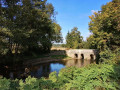
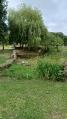
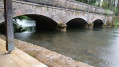
The stone bridges over the Lambon

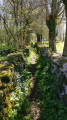
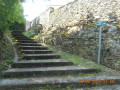
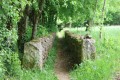
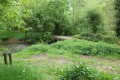
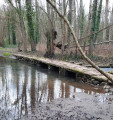
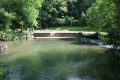
A pleasant hike around the Lambon, which is crossed several times via magnificent stone bridges. It begins with a bucolic route between old stone walls, traces of the laborious work of our ancestors.

Details

1100453
Creation:
Last update:
Last review:
  • Walking
    Activity: Walking
  • ↔
    Distance: 12.60 km
  • ◔
    Average duration: 3h 55 
  • ▲
    Difficulty: Moderate

  • ⚐
    Back to start: Yes
  • ↗
    Ascent: + 96 m
  • ↘
    Descent: - 96 m

  • ▲
    Highest point: 105 m
  • ▼
    Lowest point: 53 m
  • ⚐ Country: France
  • ⚐ District: La Crèche (79260)
  • ⚑
    Start/End: N 46.346901° / W 0.320915°
  • ❏
    IGN map(s): Ref. 1628SB
  • Hour-by-hour weather

Photos

Description of the walk

Park behind the school in Chavagné, taking the Impasse de l'École.
(DA) Go up Impasse des Écoles and, when it turns right, continue straight ahead on the path that runs alongside the buildings. At Rue de la Fontaine, first turn right then left and follow Impasse de la Burgalerie. At the first crossroads, turn right into a winding alley. At the next crossroads, turn left into the street, which is a cul-de-sac extended by a path.

(1) Turn right and leave the Mare à Migault on your right. Then take the narrow path that winds between two low stone walls like a small labyrinth (a beautiful testament to the prodigious work of our ancestors). At the T-junction, turn left and go up the path that continues as a tarmac road at the level of the houses (Chemin Noir).

(2) Cross the Route de la Mothe with caution and continue straight ahead on Chemin du Plumail (slightly to the left). At the fork, turn left. Then ignore all the turnings on the left.

(3) At the crossroads, follow Chemin de l'Homme du Moulin on the left (tarmac road; beautiful old houses). Before reaching Route de la Mothe, turn right and take the D174, known as Route de Vouillé , which slopes slightly downwards (take care). Then pass over the A10 motorway.

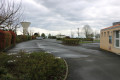
(4) Just after the bridge, turn left onto the small path that runs alongside the A10 (you will need to climb over the safety rail). Be careful due to poor visibility and heavy traffic! After about 250 metres, turn right down a small road leading to the motorway maintenance depot. Then first turn right then left to follow Rue de la Rande south-east. Well before the D7, turn right onto a path that runs alongside a stone wall on the left. At the T-junction, turn left.

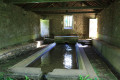
(5) At the crossroads, turn right onto Route de Vaumoreau (traffic is generally light, but caution is advised). Cross the Lambon (pump and wash house below). Continue along the road uphill. At each intersection, take the right-hand lane and end up on Chemin de la Guiberte (tarmac), which soon descends and runs alongside the Lambon at some distance.

(6) At the end, turn right onto Venelle Jeannot, a small path that crosses the Lambon river via a stone bridge and leads to Pied l'Ouaille. Cross the hamlet and take Venelle du Pied de l'Ouaille (tarmac). Follow the Lambon river to the D174 (pumping station).

(7) Cross the road carefully and take the path opposite that leads off to the left (west). Continue along the Lambon on your left.

(8) The path arrives at a double tunnel under the A10: take the one on the right (be careful, there is no lighting, feel your way along a good path; the second tunnel is for the Lambon in case of excess water). Continue along the path that runs alongside the Lambon. At the T-junction, turn left. At the next junction, turn right onto Rue du Moulin. Take the first path on the left and go downhill. Cross the Lambon via a stone bridge and go back up Rue du Lavoir.

(9) At the crossroads, turn right into Rue de la Garenne. Continue straight ahead towards La Salmandière, ignoring all the side roads. At La Révolinette, first turn right then left and follow Rue de la Gare (take advantage of the facilities on the left and then on the right to walk safely behind the bollards). Cross Le Pré.

(10) Turn right onto Impasse du Pré. Descend towards the Lambon, cross it on a stone bridge and climb slightly. At the T-junction, turn right. Near L'Houmaye, continue along a downhill road.

(11) When the road turns right, take a path on the left that runs along the right side of the Lambon before turning away from it and climbing towards the plateau. Cross Rue de Brimard with caution, then pass under a high-voltage power line. At the T-junction, turn right.

(12) At the crossroads, take the leftmost path. Cross a plateau heading north-northeast, ignoring a path branching off to the left. At the end, turn right onto Chemin de Miséré (tarmac road).

(13) At the crossroads, continue straight ahead onto Chemin de Baigne Cane. At the end, first turn left then right and follow the D5 with caution.

Turn right onto Route de la Mothe and follow it carefully until you reach the crossroads with Chemin Noir on the left and Chemin de Plumail on the right.

(2) Turn left onto Chemin Noir, which is downhill. At the end of the tarmac road, continue along the path. Then turn onto the small path between two low walls and continue to Mare à Migault.

(1) Immediately after the first house, turn right into a small alleyway. At the end of the alleyway, turn right onto the street towards Impasse de la Burgalerie. At the crossroads, turn left and at the next crossroads turn right onto Rue de la Fontaine. Shortly afterwards, take the small path on the left which leads back to the car park (S/E).


Waypoints

  1. S/E : km 0 - alt. 73 m - Impasse des l'Écoles
  2. 1 : km 0.43 - alt. 81 m - Path on the right
  3. 2 : km 1.05 - alt. 100 m - Crossroads of Route de la Mothe and Chemin Noir
  4. 3 : km 1.46 - alt. 104 m - The Man from the Mill
  5. 4 : km 2.04 - alt. 90 m - Start of the trail after the bridge
  6. 5 : km 3.38 - alt. 88 m - Crossroads between the path and the Vaumoreau road
  7. 6 : km 4.5 - alt. 61 m - Crossroads between Chemin de la Guiberte and Venelle Jeannot
  8. 7 : km 4.95 - alt. 61 m - Venelle du Pied d'Ouaille junction - D174 road
  9. 8 : km 5.39 - alt. 72 m - Tunnels under the A10 motorway
  10. 9 : km 6.54 - alt. 73 m - La Rivière
  11. 10 : km 7.95 - alt. 61 m - Crossroads between Rue de la Gare and Impasse du Pré
  12. 11 : km 8.48 - alt. 54 m - Crossroads at Impasse des Iris with a path
  13. 12 : km 9.76 - alt. 81 m - Crossroads
  14. 13 : km 11 - alt. 90 m - Crossroads of Chemin de Misere and small road
  15. S/E : km 12.6 - alt. 73 m - Impasse des l'Écoles

Notes

This hike covers varied terrain and requires sturdy footwear. The section of the route between low walls can be slippery in wet or rainy weather.

This unmarked route does not present any real difficulties. It follows marked sections. It is therefore advisable to follow the directions in this description and on the map, while also taking note of the landscapes you pass through. Indications of distance from the starting point, or even the GPS coordinates of the waypoints (including the starting point), can also help hikers find their way.

Hike completed by the author on 25 April 2018.

Worth a visit

The Lambon
The Lambon rises in Goux, in the commune of La Couarde, at an altitude of 154 metres.
It originates from a multitude of springs, which are located at an altitude of around 155 metres above sea level.
With a length of 37.85 km, it extends over the territory of the following 11 municipalities: La Couarde, Beaussais, Vitré, Thorigné, Prailles, Mougon, Aigonnay, Fressines, La Crèche, Vouillé and Niort, where it flows into the Sèvre Niortaise 12 metres above sea level, near the source of the Vivier, after crossing the Bois de Vachette.

From its source to Thorigné, it crosses the Mellois plateau and already loses 50 metres in elevation.
From Fressines to Niort, the Lambon flows through the cereal-growing plain of the Niort region with a gentler slope.
The geological structure of the plain, consisting of groies soil on limestone rock, gives it a more sinuous character.
It has five tributaries:
on the left bank: the Fombelle
on the right bank: the Lussaudière, the Villebeurre, the Aigonnay and the Mayolle

The ecological and hydrological status of the Lambon
The Lambon's hydrological regime is severely disrupted by low water levels; regular and repeated drying out is observed on a third of its length for up to eight years out of ten.
These dry spells are due to the geological and hydrogeological characteristics of the basin, but are exacerbated by ever-increasing water use:
- catchments,
- drilling,
- creation of ponds parallel to the Lambon riverbed.
This drying phenomenon is accompanied by disruption and degradation of the banks. In addition, the water quality is highly variable.

To ensure the management and protection of 61 km of riverbanks, the Joint Association for the Restoration of the Lambon and its Tributaries (SYRLA) was created in early 2010.
This new public body replaced the Association for the Restoration of the Lambon and its Tributaries (ARLA), which had existed since 1997 but whose articles of association did not allow it to undertake the public works required by the Water Framework Directive.
This joint association will therefore be able to issue a Declaration of Public Interest, which is essential for the implementation of hydromorphological improvements to the watercourse. All of the planned actions are geared, as was the case with ARLA, towards restoring the Lambon and its tributaries to good ecological status.
Furthermore, the Lambon is part of the Sèvre Niortaise catchment area, for which the Water Development and Management Plan (SAGE) was approved in April 2011.
This is a planning tool designed to promote coordinated and balanced management of water resources and associated aquatic environments within a catchment area. Covering an area of 3,650 km², the SAGE "Sèvre Niortaise and Marais Poitevin" covers 217 municipalities.

Riparian vegetation: an element to be maintained and preserved
The good ecological status of a watercourse depends on the maintenance of its banks and riparian vegetation.
Riparian forest refers to the abundant and varied vegetation that borders the river.
There are three distinct layers, which in the case of the Lambon consist of the following plants:
- Trees: alders, ash trees, oaks, etc.
- Shrubs: hazel, spindle, hawthorn, blackthorn, etc.
- Herbaceous plants: grasses, nettles, reeds, etc.
Riparian forests serve many purposes:
- maintaining riverbanks and limiting erosion,
- preventing flooding,
- self-purification and absorption of certain types of pollution,
- providing shade that is favourable to the life cycle of aquatic fauna,
- providing firewood, etc.
It is therefore essential to maintain the vegetation on riverbanks by preserving a diversity of sizes and species and maintaining a balanced structure for all trees and shrubs.
For example, it is important to avoid leaving only the branches above the watercourse or systematically felling leaning trees!
These trees are not necessarily the ones that are in danger of falling. On the contrary, they can play an important role as shelters for fish.
As such, for fishing, the Lambon is classified as a second category fishing river (minnow, gudgeon, carp, tench, eel, trout).

The Lambon and the tragic history of the Protestants
The upper reaches of the Lambon flow through an area where there were many Protestants in the 17th century.
In 1681, this Protestant community suffered the first persecutions known as the "dragonnades".
The dragoons were sent by Louvois, Louis XIV's Minister of War, and were normally used to collect taxes.
Thus, soldiers on horseback were tasked with forcibly converting Protestants to Catholicism...
Jean Migault, in his diary, recounts the passage of the "Cavaliers" in 1681 and the violence they caused.
Protestants who did not renounce their faith were threatened and went into hiding, their furniture destroyed or sold at a pittance to neighbouring "Papists" (Catholics).
Jean Migault was a reader and schoolmaster who taught the precepts of Protestantism to young children.
Jean Migault was born in 1645 and lived near Lambon. His father, Louis, died in Les Touches de Thorigné in 1662.
To escape persecution, Jean Migault went into exile with his large family in Holland.
He left from the port of La Rochelle in April 1688 and ended his life there in exile.
Around 1990, the small Bellevue Bridge was restored by the municipality of Thorigné.
This small bridge was reserved for pedestrians and mules bringing wheat to the mill; carts had to cross the ford to the left of the bridge.
This small bridge spans the Lambon River and was adjacent to the Moulin des Basses Touches, now gone, which is believed to be the birthplace of Jean Migault.

The Pump and Wash House of Vaumoreau
The Pump
This well, which never ran dry, allowed the inhabitants of Vaumoreau, Bougouin and, in summer, other neighbouring villages to come and draw high-quality water for their own consumption and that of their livestock. Next to the pump was a large stone trough (a bassaïe) filled by the pump to allow animals to drink.
The wash house (or fountain)
It was renovated a few years ago by the municipality of La Crèche. Women used to come here to wash their clothes. In winter, they appreciated the temperature of the water (less icy than that of the stream). In summer, they also washed their clothes upstream from the bridge, directly in the stream, hence the presence of flat stones.

Reviews and comments

4.6 / 5
Based on 10 reviews

Reliability of the description
4.7 / 5
Ease of following the route
4.6 / 5
Route interest
4.4 / 5
User 21530545

Overall rating : 4.3 / 5

Date of your route : Dec 02, 2025
Reliability of the description : ★★★★★ Very good
Ease of following the route : ★★★★☆ Good
Route interest : ★★★★☆ Good
Very busy route : No

Varied terrain and landscapes.
The section along the motorway (point 4) is difficult because the path is overgrown with brambles, but it is possible to take the small road a little further on the left.

Machine-translated

Kathleen28
Kathleen28

Overall rating : 5 / 5

Date of your route : Apr 08, 2024
Reliability of the description : ★★★★★ Very good
Ease of following the route : ★★★★★ Very good
Route interest : ★★★★★ Very good
Very busy route : No

A great hike passing by animals at the start, rolling hills, stony paths, streams and sometimes tarmac. Although I don't usually like to retrace my steps, this is a hike I would do again 😉

Machine-translated

miprima
miprima
• Edited:

Overall rating : 4 / 5

Date of your route : Apr 05, 2023
Reliability of the description : ★★★★☆ Good
Ease of following the route : ★★★★☆ Good
Route interest : ★★★★☆ Good
Very busy route : No

Beautiful discoveries along this hiking trail.
But we had a lot of trouble finding the car park behind the school.
The school is located on Rue de la Fontaine.
There were seven of us. And even though there are some sections of road, we have very fond memories of this route (low walls, stone bridges, among other things).

Machine-translated

cagouille 79
cagouille 79

Overall rating : 5 / 5

Date of your route : Apr 10, 2023
Reliability of the description : ★★★★★ Very good
Ease of following the route : ★★★★★ Very good
Route interest : ★★★★★ Very good
Very busy route : No

A very pleasant walk. Worth repeating even in summer.

Machine-translated

pgetrochon
pgetrochon

Thank you for your comment.
You have to climb over the safety rail immediately after crossing the bridge. There is a narrow path between the motorway fence on the left and a small wood on the right. It may be that after lockdown, the lack of walkers has made the path less visible, with increasingly abundant vegetation growing along the roadside. Your solution is interesting, but in a group you have to go past the bend in the road, which is more dangerous than the path... when it is passable. Perhaps there are just a few branches that need to be cut back at the side of the road, but they are enough to hide the path.
The pump is at the bottom of a descent before crossing the Lambon via a road bridge. It is on the right-hand side of the road. The wash house is below the parapet that borders the road at the same place, as the road is raised above the watercourse. The pump is located against a large upright stone.
I do not know the origins of Rue Quartier Latine: perhaps there was a Roman settlement in this area. To be investigated.
I can confirm that this website is a valuable resource for wash houses in Deux-Sèvres. I often consult it when planning routes, and the photos make it easier for me to find them, as some are sometimes hidden at first glance.
Happy hiking.

Machine-translated

Sneg
Sneg
• Edited:

Overall rating : 5 / 5

Date of your route : Jun 23, 2020
Reliability of the description : ★★★★★ Very good
Ease of following the route : ★★★★★ Very good
Route interest : ★★★★★ Very good
Very busy route : No

A lovely walk! Admittedly, you are sometimes lulled by the traffic on the A10 motorway, but you pass through some truly charming areas and the route is very pleasant. Comments: 1) We couldn't see where to cross the safety rail (4), so we continued a little further to the left and made a hairpin turn (which took a few minutes). 2) We looked but couldn't find the pump and the wash house. Where are they? 3) Surprised and intrigued by the name "Rue du Quartier Latine" (Latin Quarter Street), we'll have to look for an explanation.
Despite the sometimes noisy atmosphere, we will be back soon for the route that starts in Fressines because this corner of Deux-Sèvres is very nice.
Website/ Wash houses in Deux-Sèvres, the one in Vaumoreau: http://lavoirsdeuxsevres.free.fr/html/Fi... Very interesting.

Machine-translated

pgetrochon
pgetrochon

Thank you for your message.
Maintaining certain paths is still difficult in some areas due to the lockdown that lasted nearly three months in the spring of 2020. This sector was undoubtedly not a priority, and the weather has also been particularly favourable for grass growth.
I did not take your suggestions into account when making my proposal:
- the first because we walk in groups and avoid paths that are too steep
- personally, I think it is a shame not to return to the area between the Route de la Mothe and the Impasse de la Burgalerie, with its remarkable single-file path between the dry stone walls, which are particularly well preserved and bear witness to the important work of our ancestors and their talent.
- Finally, the choice of parking spot is due to the need to be able to park up to ten cars (group walk). It is obvious that small groups of people can find parking spots closer by.

Of course, the routes I post on Visorando are only suggestions that meet my specific criteria, but they allow me to offer ideas to others who want to discover little-known areas. It is up to those who feel capable of modifying them to suit their own constraints and wishes.

Happy hiking.

Machine-translated

jlfaure
jlfaure

Overall rating : 5 / 5

Date of your route : Jun 12, 2020
Reliability of the description : ★★★★★ Very good
Ease of following the route : ★★★★★ Very good
Route interest : ★★★★★ Very good
Very busy route : No

Thank you for this very pleasant route, despite the background noise from the motorway along much of the way. However, you can still hear the birds singing. Minimal maintenance is required after the point (4) where the path runs alongside the motorway through the scrub.

I suggest two alternatives:
1: After crossing the Lambon at La Rivière, before the point (9) at the bottom of Rue du Lavoir, turn right onto Allée des Écureuils and join the road via a fairly steep but very shady path.

2: To avoid retracing your steps on the way back to Chavagné, turn left onto the D5 as you leave Chemin de La Pierre, then a little further on, turn right onto Chemin des Rocs. The street is extended by a path that descends into the vegetation and joins the road. Immediately afterwards, turn right onto Chemin de La Grand Chaume and arrive at Rue de la Dibe. There is a small car park on the right with a shelter and bus stop where we started.

Machine-translated

pgetrochon
pgetrochon

Thank you for your message.
The unusual weather conditions this autumn and early winter make hiking difficult, especially near waterways.
I invite you to try this route again when the weather is less wet.
Kind regards

Machine-translated

Cmarsil
Cmarsil

Overall rating : 4.7 / 5

Date of your route : Feb 05, 2020
Reliability of the description : ★★★★★ Very good
Ease of following the route : ★★★★★ Very good
Route interest : ★★★★☆ Good

Hello,

And thank you for this route close to home, which allowed us to discover charming stone walls starting in Chavagné.
We expected to find a lot of water and we were not disappointed.
We had to turn back at point 10 (picnic table) because the Lambon was overflowing and made it impossible to cross.
We retraced our steps and took the Iris cul-de-sac, which leads directly to point 11.
The passage at point 6 was quite complicated for the same reasons.
Best regards

Machine-translated

pgetrochon
pgetrochon

Thank you for your comment.
Disappointment after a hike often depends on what you expected. Others enjoyed it... see the other comments.
You don't mention the passages over the stone bridges, some of which are very old and are the main attraction of this hike.
There is also nature that is still fairly unspoilt, even though we are close to residential areas. Finally, the old houses, most of which have been tastefully restored, are a pleasure to see and remind us of the work of our ancestors.

I discovered this hike thanks to a hiker friend, and I am sharing it with you because I am sure that some of you will find it a great way to have a good time.
Happy hiking!

Machine-translated

Henryjj79
Henryjj79

Overall rating : 3.3 / 5

Date of your route : Jun 03, 2019
Reliability of the description : ★★★★☆ Good
Ease of following the route : ★★★★☆ Good
Route interest : ★★☆☆☆ Disappointing

Many tarmac roads; many crossings through residential areas. A few small passages between walls or hedges.

Machine-translated

pgetrochon
pgetrochon

Thank you for your comment.
There are still plenty of beautiful walks in our area.

Machine-translated

claudemoinet
claudemoinet

Overall rating : 5 / 5

Date of your route : May 20, 2019
Reliability of the description : ★★★★★ Very good
Ease of following the route : ★★★★★ Very good
Route interest : ★★★★★ Very good

A very pleasant, hilly route. Can be completed in three hours without overexerting yourself. How beautiful our region is!

Machine-translated

marichantal
marichantal

Overall rating : 4.3 / 5

Date of your route : Jul 08, 2018
Reliability of the description : ★★★★☆ Good
Ease of following the route : ★★★★☆ Good
Route interest : ★★★★★ Very good

Hello
The beginning of the description may be confusing.
Go up Impasse des Écoles to the intersection, turn left onto Rue de la Fontaine, then right onto Impasse de la Burgalerie.

AND CONTINUE FOLLOWING THE MAP PROVIDED.

Kind regards. MARICHANTAL

Machine-translated

Other walks in the area

For more walks, use our search engine .

The GPS track and description are the property of this route's author. Please do not copy them without permission.