Country:
 City:
City:


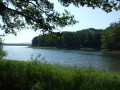
We could start at one end of the dam, but we prefer to discover this structure during the walk and will start at the western end of the lake. To do this, on the N19 at the entrance to the hamlet of Ban de Champagney, on the Ronchamp side, take the road that descends to the centre of the village of Champagney. After 150 m, in the first bend on the left, park at the side of the road at the crossroads with an unpaved ochre-coloured path.
(S/E) Do not take this path, but go down the grassy path under the fir trees.
(1) After 300 m, you will reach the banks of the Bassin de Champagney at the end of one of the many coves that dot this stretch of water. Take a wide, well-maintained path on the right that skirts the basin to the south. A few fishermen in their boats, great crested grebes, moorhens, coots, ducks and various other waterfowl, as well as the multicoloured sails of Optimist 420s and other dinghies, add to the charm of the walk.
(2) After a few bends, you will reach the western end of the dam and its surface spillway. Take the time to read the explanations about the construction of the Champagney dam and its role in supplying water to the canals before turning left onto the tarmac road. Cross the bridge over the supply channel and continue along the road to the other end of the dam, admiring this majestic stone structure with its imposing buttresses, worthy of a Vauban fortification. Note the instruments used to measure the stability of the structure (vernier scales, inverted pendulums, piezometers, inspection wells).
(3) When you reach the east car park, turn left and, given the presence of a campsite by the water's edge, hikers have two options:
- if the water level is low enough, follow the shore in full sun on stony ground, which makes walking difficult,
- otherwise follow the paved road (D219).
There is little traffic and the route has the advantage of being in the shade. Pass the campsite entrance, then turn left at the crossroads and join Rue des Fontenis on the left.
(4) Follow this road straight ahead until you reach the water sports centre and the shore lined with small oak trees. Turn right, go around a deep cove to the north and return behind another sailing centre.
At the entrance to the centre, turn right onto the limestone path and follow it for 50 metres. After the centre's facilities, go back down to the edge of the lake and follow a path along the edge of the vegetation. You will soon reach the water, which you can cross on dry land if the water supply is cut off and the water level allows it. Otherwise, go around the top of the embankment and cross over the underground tunnel.
The path continues along the edge of the forest.
(5) Here is another cove that cuts into the north, then another at the western end of the basin. After a charming little cottage, turn left, cross a small backwater and, after going around this last cove, you will find yourself facing the island (at high tide).
(6) Continue along the water's edge, following a beautiful, wide path at the foot of the embankment to return to the path you started on.
(1) Go back up the path you took on the way there until you reach the car park (S/E).

 very good hike




 Visorando Member
 Moderate
 Association / Club / Walk leader