Country:

 City:
City:


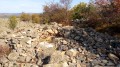
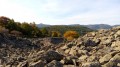
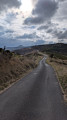
The walk starts in Girond. To get there from Le Cheylard, take the D578 (towards Vals-les-Bains, Mézilhac). On leaving Mariac, turn right just before the bridge over the Dorne. Drive through the village of Pont-de-Fromentières and take the road on the right just after the bakery, heading towards Girond and Cornuscle. Girond is 4 km further on. Park in the car park at the edge of the hamlet.
(S/E) Walk back the way you came for about 50 metres. You’ll pass the old school in Girond. The walk starts at the crossroads. Take the small tarmac road on the right which runs behind the school (yellow and white markings, sign saying ‘fire reservoir’). A few metres further on, you’ll pass the Girond fire reservoir; take a look at the photos and the gabions filled with local stones.
Walk for about 150 metres and take the path branching off to the right. Walk uphill for about 30 metres.
(1) On the embankment, you’ll find a fantastic summary of the geological evolution over the last 500 million years (see the section ‘During the walk or nearby’ for explanations, or the photo ‘500 million years of geological history right before your eyes’).
Retrace your steps and rejoin the tarmac road on your right. The tarmac ends at the last house. Continue along the path which runs on the north-facing slope (in the shade) through a chestnut forest. You’ll notice that the chestnut trees give way to pine trees as soon as you reach the south-facing slope (in the sun).
About 50 metres after leaving the woods, you’ll spot on your right, on the embankment right beside the path, a tiny basalt chimney about one metre wide. You really do need to look carefully to spot it.
(2) Easier to spot, 70 metres further on, right next to the path on the right, is a pile of rocks that looks like a marbled cake. It’s almost as if the granite hasn’t quite finished baking.
Continue along the path for about 2.5 km until you reach a signpost for the walking trails at the entrance to a large open area.
(3) Roughly in the middle of the clearing, on its right-hand side, take the path on the right. The start of the path isn’t necessarily easy to spot due to forestry work, but as soon as you enter the woods, you’ll see it. The path climbs steeply up the spur and you’ll reach the ridge.
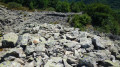
(4) Shortly afterwards, you’ll come across a fine pile of granite boulders (note how erosion has smoothed the edges). Continue along the path, which you’ll follow for about 1.4 km. Be careful, as the climb is quite steep – the distances seem longer!
The path emerges from the forest into a large meadow and the trail is no longer visible. Carry on straight ahead (south-east); the path resumes at the top of the meadow, veering to the right. Follow it until you reach a junction.
(5) Take the path on the left. A few metres further on, you’ll see theGR®® markings. Follow the path, which leads to the hamlet of Soulage. The brownish-black stones and rocks you see in the landscape and also in the walls are basalt. Walk through the hamlet and continue along the road. Less than 100 metres before the Croix du Planas – which marks both the pass and the crossroads – you’ll notice, on your right, some fairly flat stones with very attractive yellow and red marbling. This is rhyolite, of volcanic origin.
(6) At the Croix du Planas, take the road on the right towards the Grand farm. Before you reach it (350 metres after the cross), follow the path that climbs to the right. At the hairpin bend, carry on straight ahead to reach a small pass. Turn right towards a gate less than 100 metres away and join the GR®®.
(7) Follow theGR®® to the left, heading north-north-west, to the summit of Coudiol.
(8) This summit may not look like much, but it is also a volcano, the source of the basalt flow you will be walking on all the way to Cornuscle.
Continue along theGR®® for about 800 metres.
The small hill opposite you, slightly to the right, is called “La Pigne”, simply because a few pine trees are struggling to survive on its summit. If you’ve still got a bit of energy left, climb up to it (otherwise, follow theGR®®).
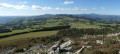
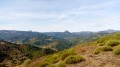
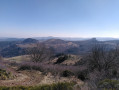
(9) From here, there’s a splendid view over the entire Boutières range, with more than 20 volcanoes in sight.
Head back down the other side (to the north) to rejoin theGR®®. Continue along theGR®®, which passes above the hamlet of Cornuscle and joins the road leading to it. Turn left onto the road. A few dozen metres further on, there’s a hairpin bend – take it.
(10) A few metres after the bend, take the yellow and white-marked path on your left. Follow it all the way; it ends on the road a few dozen metres before the car park. Turn left to return to the car park (S/E).


 . The end of the trail is rough enough that it is not recommended for people with reduced mobility.
 Visorando Member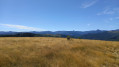

 Difficult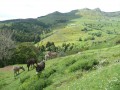
 Easy
Easy  Association / Club / Walk leader