The historical heritage of Neussargues en Pinatelle

Discover the history of this part of the Cézalier through the archaeological and historical remains that dot this route. Prehistoric rock shelters, tumuli, Merovingian sarcophagi, medieval forest trails, 12th-century churches, a monumental 15th-century cross, a communal oven, a wash house and beautiful old houses.

Details

780368
Creation:
Last update:
Last review:
  • Walking
    Activity: Walking
  • ↔
    Distance: 14.58 km
  • ◔
    Average duration: 5h 05 
  • ▲
    Difficulty: Moderate

  • ⚐
    Back to start: Yes
  • ↗
    Ascent: + 322 m
  • ↘
    Descent: - 315 m

  • ▲
    Highest point: 1,096 m
  • ▼
    Lowest point: 813 m

Description of the walk

There is a small car park near the church in Chalinargues. You can also find a few parking spaces near the town hall, on the D23, north-east of the village.

(S/E) From the south side of Saint-Barthélémy Church, follow the street to the left of the church, which heads north-west. At the junction between the D23 and D39, take the D23 on the right for about 60 metres. Look for the chess tower logo, which marks the "Sentier des Vieilles Pierres" (Old Stones Trail) that you will follow throughout this route. Turn onto the first street on the left and continue straight ahead on the path that extends from it to reach the D39. Continue on the side of this quiet road for about 500 metres.

(1) Turn right onto a path that leads to some meadows. At the crossroads with a small road, continue straight ahead. You will come to a small road in the hamlet of Mons, where you will see a small cross on your left (you can buy cheese from a farmer on your left).

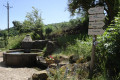
(2) Turn right and then immediately left to see the beautiful 15th-century Mons Cross. Next to the cross, you will see an old shoeing rack, which was used to lift large animals, such as oxen, in order to shoe or treat them. Go behind the cross and turn right to reach the drinking troughs. Walk alongside them and continue on the path opposite, heading east-south-east.

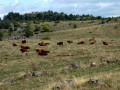
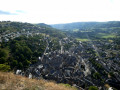
(3) When the path turns right, continue straight ahead on a narrower path. When you reach the edge of the plateau, facing the Rocher de Laval, follow the path that turns right and winds down towards Moissac.

(4) At Moissac Castle, turn left, cross the disused railway line and continue straight on towards the church to find the communal oven, which is in perfect condition and still in use. Continue along Rue du Four, then turn left to visit the beautiful church with its 12th-century bell tower. This "privileged altar" is visited by pilgrims on the Way of St James. Inside, just to the right of the door, you will see an ancient pilgrim's tombstone. You can climb a few steps on the outside of the bell tower. Leaving the church, continue south for a few metres to reach the D23.

(5) Shortly afterwards, on leaving the village, you will see a stone shelter on your left protecting Carolingian and Merovingian sarcophagi from the 6th and 7th centuries. Continue along the D23. Ignore a path on the right and then, a hundred metres further on, take a small road also on the right.

(6) Cross the railway line via a high bridge and continue along the railway line on your left. Further on, the path veers off to the west.

(7) Ignore the small road on the left that descends towards Neussargues. Further on, at a fork, continue to the right and you will arrive at the Prehistoric Caves of Cuzers. A stepladder on the right-hand side of the path allows you to climb up to the caves via a narrow path. These caves are actually rock shelters that were used by prehistoric hunters. Back on the path, continue to the right to enter the Bois du Cheylat woods further on. In these woods, follow the signposts carefully.

(8) A sign indicates that you are on a medieval path. And indeed, this beautiful, enclosed path, lined with mossy stones, seems very old. You will come to a track, which you should follow to the right (signposted "Cascades"). At the next crossroads, continue straight ahead. At each intersection, follow the markings indicated by the chess tower logo or the "Sentiers des Vielles Pierres" signs. At the next intersection, the only one without markings, ignore the path that branches off to the right and backwards. Just after this, at the entrance to a meadow, at a fork, the paths to the left and right join further on. Shortly afterwards, a sign indicates the direction of the "waterfall (15 min round trip)" on the left.

(9) Descend a few steps and a path to a picnic area, from where you can already see the waterfall above. Then climb the stairs to the foot of this beautiful waterfall. Return to the previous crossroads.

(9) Continue to the left, still in the Bois du Cheylat. On your right, you will see a sign indicating the medieval tower (which probably inspired the logo for this hike), the ruins of which can be seen a few metres away. Leave the woods and you will come to the D40. Follow it to the right for about 300 metres.

(10) At the path that branches off to the right, signs indicate that a hundred metres further along the D40, there are tumuli mounds in a field just to the left of the road.

(10) On the way back, continue along the path and, at the next crossroads, turn left towards Freissinet. At the fork in the hamlet, turn right to join the D40. On your right, a few metres from the road, you will see a beautiful wash house. Follow the D40 (a quiet road) to the right for about 300 metres.

(11) At the cross, take the path on the left. At the junction with a small road, continue straight ahead.

(12) At the crossroads with the D39, continue straight ahead. You will come to a small road; follow it to the right until you reach the D23 at the entrance to Chalinargues. Follow this road to the right, towards the village. Pass a wash house and you will arrive at the junction between the D23 and the D39. Continue along the small road opposite to reach the church (S/E).

Waypoints

  1. S/E : km 0 - alt. 1,069 m - Church of Chalinargues
  2. 1 : km 0.81 - alt. 1,073 m - Path on the right
  3. 2 : km 2.73 - alt. 1,017 m - Right then left
  4. 3 : km 3.75 - alt. 998 m - Straight ahead
  5. 4 : km 5.17 - alt. 857 m - Moissac Castle
  6. 5 : km 5.61 - alt. 823 m - Sarcophagi
  7. 6 : km 6.29 - alt. 843 m - Bridge over the railway line
  8. 7 : km 7.07 - alt. 840 m - Straight ahead
  9. 8 : km 8.24 - alt. 892 m - Medieval path
  10. 9 : km 9.09 - alt. 918 m - Round trip to the waterfalls
  11. 10 : km 10.68 - alt. 1,019 m - Path on the right
  12. 11 : km 11.77 - alt. 1,049 m - Path on the left
  13. 12 : km 12.85 - alt. 1,080 m - Opposite
  14. S/E : km 14.58 - alt. 1,069 m - Church of Chalinargues

Notes

Moderate difficulty hike, standard hiking equipment required.

Thanks to the Pays de Murat community of communes for the quality of the signposting on this route.

Worth a visit

Discover more hikes in this area with a description or the Visorando app here

The new commune of Neussargues-en-Pinatelle comprises several villages, including Chalinargues, Mons, Moissac and Freissinet, which this route passes through.

(S/E) The village of Chalinargues and the Church of St Bartholomew with its 12th-century bell tower, which is a "privileged altar" on the Way of St James.

Although the first and last kilometres of this route are a little monotonous, there is plenty to discover between (2) and (11): In Mons, the monumental basalt cross, the blacksmith's workshop and the drinking troughs.
In Moissac, the castle, the communal oven, the church, the sarcophagi, the prehistoric rock shelters, the waterfall and the Freissinet wash house.

(4) The volcanic complex of the Monts du Cantal is the largest stratovolcano in Europe. Eruptive phases occurred between 9 million and 10,000 years ago. The Cantal volcano forms a star-shaped complex, each arm of which represents a planèze, an immense straight plateau resulting from the outpouring of fluid basalt lava, separating two valleys. The Rocher de Laval is a ledge of the Saint-Flour planèze exposed by erosion.

(6) Sarcophagi were a very common form of burial during the Early Middle Ages and were always associated with places of worship. They fell out of use at the end of the Romanesque period. The sarcophagi of Moissac date from the 8th and 9th centuries.

(8) Rock shelters were used seasonally as hunting lodges by Upper Palaeolithic reindeer hunters (35,000 to 9,000 years ago), who were Homo sapiens hunter-gatherers. They did not use metals to make their tools, but stones, especially flint, and organic materials such as bones, reindeer antlers and ivory.

(10) The tumulus is a type of burial mound dating from the Bronze Age and the early Iron Age. The cremated remains of the deceased were placed in the ground or in a casing under a mound of earth surrounded by a circular ditch. Here, the eroded summit has more or less filled in the ditch.

Reviews and comments

4.7 / 5
Based on 9 reviews

Reliability of the description
4.8 / 5
Ease of following the route
4.8 / 5
Route interest
4.6 / 5
User 13544406

Overall rating : 4 / 5

Date of your route : Aug 12, 2025
Reliability of the description : ★★★★☆ Good
Ease of following the route : ★★★★☆ Good
Route interest : ★★★★☆ Good
Very busy route : No

Variety: stream, waterfall, forest, small church...
Everything is easy to access and well signposted, and the ground was dry. We only got lost twice in the Cheylat forest.
We recommend this lovely walk.

Machine-translated

BOB63
BOB63

Overall rating : 4 / 5

Date of your route : Jun 03, 2025
Reliability of the description : ★★★★☆ Good
Ease of following the route : ★★★★☆ Good
Route interest : ★★★★☆ Good
Very busy route : No

Between 3 and 4, to reach the edge of the plateau, the path passes through wet pastures (with numerous traces of cows) and is quite difficult to see, especially as there are few markings (or I did not see them). Be careful.

Machine-translated

quentier
quentier

Overall rating : 4.7 / 5

Date of your route : Sep 14, 2023
Reliability of the description : ★★★★★ Very good
Ease of following the route : ★★★★★ Very good
Route interest : ★★★★☆ Good
Very busy route : Yes

Lovely walk. Monotonous at the beginning and end. Very interesting heritage.

Machine-translated

leonisa14
leonisa14

Overall rating : 5 / 5

Date of your route : Aug 06, 2023
Reliability of the description : Not used / Not applicable
Ease of following the route : ★★★★★ Very good
Route interest : ★★★★★ Very good
Very busy route : No

A very enjoyable and varied hike: crossing the plateau, a beautiful descent into the valley, lovely woods, a waterfall, heritage sites.
Bring a windbreaker, as the wind on the plateau can be cool. Be aware that there is virtually no mobile phone reception in Chalinargues.
One downside: motocross bikes in the woods, noisy and speeding along the path.

Machine-translated

patounette42
patounette42

Overall rating : 4.7 / 5

Date of your route : Jul 30, 2023
Reliability of the description : ★★★★★ Very good
Ease of following the route : ★★★★★ Very good
Route interest : ★★★★☆ Good
Very busy route : No

Crossing the Cheylat forest along this medieval trail is magical
There are beautiful things to discover along the way
But the paths to and from the trailhead are monotonous... especially the climb in the blazing sun!

Machine-translated

Marianne et Heidi
Marianne et Heidi

Overall rating : 5 / 5

Date of your route : Sep 17, 2021
Reliability of the description : ★★★★★ Very good
Ease of following the route : ★★★★★ Very good
Route interest : ★★★★★ Very good
Very busy route : No

Accompanied by non-walkers, we only did part of the hike (from the Mons cross to Freissinet). This allowed us to visit the interesting spots in the villages (particularly Mons and Moissac) with the non-walkers. It was a very successful "heritage afternoon"! Arriving at nightfall, we only missed the Freissinet burial mounds. A lovely, enjoyable and interesting walk. No problem following the route.

Machine-translated

vuagnoux
vuagnoux

Overall rating : 5 / 5

Date of your route : Aug 11, 2021
Reliability of the description : ★★★★★ Very good
Ease of following the route : ★★★★★ Very good
Route interest : ★★★★★ Very good
Very busy route : No

A very interesting tour with a variety of discoveries.
I highly recommend it!

Machine-translated

aigue blanche
aigue blanche

Overall rating : 5 / 5

Date of your route : May 31, 2018
Reliability of the description : ★★★★★ Very good
Ease of following the route : ★★★★★ Very good
Route interest : ★★★★★ Very good

Did not complete the entire route due to bad weather. The section through the Cheylat woods between 7 and 10 is very wet, even completely soggy. To be seen in dry weather to see if this section improves.

Machine-translated

PEDIBUS69
PEDIBUS69

Overall rating : 5 / 5

Date of your route : May 07, 2018
Reliability of the description : ★★★★★ Very good
Ease of following the route : ★★★★★ Very good
Route interest : ★★★★★ Very good

Very well-marked trail. Very varied landscapes (forest, waterfalls, typical hamlets, historical monuments, large meadows, stone-lined paths), magnificent, birdsong, herds of Salers cattle...The only downside was that the hiking trail after the place called Les Mons was "cut off" by an electric fence for a herd of cows. We had to cross it under their curious gaze to continue our hike. Nothing serious, but it could cause some people to turn back, which is a shame because the descent to Moissac offers a magnificent view.

Machine-translated

Other walks in the area

For more walks, use our search engine .

The GPS track and description are the property of this route's author. Please do not copy them without permission.