Points of interest
Forest evolution: a large part of the Transet hill was once owned by the Abbaye du Palais.
Before the forest, there were many cultivated plots around the villages, where farmers practised crop rotation, growing rye, buckwheat and fallow land, according to a 1812 survey.
Around 1854, oats and potatoes appeared (almost a century after their introduction in Limousin). The latter provided a significant source of income, so many people sold their sheep to plough more land, greatly reducing the amount of fallow land.
At that time, there were few wooded areas, only a few chestnut copses, which were very useful for making stakes and fences and for harvesting chestnuts, which provided a significant source of additional food.
The population of Thauron peaked in 1876 with 850 inhabitants. It was also at this time that seasonal migration was at its highest, with men leaving to work as masons in the cities of France.
The poor soil and small size of the properties meant that it was not possible to feed everyone, so seasonal migration provided a little extra income to pay off debts and expand properties. Over the years, seasonal migration often became permanent, accentuating the negative demographic trend that was exacerbated by the First World War.
The cultivated plots abandoned by agricultural decline were naturally reforested with birch, hazel, then oak and beech trees, eventually forming a beautiful deciduous forest. This forest was largely destroyed in 1986 and replaced by plantations of conifers, which are now reaching maturity. They are clear-cut and replaced by plantations of Douglas fir, larch and American oak.
On the top of the hill, you can see some remains of the plot layout: mounds, ditches, boundary markers and vestiges of dividing walls partially destroyed by forestry machinery.
The funerary urn
In the village of La Chaize, you can see a funerary urn found on the Gallo-Roman site of Poutignat, located between the villages of La Chaize and Le Mas.
Other carved stones were found at Lombrot, a plot of land between the villages of La Chaize and Mont de Transet. This site was the subject of archaeological research in 1966, which concluded that a Gallo-Roman cemetery probably existed there. Further away, fragments of tiles, platforms and embankments, and shepherds' huts have been observed, suggesting that this area was occupied in ancient times.
Local road 7, a never-ending story
The first mentions of this project date back to 1890, then in 1901, when the communal land was sold, the inhabitants requested the construction of a local road linking Pontarion to Bosmoreau les Mines (where the railway station is located), passing through Le Mas, La Chaize and Le Mont de Transet. They ceded their land free of charge and undertook to build at their own expense all the aqueducts necessary for drainage. Despite all this goodwill, the project was not finalised until around 1950 because a section of land between La Chaize and Le Mont de Transet was still unfinished.
The old trees and stone walls
Numerous walls remain along the paths. It is difficult to date these structures, but some sections appear to be very old. We can assume that most were built in the Middle Ages, when the monks of the Abbaye du Palais used these paths to transport various goods.
The remarkable old trees also add to the charm of the path. They are witnesses to the past and provide a habitat for many species (birds, mammals, reptiles, insects, etc.).
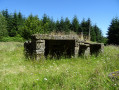
The canal and fishery: this hydraulic system may have been a fishpond during the time of the Cistercian Abbey of Palais Notre-Dame. Fish was an important source of protein at a time when meat was scarce.
The fully masonry fishery is much larger than average and does not appear to have been used as a wash house.
The canal is also lined with stones hidden under the vegetation.
Landscapes, fauna and flora
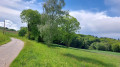
The balcony position overlooking the Thaurion valley, the alternation of wooded plots and meadows, and a few wetlands offer a variety of natural environments where animal and plant species can thrive.
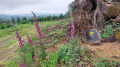
Depending on the season, the path is carpeted with wood anemones, wild hyacinths and lesser celandines, followed by broom, foxgloves, thistles, centaury, ferns and more.
With a little luck or patience, you may spot mammals such as roe deer, wild boar, foxes, hares, squirrels, small mustelids, badgers, wildcats, not to mention the greater mouse-eared bat and noctule bats, which use the hollows carved out by black woodpeckers in tree trunks, and a large number of bird species characteristic of deciduous forest environments.
The open views offer wide panoramas that are perfect for contemplation.



 Country:
 City:
City:


 Visorando Member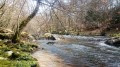

 Tourist office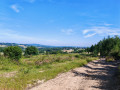
 Moderate