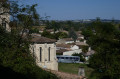
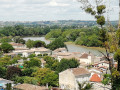
(S/E) Branne Town Hall, in the tradition ofthe 19th century: Justice of the Peace, flanked by the Municipal School for Girls and Boys.
(S/E) The war memorial commemorates the wars of 1870-71, 1914-18, 1939-45, and Indochina (1946-54). Inaugurated in 1903, four cannons adorned its perimeter, now replaced by four shells. The bronze cast iron statue is the work of sculptor Onésyme-Aristide Croisy. Unfortunately, the tone of the paint with which it is currently coated is highly questionable. The deportation memorial was unveiled in January 2019.
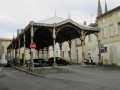
(1) This vital trading centre has been listed in the land registry since 1672. Here we see its last19th-century cast iron market hall.
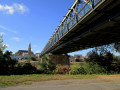
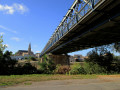
(2) Crossing the river at Branne dates back to the time of the barbarian invasions; until the17th century, people crossed on a pontoon bridge, then on a wooden suspension bridge built inthe 19th century.
In 1911, it was joined by the Eiffel Bridge, which was destroyed by the retreating German army on 24 August 1944.
It was rebuilt and widened after the war, taking on the appearance we know today.
Since you are "close by", take the time to observe the technical aspects of the structure...
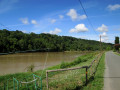
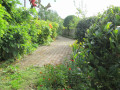
All along the 3,500 metres that run alongside the river, on your right you will see a succession of pleasant holiday homes, vineyards, meadows, crops and fallow land.
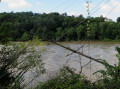
On the left, on the water side, there are beautiful views of the opposite banks. You can also see numerous carrelets (fishermen's huts), most of which are unfortunately disused.
About 2 km from the start, between Grange Neuve and Lacayot and at the top of the wooded hillsides, you will see Château Montlau. At this location, formerly known as "Mont des Lauriers" (Mount of Laurels), there are Gallo-Roman remains on which a fortified castle was built during the English occupation. Today, we can see the result of centuries of incessant work.
The estate now produces an excellent Bordeaux Supérieur AOP wine.
Finally, if you are lucky, depending on the time of day, you may encounter the "mascaret", a wave formed by the meeting of the natural downstream current and the rising tide, which leaves behind striking ripples. The phenomenon subsides shortly after Branne, 135 km from the ocean...
The return journey by land is a peaceful stroll through unspoilt countryside, with nothing to obstruct the view...



 06/06/2024: Hike modified between 8 and 10.


 Country:
 City:
City:



 .
. Visorando Member

 Moderate
  Tourist office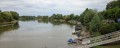
 Difficult