The Chemin Carriès

Marked trail No. 40
Taking this path is to step into the life and work of Jean-Joseph Carriès. This trail begins with the history of pottery and ends with a sunken path lined with works by ceramicists and the potters’ quarters in the village of Saint-Amand-en-Puisaye.

Details

2251354
Creation:
Last update:
Last review:
  • Walking
    Activity: Walking
  • ↔
    Distance: 8.29 km
  • ◔
    Average duration: 2h 30 
  • ▲
    Difficulty: Easy

  • ⚐
    Back to start: Yes
  • ↗
    Ascent: + 51 m
  • ↘
    Descent: - 44 m

  • ▲
    Highest point: 212 m
  • ▼
    Lowest point: 170 m

Description of the walk

The route starts at Place de la Liberté (Tourist Office).

(S/E) Set off along Avenue de la Gare, lined with plane trees. At the fire station, turn right, walk alongside a small pond following Chemin du Tacot. Join Route de Cosne at the western exit of Saint-Amand-en-Puisaye.

(1) Cross this road with care. Immediately take the path on the left, then turn straight onto the one on the right. Shortly afterwards, you’ll reach Route de Donzy; turn left.

(2) At the electricity pylon, turn right and follow the path through the coppice. Just before the garage, turn left and you’ll come out onto the D955.

(3) Head left , keeping to the left-hand verge. At the first junction, turn left and enter the hamlet of Les Mottes. At the crossroads, turn right. Walk past the old Les Mottes pottery with its chimney on your left.

(4) At the junction with the D955, cross with care, turn left and then immediately right towards Argenoux. Walk through this hamlet, keeping to the main road. Cross the bridge over the Vrille and turn left onto the first path. Walk past a lovely pond, then turn right.

(5) Cross the D957 with care and head up the Chemin de la Chapelle towards Biron Blanc.

(6) At the junction with side paths, take the one on the right and follow it down, flanked by hedges. It widens as it continues and leads to Les Lamberts.

(7) Continue straight ahead along the tarmac road, ignoring the side roads branching off to the right and left. After about 200m, the road ends in a sunken lane lined with hedges and pollarded trees.

(8) Cross the road and take the path opposite to reach another road, which you cross by making a slight left/right turn. Continue along the path. At the Carrefour des Potiers (artists’ works), go straight on. Cross a tarmac road and pass a hut housing collections of press cuttings.
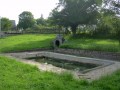
Cross the Ruisseau de la Maladrerie (old wash house on the left).

(9) Cross the D2 with care and head towards Rue Creuse, almost directly opposite. Turn into the first street on the left (Rue des Anseuses). At the junction with Faubourg des Potiers, go down to the right.
At the main crossroads (Carrefour Carriès), cross with care to reach the Grande Rue. Cross the first branch of the river and then the Vrille to return to the starting point (S/E).

Waypoints

  1. S/E : km 0 - alt. 178 m - Office de Tourisme de Saint-Amand-en-Puisaye
  2. 1 : km 1.27 - alt. 178 m - Route de Cosne
  3. 2 : km 1.99 - alt. 193 m - Sunken path under coppice
  4. 3 : km 2.52 - alt. 192 m - Junction with the D955 (garage on the right-hand side)
  5. 4 : km 3.09 - alt. 182 m - Former Les Mottes pottery on the left-hand side
  6. 5 : km 4.96 - alt. 176 m - Turn onto the D957 after crossing the - La Vrille
  7. 6 : km 5.12 - alt. 182 m - Crossroads
  8. 7 : km 5.65 - alt. 200 m - Exit onto the Route des Lamberts
  9. 8 : km 6.33 - alt. 201 m - Junction with a tarmac road
  10. 9 : km 7.69 - alt. 182 m - Junction with the D2
  11. S/E : km 8.29 - alt. 178 m - Musée du grès de Saint-Amand-en-Puisaye

Notes

It is best to undertake this route outside of very wet periods. Sections between (6 and 9) are slippery in places due to the presence of mud.
Numerous artworks are installed along the route; please treat them with the utmost respect, even if time has caused some damage.
From (6), it is possible to make a return trip to the hamlet of Montriveau to visit the house where Joseph Carriès once lived. To do this, at this crossroads, turn left; on the D957, keep to the right-hand verge and head up towards Lieu du Puits. Just before the Y-junction, turn left onto the track to reach a road which, after turning left, descends to Montriveau. The house is the last one on the left.

This signposted route, following the signposting guidelines of the Puisaye-Forterre Community of Communes, is marked with the number 40 on yellow-backed signs. It was created by the association À chacun son chemin en Puisaye-Forterre in December 2019.
If you encounter any issues, please complete this questionnaire (it only takes a few minutes).
Take care when crossing roads.
However, as the route is signposted, you must set off with at least this description and the accompanying IGN map or the Visorando app.

Worth a visit

The son of a cobbler, Jean-Joseph Carriès was orphaned in 1861 at the age of six. He began his apprenticeship as a modeller and engraver with Pierre Vermare, a sculptor of religious objects, in 1868.
He moved to Paris in January 1874, where he became a temporary pupil of Auguste Dumont and received guidance from Alexandre Falguière and Henri Lehmann.

Time Unveiling the Hours (1874), pediment of the Château de Meslay-le-Vidame
The Count of Brimont commissioned him to create a pediment for his Château de Meslay-le-Vidame. This bas-relief, Time Unveiling the Hours, was co-created with Jean-Alexandre Pézieux; Carriès sculpted the figure of Time and Pézieux created that of the Hours.

1875–1888: Parisian portraits
During this period, Carriès worked in series, preferring to model busts; following his series of The Desperate Ones, he produced Baby Heads, then historical figures (Frans Hals, Velázquez, Loyse Labé…).

The 1881 Salon enabled Carriès to make a name for himself. By exhibiting the dramatic decapitated head of Charles I, he was awarded an honourable mention.

In 1882, he exhibited his busts from the ‘Déshérités’ series in plaster, enhanced with skilful patinas.

At the 1883 Salon, he exhibited *The Bishop*, which was also a success and received an honourable mention. This bust, along with that of Charles I, was cast in bronze and acquired by the State in 1889.

Between 1886 and 1887, the German-Swiss painter Louise Catherine Breslau painted Carriès’s most famous portrait, Portrait of Jean Carriès in his Studio, now on display at the Petit-Palais in Paris.

1888–1894: the decisive influence of the Puisaye
By the autumn of 1888, Carriès had achieved sufficient financial independence to allow him to devote himself primarily to perfecting the complex firing process for glazed stoneware: ‘this male of porcelain’, as he called it. The artist set up a studio in Saint-Amand-en-Puisaye, a town renowned for its clay and its potters.

From 1888–1889, he applied these colour effects to numerous versions of his earlier ceramic portraits and to an ever-expanding repertoire of self-portraits, animals and fantastical masks inspired by Gothic sculpture and Japanese art.

In January 1889, he organised his first exhibition of stoneware in his studio in Paris; the cultured Parisian elite attended.

In 1892, Carriès displayed glazed stoneware in a shop window, combining ceramic sculptures and pottery. By exhibiting over 130 pieces—some of which were taken from the Porte de Parsifal—at the Salon of the Société nationale des beaux-arts, the sculptor-ceramist earned widespread acclaim, which led to his being appointed a Knight of the Legion of Honour on 19 July 1892.
Subsequently, the State decided to purchase twelve stoneware pieces from him for the Musée du Luxembourg and the Musée de Sèvres. The City of Paris also acquired six vases and a sculpture for the Musée Galliera.
Excerpts from Wikipedia.

Reviews and comments

4.5 / 5
Based on 5 reviews

Reliability of the description
4.6 / 5
Ease of following the route
4.2 / 5
Route interest
4.6 / 5
Feanturi
Feanturi
• Edited:

Overall rating : 4.3 / 5

Date of your route : Jan 25, 2026
Reliability of the description : ★★★★☆ Good
Ease of following the route : ★★★★☆ Good
Route interest : ★★★★★ Very good
Very busy route : Yes

A very pleasant hike in Puisaye, revealing hidden little paths. A pretty little cottage in a place called Les Mottes. After that, the path above Les Lamberts was very wet, but this drawback was mentioned in the description and it is Puisaye, so no surprise there. To be repeated in drier weather. However, it is true that for those who do not know the area, the signposting on the path to the Forge pond may be poorly placed. It is quite high up on the concrete electricity pylon, which is not immediately obvious. It is easy to mistake the entrance to the path for the entrance to a field. I have been coming to this area for years and had never noticed that a path started there. I had to look at the VisoRando route to find out.

Machine-translated

marchorando
marchorando

Overall rating : 4 / 5

Date of your route : Mar 03, 2025
Reliability of the description : ★★★★★ Very good
Ease of following the route : ★★★☆☆ Average
Route interest : ★★★★☆ Good
Very busy route : No

To complete this route, you need to choose the right season. At the moment, much of the section between points 6 and 7 is nothing but mud and water. Even with the right kit, it’s not as enjoyable as when the ground is dry. And unfortunately, the artworks that used to be on display along the paths are either neglected or have disappeared.
Otherwise, the route is pleasant, the countryside is unspoilt and the atmosphere is peaceful and relaxing.

Machine-translated

minescape
minescape
• Edited:

Overall rating : 4.7 / 5

Date of your route : Jun 19, 2022
Reliability of the description : ★★★★★ Very good
Ease of following the route : ★★★★★ Very good
Route interest : ★★★★☆ Good
Very busy route : No

A lovely walking route that’s mostly in the shade.
Along the path, you’ll find a few artistic gems carved from sandstone.
There is a beautiful wash house.
On this route, you must take great care near major roads as they are very busy.

Machine-translated

Dominique Durin
Dominique Durin

Overall rating : 5 / 5

Date of your route : Jun 14, 2021
Reliability of the description : ★★★★★ Very good
Ease of following the route : ★★★★★ Very good
Route interest : ★★★★★ Very good
Very busy route : No

A route that is particularly well suited to the region, thanks to both its natural surroundings and its pottery theme.

Machine-translated

thefoot
thefoot

Overall rating : 4.3 / 5

Date of your route : Sep 12, 2020
Reliability of the description : ★★★★☆ Good
Ease of following the route : ★★★★☆ Good
Route interest : ★★★★★ Very good
Very busy route : No

There is a deviation from the route as early as point 1, where we missed the suggested path. We stayed close to the pond, following its western bank – a very pleasant route, incidentally. We then passed through Les Perchers, Le Champ du Bois, Les Prés Varennes and Les Beaux-Arts to rejoin the Chemin Carriès route. This detour adds nearly 3 km to the journey but is not without its charms.
It’s also not easy to find the path once past the Chapel, which is obscured on the map by checkpoints 5 and 6. You must absolutely avoid the road towards Les Savois, which adds nearly a kilometre to the route, is uphill, and is of no interest whatsoever.
All in all, a 3½-hour walk instead of 2½ hours, leaving us with lovely memories. We passed through a beautiful sunken lane with a few yew trees, unfortunately not maintained and which will collapse one after the other if they are not pollarded soon. A huge nest of ‘cabro’ hornets (not the ‘orange-legged’ variety mistakenly nicknamed the ‘Asian hornet’), perched 4 metres high in a majestic tree trunk, reminds us of nature’s delicate balance!

Machine-translated

Other walks in the area

For more walks, use our search engine .

The GPS track and description are the property of this route's author. Please do not copy them without permission.