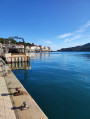
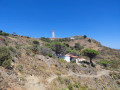
Cap Béar and Anse de Paulilles from Port-Vendres

A hike starting from the Port-Vendres pier, which leads along the coastal path to Cap Béar and then on to the listed site of Anse de Paulilles (Nobel factory). The return journey is inland, through the vineyards. A more detailed tour of Port-Vendres takes in the railway station and the fishing, commercial and yachting ports, not forgetting the Fort du Fanal and the Batterie de la Mauresque at Cap Gros, before skirting around the Redoute Béar and the Batterie de Mailly.

⚠️Check whether the coastal path linking Argelès-sur-Mer to Cerbère is open or closed here before starting this hike.

Details

14074183
Creation:
Last update:
Last review:
  • Walking
    Activity: Walking
  • ↔
    Distance: 16.81 km
  • ◔
    Average duration: 6h 05 
  • ▲
    Difficulty: Moderate

  • ⚐
    Back to start: Yes
  • ↗
    Ascent: + 453 m
  • ↘
    Descent: - 447 m

  • ▲
    Highest point: 109 m
  • ▼
    Lowest point: -1 m

Photos

Description of the walk

Go to Port-Vendres via the dual carriageway. At the entrance to Port-Vendres, follow the signs for the commercial port and the gendarmerie, then take the Route de la Jetée to the beach car park, after the Batterie de Mailly but before the jetty.

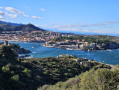
(S/E) Go back a few metres and climb the steep, signposted redoute trail on the left, which starts to the right of the lighthouse house. Turn around to take in Port-Vendres, the hinterland and the harbour opening onto the sea. Continue along the marked path that runs alongside the Cap Béar road (guide on the left) until you cross it carefully, then follow it for about 40 metres before continuing on the right along the original path, which climbs steeply in places (towards the Cap Béar lighthouse). Follow it for a long way until you approach a rocky outcrop. At the crossroads, directly below a power line, turn left.

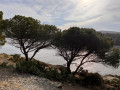
(1) Head towards Cap Béar and its semaphore (military terrain). Cross the road carefully and go around it on the left (German bunker on the right). This will take you to the road overlooking the sea, then to the Cap Béar lighthouse and, at its tip, the ruins of old military buildings.
Retrace your steps back to the road.

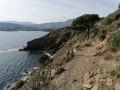
(2) Descend to the left, continuing along the marked coastal path towards Anse Santa Catarina (towards Anse de Paulilles). Continue along this path, which alternates between ascents and descents overlooking the sea, until you reach the small Balanti Beach. Continue along the path (with the sea on your left) until you reach Bernardi Beach, which is larger and more accessible. Cross the beach from one side to the other.

(3) At its southern end, still on the coastal path, go up and around the old Nobel factory buildings and descend towards Anse de Paulilles. Cross the Rec de Cosprons via the metal bridge and approach the sea either by walking on Paulilles Beach or via the footbridge created to keep your feet dry.

(4) The Nobel factory property, or what remains of it, can be visited by strolling from one restored building to another, passing through the gardens and the museum. Leave this public park via the museum, heading towards the outdoor car park on the other side of the D914.

(5) Take the tunnel to pass under the road. Turn left to cross the large car park (dedicated to visitors to the site and the busy beach) so that, at its southern end, you pass along the Rec de Cosprons, under the railway bridge. Head inland towards the mountains, through the often dry ravine on the right. Shortly afterwards, turn right (towards Coll del Mitg).

(6) Climb northwards along a stony path through the vineyards, following the marked trail. It joins the D86a road linking Anse de Paulilles to Cosprons. Carefully cross this road and continue straight ahead. After 100 m, keep to the right (cairn and yellow markings). The path climbs northwards towards Puig de Les Cabreres. Carefully cross a tarmac road serving the vineyards, keeping to the left for a few metres before turning onto the path on the right (buried cistern).

(7) Follow it straight ahead until you reach Coll del Mitg. Carefully cross another tarmac road. View overlooking Port-Vendres. Descend opposite on a grassy path that marks the boundary of a residential area, Mas Rovira. Shortly after the last houses, at the yellow cross, turn left to reach Rue Ramio, which serves this neighbourhood.

(8) Descend the street on the left-hand pavement to the lower roundabout, which temporarily ends the Perpignan-Port-Vendres four-lane road. Go around it on the right. Cross carefully at the pedestrian crossing. (Please note: road works since March 2022 for the continuation of the road to Banyuls-sur-Mer).

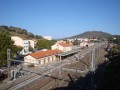
(9) The marked trail starts on the left and runs along the top of the railway tracks (guide on the right) before diving under them and then returning to the right to the SNCF station via Route du Val de Pinte.

(10) Head towards the town centre before turning left to climb the Route Stratégique.

(11) When it turns left, turn right onto a descending pedestrian lane that cuts through houses, crosses three streets, and then reaches a shaded square. It continues along the extension via wide steps towards the marina and leads to a large roundabout.

(12) Continue straight ahead to Quai François Joly and turn left. Walk along the marina via Quai Pierre Forgas and then Quai Jean Moulin, which continues to the left. Go around the fishing port and walk along Quais de l'Artillerie and Quais du Fanal until you reach the entrance to the fish market. Cross the road carefully and turn left onto Rue Mitjaville.

(13) After 100 m, turn right onto Rue Arago (or Route de la Miranda). Walk along the entire length of the street on the right-hand pavement (sea side) until you reach Fort Vauban du Fanal and the statue of the Virgin and Child.

(14) Take your time, as this is a beautiful viewpoint. Retrace your steps along Route de la Miranda until it turns sharply left. Then turn right and climb the marked path towards Anse de La Mauresque, overlooking the sea, until you reach Cap Gros (former Mauresque fort).

(15) Walk around the battery of the same name (ancient and more recent remains). Retrace your steps until you reach the Route de la Miranda towards the town centre. Then walk down Rue Arago, overlooking Quai du Fanal. Carefully cross the streets to return and go around the port via the quays mentioned above, until you reach the commercial port on the other side via Quai de la République.

(16) Leave the quays and walk along the pavement (Quai de la République) which leads to the commercial port warehouses. Go around the roundabout on the right (footpath) until you cross a railway line further on. At this point, turn left and walk along the port fence (guide on the left). When you reach another roundabout, go around it on the right, then leave the street leading to the police station on your right. Continue on the pavement on the left of Route de la Jetée. After the motorhome car park, at a fork in the road, turn right onto the footpath.

(17) This seafront path goes around the Redoute Béar (path leading to it on the right) towards Anse Cristina. It then joins the road after the tunnels, then heads back towards the sea to go around the Batterie Mailly. It ends at Chemin du Mole (or Route de la Jetée), which leads back to the left to the car park (S/E).

Waypoints

  1. S/E : km 0 - alt. 3 m - Beach car park - Batterie Mailly
  2. 1 : km 1.21 - alt. 109 m - Crossroads
  3. 2 : km 2.72 - alt. 57 m - Cap Béar - Phare de Béar
  4. 3 : km 5.1 - alt. 3 m - Bernardi Beach
  5. 4 : km 5.75 - alt. 3 m - Paulilles Beach
  6. 5 : km 6.73 - alt. 13 m - Passage under the D914
  7. 6 : km 7.18 - alt. 12 m - Crossroads
  8. 7 : km 8.22 - alt. 55 m - Road
  9. 8 : km 9.01 - alt. 60 m - Rue Ramio
  10. 9 : km 9.5 - alt. 26 m - Exit from roundabout
  11. 10 : km 10.11 - alt. 23 m - Gare de Port-Vendres
  12. 11 : km 10.33 - alt. 29 m - Path between houses
  13. 12 : km 10.54 - alt. 2 m - Quai Joly - Marina
  14. 13 : km 11.5 - alt. 1 m - Fishing port and fish market
  15. 14 : km 12.04 - alt. 12 m - Fort du Fanal
  16. 15 : km 12.89 - alt. 14 m - Blockhouse - Fort de la Mauresque
  17. 16 : km 14.91 - alt. 1 m - Commercial port
  18. 17 : km 16.06 - alt. 4 m - Redoute Béar
  19. S/E : km 16.81 - alt. 3 m - Beach car park - Batterie Mailly

Notes

Walking sticks are useful for ascents and descents along the coastal path.
Remember to stay hydrated in hot weather and to bring a hat.

Picnics are possible at Cap Béar, near and on the beaches of Balanti, Bernardi and Paulilles (shops and/or designated areas depending on the location), and at Cap Gros.

Stay on the marked trails (especially the coastal path). The environment is fragile.
Use the protected crossings when crossing roads and roundabouts.

Worth a visit

Port-Vendres has an illustrious maritime history, from antiquity to the present day. The village is said to have been founded by the Phoenicians during the 6th century BC and was the first trading port in Roussillon, used to connect the Western world to the Eastern world.
Its port is at the heart of the town. The only deep-water port in the department, it is now a marina, fishing port and commercial port, welcoming prestigious yachts and cruise ships, whose manoeuvres offer a unique spectacle every day.

- Cap Béar with the Béar Lighthouse - the Semaphore - the German defence installations:
The lighthouse was built in 1905 to replace the Fort Béar Lighthouse, which was considered too far from the shore and dated back to 1836. This building, made of pink marble from Villefranche-de-Conflent and granite, is located 79 metres above sea level and has a range of 58 miles, or approximately 52 kilometres. The lighthouse has been electrified since 1936. Previously, it ran on oil. Today, it is automated, with the light being switched on and off by a photodiode cell.
The radio beacon transmits Morse code signals, enabling sailors to determine their precise position at sea. It is equipped with a navigation system connected to a network of 24 satellites.
The semaphore was built in 1861. It is a military installation permanently manned by three sailors.

- Bernardi Beach in Port-Vendres is one of the must-see coves on the Côte Vermeille. It is located in Paulilles Bay, next to two other coves. The environment is typical of this part of the Pyrénées Orientales, with rugged coastlines set against a backdrop of vineyards.

- Listed site of Anse de Paulilles with the dynamite factory - the Catalan boat workshop - the site house (museum) - the 17-hectare landscaped park - old moulds and metal parts from the dynamite factory - the old residue furnace - the landscaped garden.
This former dynamite factory, established on the Côte Vermeille by Alfred Nobel and his partner Paul Barbe in 1870, was a major industrial production site for over a century: hundreds of workers, thousands of tonnes of dynamite, a church, a school, shops...
Today, seven of the factory's 32 buildings are open to the public, allowing visitors to enjoy this exceptional industrial heritage.

- Port-Vendres railway station: built in 1867 and opened in 1878 by the Compagnie des chemins de fer du Midi et du Canal latéral à la Garonne.

- The Vauban forts: along with the Fanal and Presqu'île redoubts, the Béar redoubt is part of a set of three fortifications built to defend Port-Vendres in the 1690s. Built opposite each other on natural promontories, the two redoubts of Le Fanal and Béar defended access to the port, construction of which began in 1680. The back of the cove sheltering the port was defended by the Redoute de la Presqu’île, also built on a promontory.
At the foot of the Béar redoubt stands a monument dedicated to the African Army.

- The Mauresque Battery at Cap Gros: The first fort is thought to have been built at the end of the 15th century, under Spanish rule. Following the Guerra Gran, which ended in 1794 with Dugommier's recapture of Fort Saint-Elme, the need to fortify the coast and secure access to the military port of Port-Vendres became apparent.
At the tip of Cap Gros, Fort de la Mauresque was built around 1850. It was equipped with a battery of 10 guns manned by 20 men. Today, only three arches opening onto the sea remain at Fort de la Mauresque.
After the successful American landings in Morocco and Algeria in November 1942, the German high command decided to strengthen the defences of the Mediterranean ports. At Cap Gros, less than 10 km from the Spanish border, there was a French battery (La Mauresque) dating from 1848. The four original French 75 mm guns were replaced by German 127 mm guns, protected in bunkers, and a 65 mm gun, also placed in a bunker. As Port-Vendres was one of only two ports in the region, the German navy undertook to reinforce this strategic position.

- The commercial port: Although dormant, despite still being used in the Middle Ages, the port began to develop again in the 18th century. Today, it is the second largest fruit port in France in the Mediterranean because:
. it is close to North Africa, offering the shortest crossing in sheltered waters;
. it is connected to motorways and combined rail-road transport terminals (Perpignan and Boulou);
. it is located 25 km from Saint-Charles International, Europe's leading distribution centre for imported fruit and vegetables, with a volume of 1,400,000 tonnes per year.

- The Mailly redoubt was built in 1775 by the Count of Mailly (Augustin-Joseph de Mailly) following subsidies from Louis XVI to improve and dig out the port. It is located opposite the Redoute du Fanal (listed as a historic monument in 1933). Overlooking Port-Vendres Bay above Tamarins Beach, in the 1930s it was home to the Mailly Holiday Camp, run by the Federation of Secular and Republican Youth for holiday camps and physical and moral education. It was destroyed on 19 August 1944 by the Germans (19th German Army) who were fleeing the region after occupying it since November 1942 and blew up their ammunition depots and numerous sea mines, destroying almost the entire town. The Mailly redoubt was listed as a historic monument in 1991.

Reviews and comments

4.7 / 5
Based on 9 reviews

Reliability of the description
4.7 / 5
Ease of following the route
4.8 / 5
Route interest
4.6 / 5
Fabrice Passat
Fabrice Passat

Overall rating : 5 / 5

Date of your route : Oct 13, 2025
Reliability of the description : ★★★★★ Very good
Ease of following the route : ★★★★★ Very good
Route interest : ★★★★★ Very good
Very busy route : Yes

great information!

Machine-translated

RICOUT
RICOUT

Overall rating : 4.3 / 5

Date of your route : Jan 21, 2025
Reliability of the description : ★★★★☆ Good
Ease of following the route : ★★★★★ Very good
Route interest : ★★★★☆ Good
Very busy route : No

Hike done in good weather with no wind. Departure from Cap-Bear to Paulilles beach. We avoid the section through the centre of Port-Vendres, which is currently under construction, and the sea is beautiful! The little "hamlet" by the sea at the foot of Cap-Bear is worth a visit in its own right. The trail then follows the coastline with a few slightly dizzying passages. A handrail has been installed, but it is only there to reassure those who are not too sure-footed. Therefore, avoid this trail with young children and on windy days! There are a few coves along the way. Allow 4 hours for the round trip.

Machine-translated

RPodor
RPodor

Overall rating : 4.7 / 5

Date of your route : Apr 23, 2024
Reliability of the description : ★★★★★ Very good
Ease of following the route : ★★★★★ Very good
Route interest : ★★★★☆ Good
Very busy route : No

Hike undertaken in VERY strong winds. Impossible to reach the end of Cape Bear. The hike is rather uneven in terms of interest. Crossing Port-Vendre is not particularly interesting and takes quite a long time. Otherwise, the scenery is magnificent and quickly makes you forget the time spent in the town.

Machine-translated

jlram49
jlram49

Overall rating : 5 / 5

Date of your route : Oct 30, 2023
Reliability of the description : ★★★★★ Very good
Ease of following the route : ★★★★★ Very good
Route interest : ★★★★★ Very good
Very busy route : Yes

The scenery is superb and the route is very well signposted, making it easy to follow. We just did it today in glorious weather.

Machine-translated

Marmotte66
Marmotte66

Overall rating : 3.7 / 5

Date of your route : Feb 27, 2023
Reliability of the description : ★★★★☆ Good
Ease of following the route : ★★★★☆ Good
Route interest : ★★★☆☆ Average
Very busy route : No

Machine-translated

PAT le lion
PAT le lion

Overall rating : 5 / 5

Date of your route : Oct 19, 2022
Reliability of the description : ★★★★★ Very good
Ease of following the route : ★★★★★ Very good
Route interest : ★★★★★ Very good
Very busy route : Yes

A beautiful parish-specific coastal route to Paulille and back through the vineyards.

Machine-translated

ALAINVERO
ALAINVERO

Overall rating : 4.3 / 5

Date of your route : Sep 09, 2022
Reliability of the description : ★★★★☆ Good
Ease of following the route : ★★★★☆ Good
Route interest : ★★★★★ Very good
Very busy route : Yes

Hello,
We are not hiking experts and thought this would be a hike similar to Le Racou in Collioure, i.e. easy, without any major climbs. We found the route from the lighthouse to Paulilles beach quite difficult due to the long, stony climbs. What's more, we set off at 11am instead of 9am and it was hot. Fortunately, the two litres of water we brought with us were enough. Apart from that, the walk is magnificent, with crystal-clear sea. A picnic on a small beach with a swim was a must.

Machine-translated

RL30260
RL30260

Overall rating : 5 / 5

Date of your route : Aug 21, 2022
Reliability of the description : ★★★★★ Very good
Ease of following the route : ★★★★★ Very good
Route interest : ★★★★★ Very good
Very busy route : Yes

If you want to avoid a complete round trip on this route, there is a slight variation that shortens the return journey. Starting from Valenti beach, take a path that climbs straight up to the ridge, then follow a track to the left for a short while and take another path that passes under Fort Béar. You will then rejoin the path you took on the way out.
It is best to set off early in the morning or on a day when the tramontane wind is blowing in summer.

Machine-translated

Bärble
Bärble
• Edited:

Overall rating : 5 / 5

Date of your route : Jul 12, 2022
Reliability of the description : ★★★★★ Very good
Ease of following the route : ★★★★★ Very good
Route interest : ★★★★★ Very good
Very busy route : No

We only did the magnificent first part to Paulilles, from where we returned to Port Vendres by bus. Buses run frequently. Then we continued on to the section from the quays to the car park.
It is entirely possible to do this hike in summer if you set off early.
We took advantage of the many opportunities to swim in the pretty coves and didn't want to face the heat of the inland areas in the afternoon. We'll save that for another time, in winter for example.

Machine-translated

Other walks in the area

For more walks, use our search engine .

The GPS track and description are the property of this route's author. Please do not copy them without permission.