Country:
 City:
City:


Starting point and access: Paris-Est station.
- Metro – Lines 4, 5, 7. Take Exit 6 onto Boulevard de Strasbourg.
- Transilien – Line P. Take the main exit onto Rue du 8 Mai 1945.
- Bus – Lines 31, 32, 38, 39, 46, 54, 56, 91.
The main animal depictions and key features to look out for are highlighted in italics within the description.
(S) As you exit the metro station, head straight along Boulevard de Strasbourg. Walk past the base of Saint-Laurent Church and, at the corner, turn left into the square of the same name (on the right, a wooden structure ending in what appears to be a wolf’s head). Cross the square and walk past a sculpture called “Brother and Sister”, dating from 1897. At the other end, cross Rue du Faubourg Saint-Martin (be careful, there’s no pedestrian crossing here) and head straight into the Passage des Récollets opposite. On the wall to your left, a mural imitates the cave engravings of Lascaux (aurochs, bison, horses, etc.).
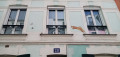
When the street bends to the left, turn right, go down a flight of steps and pass under a porch. On the other side, continue straight on into the Passage Dubail. At the end, turn left onto Rue des Vinaigriers. At the junction, turn left into Rue Lucien Sampaix and walk slightly uphill. At No. 35, there is an Art Deco-style building (1934) and, at No. 41, a former Art Nouveau-style dispensary (1908) with a ceramic-clad façade. At the end, turn right and head towards the banks of the Canal Saint-Martin.
(1) Turn right and walk along the canal on your left. After about fifty metres, take the footbridge over the canal (a lovely view on both sides). On the other side, head right along the Quai de Jemmapes. Walk past the Récollets lock on your right and pass by the Hôtel du Nord, which gave its name to a famous 1938 film by Marcel Carné. Cross the Rue de la Grange aux Belles on your left (wall mural featuring dogs) and continue along the canal.
Take the second left, Rue Alibert. At the junction, turn right into Rue Bichat. Take the first left, Rue Jacques Louvel-Tessier, and follow it to the junction with Rue d’Aix, on the right-hand side.
(2) Walk a little further along Rue Jacques Louvel-Tessier to see a mural featuring characters from comics and cartoon strips. Look out for a duck-shaped buoy, a cat, a rabbit and a bear (Baloo from The Jungle Book)... Retrace your steps to the previous junction.
(2) Turn into Rue d’Aix, which is also adorned with murals. At the end, turn left onto Rue du Faubourg du Temple. At the traffic lights, cross Avenue Parmentier. Continue straight on along the bustling shopping street, Rue du Faubourg du Temple. At No. 105, note the Palais du Commerce, an Art Deco-style shopping arcade dating from 1924. After No. 102, turn right into Rue Robert Houdin. Just after passing under an archway, look out for a mural on the left depicting a flamingo.
At the end of the street, go under a portico, cross Rue de l’Orillon and continue straight ahead into Rue Desargues. At the end of this street, turn right onto Rue de la Fontaine au Roi. Keep going straight ahead, crossing Rue Morand and then Rue Saint-Maur in turn. Look out for several murals on the left-hand side, including one depicting a bird. Cross Avenue Parmentier at the traffic lights.
(3) Follow the avenue to the left. At the next junction, turn right into Rue des Trois Bornes. At No. 9 is the birthplace of the painter Alfred Sisley (1839–1899). At No. 2, there is a mural depicting a ‘rosette’ of ostrich feathers. Walk past a small square featuring the Wallace Fountain (with fish and scallop shells). At the traffic lights, turn left to cross Rue Jean-Pierre Timbaud, then right to cross Avenue de la République (where a large bird is painted on a shop window).
On the other side, first turn left then right onto Rue Gambey. At the end, turn right onto Rue Oberkampf (public baths on the left-hand side). Cross Rue de la Folie-Méricourt, then Boulevard Richard-Lenoir in two stages.
(4) Follow the boulevard to the left. At the traffic lights, turn right to cross Boulevard Voltaire opposite the Bataclan (commemorative plaque honouring the victims of the 13 November 2015 attack). First turn left then right to enter Passage Saint-Pierre Amelot. At the end, go under an archway and turn left onto Rue Amelot.
(5) Take the first left into Passage Saint-Sébastien. Walk a few metres to see some murals, including one featuring an elk’s head and another with a pigeon whose head has been replaced by a camera lens. Retrace your steps.
(5) Continue along Rue Amelot (on the left as you return from the passage) and take the first left, Rue Saint-Sébastien. Then take the first right, Rue Alphonse Baudin. At the end, turn right onto Rue Pelée. After a mural featuring a dog, the street narrows. You’ll come out onto Rue Saint-Sabin; follow it to the left. Ignore the narrow streets and dead ends on the left and note the rooster on the metal gate at No. 60.
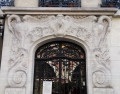
(6) Pass the Passage Sainte-Anne-Popincourt on your left and continue to No. 39 Rue Saint-Sabin to see a townhouse dating from 1909 with a richly decorated façade. Retrace your steps.
(6) Go under the archway at No. 42 and enter the Passage Sainte-Anne-Popincourt. Continue straight ahead until you reach Boulevard Richard-Lenoir, then turn right at an acute angle. At the traffic lights, cross Rue du Chemin Vert, then turn left to cross the boulevard in two stages (at Nos. 42 and42bis, a building dating from 1906 with a façade decorated in the Art Nouveau style). Follow Rue du Chemin Vert for a few more metres and turn right into Rue Froment (gate framed by two caduceus symbols between nos. 19 and17bis).
Carry on straight ahead, cross Rue Sedaine and continue along Rue du Commandant Lamy. At the end, turn left onto Rue de la Roquette and pass the entrance to the Church of Notre-Dame de l’Espérance on your left, then the Fontaine de la Roquette (1846) on your right (small lion-headed mascarons and ‘dolphins’ framing the coat of arms of the City of Paris).
(7) Pass the Passage Charles Dallery on your right and continue to No. 71 Rue de la Roquette to see the gateway to the former Pavillon de Plaisance (18th century). Opposite, at No. 98, note the metal ornamentation featuring two eagles. Retrace your steps.
(7) Enter the Passage Charles Dallery and walk alongside a square on your right. At the end, cross Avenue Ledru-Rolin and continue straight ahead along the Passage Charles Dallery. Pass the Passage Rauch on your left and note the mosaic depicting a rhinoceros above the gateway at No. 1.
Continue along the Passage Charles Dallery. You’ll emerge onto Rue de Charonne; first turn right then left to cross it and enter the Passage de la Main d’Or. Note a bas-relief depicting a cabinetmaker at No. 18, followed by a sign featuring a goat. Cross Rue de la Main d’Or on your left, continue straight ahead and pass under a portico.
(8) Cross Rue du Faubourg Saint-Antoine and continue opposite into Rue Charles Beaudelaire, walking alongside a square on your right. From No. 24 toNo. 26bis, there are buildings with façades richly decorated with sculptures by Georges Ardouin; next, a gateway surmounted by a lion-headed mascaron. Cross Rue Théophile Roussel and continue along Rue Charles Baudelaire, which is now a pedestrian street.
Further on, cross Rue de Chareton and continue along Rue Abel. Pass under a former railway viaduct, which now forms part of the René Dumont Green Corridor. On the other side, cross Avenue Daumesnil at the traffic lights.
(9) Follow the avenue to the right. At No. 30, there is an Art Nouveau-style gate featuring reeds and wading birds (probably herons). Next, you’ll see lion-headed mascarons. At the traffic lights, take the second left onto Rue Traversière. At the next set of traffic lights, cross Rue de Lyon and follow it to the right (there arenumerous lion heads high up along the entire façade of the building on the left-hand side).
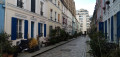
(10) Take the first left onto Rue Crémieux, lined with houses featuring facades in a variety of colours. At No. 28, there are geese by the door and a cat leaping from a window in pursuit of small birds. At No. 16, there is a cat by the door and a small lion’s head serving as a doorstop.
At the end (with a trompe-l’œil high up on the left), turn right onto Rue de Bercy. At the traffic lights, turn left onto Avenue Ledru-Rollin. At the end, cross the Quai de la Rapée in two stages.
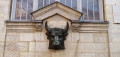
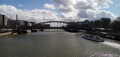
(11) Cross the Seine via the Pont d’Austerlitz. Note the metal Austerlitz viaduct on the left, which carries metro line 5. The viaduct rests on four stone piers, the tops of which are adorned with bovine heads that can be seen with the naked eye from the bridge (and are unmistakable with binoculars, as well as when travelling over the viaduct on the metro itself).
On the other side, make your way across Place Valhubert as best you can (there has been construction work here for a long time and it is expected to continue for some time). Take Boulevard de l’Hôpital and you will soon reach the metro or RER entrances at Austerlitz station (E).
To get back home:
- Metro – Line 5 or 10.
- RER – Line C.
- Bus – Routes 24, 57, 61, 63, 89, 91, 215.

 Visorando Member