Green spaces in the 10th arrondissement of Paris

The 10th arrondissement of Paris is characterised by a working-class, cosmopolitan and very lively atmosphere, marked by the presence of the Gare du Nord and Gare de l’Est stations. A densely populated area, it mainly offers small local green spaces. The largest gardens have often been created on former historic, railway or industrial sites, such as the Jardin Villemin or the Square Alban-Satragne. The Canal Saint-Martin, for its part, plays a major role by providing a green promenade and a central hub for socialising. Finally, there are a dozen community gardens and examples of community greening: tree bases and micro-gardens.

Details

36029343
Creation:
Last update:
Last review:
  • Walking
    Activity: Walking
  • ↔
    Distance: 7.23 km
  • ◔
    Average duration: 2h 10 
  • ▲
    Difficulty: Easy

  • ⚐
    Back to start: No
  • ↗
    Ascent: + 23 m
  • ↘
    Descent: - 10 m

  • ▲
    Highest point: 62 m
  • ▼
    Lowest point: 37 m
  • ⚐ Country: France
  • ⚐ City: Paris (75000)
  • ⚑
    Start: N 48.867874° / E 2.364527°
  • ⚑
    End: N 48.87015° / E 2.350519°
  • ❏
    IGN map(s): Ref. 2314OT
  • Hour-by-hour weather

Photos

Description of the walk

Departure from République Metro station – Lines 3, 5, 8, 9 and 11. Exit 4 “Rue du Faubourg du Temple”.

(S) Leave the metro via the right-hand exit. At the top of the stairs, continue straight ahead onto Rue du Faubourg du Temple. Once on the quayside, cross to the left at the pedestrian crossing and enter Square Lemaître opposite. Walk past the bust of Frédéric Lemaître on the left and take the path on the left. Walk to the end of the path and exit the square on the right onto Quai de Jemmapes. Turn left immediately. Pass the first footbridge immediately on your left (Passerelle des Douanes).

(1) At the next footbridge (Passerelle d’Alibert), turn right onto Rue Alibert and continue to a junction. Turn right onto Rue Bichat, then left onto Rue Jacques Louvel-Tessier. Cross Avenue Parmentier and Rue Saint-Maur, then continue straight ahead onto Rue du Buisson Saint-Louis. Pass the Passage du Buisson Saint-Louis on your left three times, then turn left onto Rue du Chalet. A little further on, turn right into the Jardin Blanche Hoschedé.

(2) Cross the garden and exit onto Rue Sambre et Meuse. Turn left, cross Avenue Claude Vellefaux and turn right into Square Juliette Dodu. Cross the square and exit onto Rue Juliette Dodu.

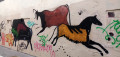
(3) Continue to the right, skirting a small triangular square on your left, cross Rue Vicq d'Azir then Rue de la Grange aux Belles. Continue straight ahead onto Rue des Écluses Saint-Martin, then take the small, artistically decorated pedestrian street Boy-Zelensky on your right. Follow this street and, when you reach a small square with a fountain in the centre, turn left, then enter Square Amadou-Hampâté-Bâ on the right.

(4) Cross the square; on leaving, go round the stadium below on the left and pass through a small gate. Go down four steps, pass a table tennis table on the right, and turn left into the pedestrian street, Georg Friedrich Haendel. At the end of the street, join the Quai de Jemmapes.

(5) Cross it at the pedestrian crossing set back to the left, then turn right and enter SquareHenri Christiné on the left. Go left and exit the square. Cross the canal via the Maria Casarès bridge and enter Square Eugène Varlin on the right. Go straight ahead, then exit the square at the far end on the left.

(6) Take Quai de Valmy on the left. At the traffic lights, turn right onto Rue Eugène Varlin, then left onto Rue Robert Blache, and a little further on, turn left into Square Madeleine Tribolati.

(7) Walk past a playground on your left and leave the square. Head back along Rue Blache to the left, passing under a block of flats. Turn immediately left to go round the green square, Place Raoul Follereau. Turn left into a pedestrian walkway, Avenue de Verdun. Continue along this, passing a central reservation on the right and, further on, the Bibliothèque Villemin on the left.

(8) Turn left into Parc Villemin.Take thefirst path on the left. At the three-way junction, take the path on the right, then the paved path on the left, opposite the playground.
Continue along a short wooden walkway that ends in large paving slabs. At the end, turn left then right, passing a large fountain on your right, then the bandstand on your left, and, before taking the exit opposite, walk around the picturesque community garden on your right. On leaving the park, turn right onto Quai de Valmy, following the canal on your left. Turn
leftinto Square des Récollets.

(9) Walk around the square, leave it and head back onto Quai de Valmy on the left. Turn right onto Rue des Vinaigriers, going down a flight of steps in front of a mural. Cross Rue Lucien Sampaix then turn right onto Passage Dubail. Follow this passageway, which turns left and joins Rue du Faubourg Saint-Martin. Turn left to cross Rue du Faubourg Saint-Martin at the pedestrian crossing, then right to find Square Saint-Laurent a little further on to the left.
Cross the square and exit onto Boulevard Magenta. Cross Boulevard Magenta at the pedestrian crossing on the left, then turn right to cross Boulevard de Strasbourg and turn left onto Rue de la Fidélité. Turn right onto Rue du Faubourg Saint-Denis, which slopes slightly upwards, and enter Square Alban Satragne on the left .

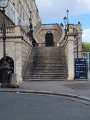
(10) Take the first path on the left, walk round the fountain, return towards the entrance, then turn left, keeping the games tables on your left, and exit onto Boulevard Magenta. Head left and cross the boulevard at the traffic lights, then cross Rue du 8 mai 1945 to the right and continue to the right. Turn left onto Rue d’Alsace. Climb the stairs, go straight on and enter the Jardin Marielle Franco on the right. Head left and take the exit further along on the left, using a footbridge to Rue d’Alsace. Continue straight ahead onto Rue de Dunkerque, then turn left onto Rue Lafayette. Cross Rue du Faubourg Saint-Denis, Rue de Saint-Quentin and Boulevard de Magenta, then turn right into Square Aristide Cavaillé-Coll.

(11) Walk around the square, exit to the right, cross Rue d’Abbeville, Place Franz Liszt and Rue Lafayette, then take the next right onto Rue d’Hauteville, which slopes downwards. Cross Rue Chabrol, Rue des Messageries, Rue de Paradis, Rue des Petites Écuries, Rue d’Enghien and turn left onto Rue de l’Échiquier. Opposite No. 28, turn right into the Jardin Yılmaz Güney. Walk through it and exit onto Impasse de Bonne Nouvelle. Turn right to reach Bonne Nouvelle metro station, lines 8 and 9 (E).

Waypoints

  1. S : km 0 - alt. 41 m - Metro - Place de la République (Paris)
  2. 1 : km 0.51 - alt. 45 m - Rue Alibert - Canal Saint-Martin
  3. 2 : km 1.44 - alt. 58 m - Blanche Hoschedé Garden
  4. 3 : km 1.92 - alt. 49 m - Rue Juliette Dodu
  5. 4 : km 2.23 - alt. 50 m - Amadou-Hampâté-Bâ Square
  6. 5 : km 2.42 - alt. 50 m - Quai de Jemmapes - Canal Saint-Martin
  7. 6 : km 2.68 - alt. 52 m - Quai de Valmy
  8. 7 : km 2.94 - alt. 51 m - Madeleine Tribolati Square
  9. 8 : km 3.35 - alt. 53 m - Villemin Park - Gare de Paris-Est
  10. 9 : km 3.78 - alt. 46 m - Square des Récollets
  11. 10 : km 4.77 - alt. 40 m - Alban Satragne Square
  12. 11 : km 6.07 - alt. 59 m - Aristide Cavaillé Coll Square
  13. E : km 7.23 - alt. 55 m - Bonne Nouvelle metro station

Worth a visit

Square Frédéric Lemaître
35 Quai de Jemmapes, 33 Quai de Valmy
Created in 1891 (2,200 m²)
Drinking water point.
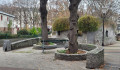
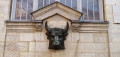
The square is situated on either side of the Canal Saint-Martin, at the Temple locks, where the canal goes underground. A footbridge spans the canal, connecting the two distinct parts of the square. It pays tribute to Antoine Louis Prosper Lemaître, known as Frédérick Lemaître (1800–1876), a French actor. Above the opening of the underground canal stands a bust of Frédérick Lemaître, created in 1898.

Blanche Hoschedé Garden
18 Rue du Chalet
Created in 2014 (1,000 m²)
Play area, drinking fountains, misting system, community garden.

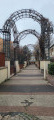
A well-maintained, long, narrow garden crossed by a central paved path. It comprises two lawns with sun loungers, a playground and a community garden. Two granite blocks adorn the garden. Rue du Chalet had given its name to this garden, which was renamed in October 2025 in honour of Blanche Hoschedé (1865–1947), a painter.

Square Juliette Dodu
Rue Juliette-Dodu
Created in 2005 (2,000 m²)
Playground, drinking fountain, multi-sports court, ecological garden, toilets.
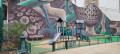
Redeveloped in 2023 on a former urban wasteland, this square came about as a result of local residents’ campaign against a property development project that would have seen a block of flats built on the site. The garden consists of a central lawn criss-crossed by paths and dotted with defined, overgrown planting beds and a pond. A large mural can be seen in front of the playground. At the entrance on Rue Juliette Dodu, a mini-amphitheatre with tiered seating in front of a white wall appears ready to welcome spectators for a screening or a performance. The square pays tribute to Lucie Juliette Dodu (1848–1909), a French spy and heroine of the 1870 war. She was the first woman in France to receive the Military Medal and the Legion of Honour for military service.

Amadou-Hampâté-Bâ Square
Place Robert-Desnos

Created in 1978 (881 m²)
Playground, drinking fountain...

A square comprising a playground surrounded by benches.
The square is named after the writer and ethnologist Amadou Hampâté Bâ (1900–1991).

Square Henri-Christiné
Rue Louis Blanc – 151 Quai de Jemmapes
Created in 1880 (2,165 m²)
Play equipment, drinking fountains.
This square is separated by a bridge from Square Eugène Varlin, located directly opposite. From the footbridge, you can look down on one of the locks on the Canal St Martin, with a drop of 25 metres. It pays tribute to Henri Christiné (1867–1941), author, composer and creator of operettas.

Eugène Varlin Square
150 Quai de Jemmapes
Created in 1891 (1,950 m²)
Drinking fountains, table tennis tables.
This square is separated by a bridge from Square Henri Christiné, located directly opposite. From the footbridge, you can look down on one of the locks of the Canal St Martin, with a drop of 25 metres. It is named in honour of Eugène Varlin (1839–1871), a bookbinder and socialist activist.

Madeleine Tribolati Square
6 Rue Monseigneur Rodhain and Rue Robert Blache
Created in 1984 (1,008 m²)
Playground, drinking fountain.
A square comprising a playground surrounded by benches. It was renamed in 2013 in honour of Madeleine Tribolati (1905–1995), a trade unionist with the French Confederation of Christian Workers.

Raoul Follereau Square
Created in 1984 (448 m²)
107 Quai de Valmy

The square consists of enclosed green areas and a fountain in the centre, surrounded by benches. It pays tribute to Raoul Follereau (1903–1977), writer, journalist and founder of an organisation dedicated to the fight against leprosy.

Villemin Garden
14 Rue des Recollets,
Created in 1977 (19,690 m²)
Playground, multi-sports cage, boules court, drinking fountains, misting system, community garden, bandstand, toilets.
The garden was created in 1977 on the site of the former Villemin military hospital, which closed in 1968. It takes its name from Dr Jean-Antoine Villemin, a French military doctor, hygienist and epidemiologist, known for having demonstrated in 1865 that tuberculosis was a contagious disease.

Square des Recollets
86, Quai de Valmy
Created in 1891 (1,450 m²)
Playground, table football, drinking fountains, table tennis tables.
This small garden, situated between two banks, overlooks a lock on the Canal Saint-Martin. It takes its name from the nearby street of the same name, which recalls the presence of the Récollets convent, founded on this site in 1604.

Square Saint-Laurent
68 Boulevard Magenta
Established in 1896 (1,456 m²)

Playground, drinking fountain, community garden.

Renovated in spring 2026, it features a stone sculpture: “La Réconciliation” (1935), by Elie Vézien, depicting two mothers and their young children. The garden is located a short walk from Saint-Laurent Church, from which it takes its name.

Square Alban Satragne
11 Square Alban Satragne
Created in 1963 (3,400 m²)
Drinking fountains.
This garden offers an unobstructed, symmetrical view—known as a French-style layout—of Saint-Lazare Chapel and its raised forecourt. A wide, tree-lined path surrounds two ponds and a mosaic fountain. In the 12th century, the site on which the garden now stands was occupied by a leper colony and then, around 1632, by the Congregation of the Priests of the Mission. It welcomed its founder, Saint Vincent de Paul (1576–1660), who spent his final days there. During the Revolution, the site was occupied by a branch of Saint-Lazare prison, which remained in use until 1935. The site then housed Saint-Lazare Hospital until 1998, after which the building was converted into a media library in 2015.
The garden is named after Alban Satragne, a district councillor from 1937 to 1954.

Marielle Franco Garden
40-48 Rue d'Alsace
Created in 2019 (2,600 m²)

Drinking fountains, playground.

Set on the roof terrace of a hotel, this garden is designed in three successive levels accessible via a footbridge from Rue d’Alsace. It rises gradually towards the east, offering views of the railway landscape of Gare de l’Est. The garden is named in honour of Marielle Franco, a Brazilian human rights and equality activist who was murdered in 2018.

Square Aristide-Cavaillé-Coll
8 Place Franz Liszt
Created in 1867 (1,980 m²)
Play areas, drinking fountains, community garden.

St Vincent de Paul Square was created in 1862 at the foot of the church of the same name. It was recently renamed in honour of Aristide Cavaillé-Coll (1811–1899), a leading 19th-century organ builder.

Yılmaz Güney Garden
27, Rue de l’Échiquier
Created in 2017 (1,000 m²)
Play area, drinking fountains.
Created in 2017, the Yılmaz Güney Garden has sprung up in the heart of a block of flats, between Rue de l’Échiquier and Boulevard de Bonne-Nouvelle, in a neighbourhood with a large Turkish and Kurdish community. Yılmaz Güney was a Kurdish actor and filmmaker born in Turkey (1937–1984) who was deeply politically engaged. He was a spokesperson for the struggles of the peasantry and the working class. In 1981, having sought refuge in France, he presented his film "Yol" (The Journey) at Cannes in 1982, where it won the Palme d’Or.

Other walks in the area

For more walks, use our search engine .

The GPS track and description are the property of this route's author. Please do not copy them without permission.