Randoguide: Bridiers through the ages

On the outskirts of La Souterraine, set off on this guided walk which, from antiquity to the end of the Middle Ages, brings to life the daily lives of our ancestors. Human settlement here has a long history, the evolution of which can be traced through the landscape.
From the shores of the Étang du Cheix to the sunken paths lined with boxwood, from the archaeological remains scattered throughout the countryside to the imposing silhouette of the castle, this excursion will transport you through time and across the ages.

Details

113927
Creation:
Last update:
Last review:
  • Walking
    Activity: Walking
  • ↔
    Distance: 8.44 km
  • ◔
    Average duration: 2h 40 
  • ▲
    Difficulty: Easy

  • ⚐
    Back to start: Yes
  • ↗
    Ascent: + 82 m
  • ↘
    Descent: - 79 m

  • ▲
    Highest point: 439 m
  • ▼
    Lowest point: 385 m

Photos

Description of the walk

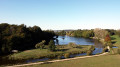
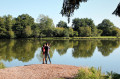
(S/E) Start at Étang du Cheix, in La Souterraine. Walk along the lake on the beach side (south bank).

(1) Leave the lakeside, cross a footbridge and continue straight on for a few metres along a two-way route until you reach the... Then, head up the slope, keeping to the left along the main track, running alongside a woodland. At the three-way junction, take the narrower path on the right. You’ll skirt a clearing on the right and arrive at a junction.

(2) Turn left (towards the “trail”) to reach some houses. In the hamlet, follow the small road that climbs up to the left, pass between two houses and continue along the path, which shortly afterwards crosses a small road and continues opposite, running alongside gardens and houses. At the next junction, turn right to reach the edge of the D951 road on the outskirts of the village. Cross carefully and follow the small road opposite, passing close to the castle mounds.

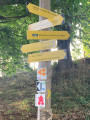
(3) Ignore the first path (signposted “trail”) on the left and continue for about 100 metres along the road (marked with a red mountain bike arrow). At the three-way junction, head up the road to the left for about 20 metres, then take a path on the left. Next, take a sunken path that descends to the right. The path leads to a track which you should follow straight ahead (slight descent) for nearly a kilometre. This track crosses a tiny stream, branches off to the left and climbs gradually before veering to the right and then descending towards a small valley. Continue until you reach a junction with a path through the undergrowth on the right.

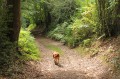
(4) Take this path which emerges on the right and leads through the woods. After the steep slope, the path narrows and then opens out onto a wide track, almost a track. Take this track on the left and, shortly afterwards, head up a sunken path on the right towards the archaeological dig site. At the entrance to the excavation site, leave the path known as the “voie-jolie” on your left and continue along the main path to the right. At the end of the path, take the track that climbs up to the right and, shortly afterwards, take the path through the box trees that descends to the left. At the bottom of the descent, continue along the path on the right, which is quite narrow at first but later becomes a track. Continue along this track, ignore the fork to the right and head towards the village entrance.

(5) Follow the main street/road, ignoring the junctions on both the right and left. You must then cross the D951 again and follow this road down to the left. Slip through a vaulted passageway that cuts across a traffic island and continue along the street until you reach the village’s main road. Follow this road, passing the memorial stone and the bus shelter, then head up the lane leading to the castle site.

(6) At the foot of the castle (near the dry toilets), climb the steps opposite which lead to a small footbridge and provide access inside the enclosure. Go round the tower and its staircase to exit the enclosure via the main entrance. After heading towards the garden, take the track on the left that runs alongside the castle mound. When you reach some small wooden huts, leave the track and go down the slope on the left to reach a footbridge. Cross this footbridge and then a clearing to reach the edge of a wood.

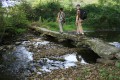
(7) Follow the path that runs along the edge of the woodland, then descends to join another track. Continue straight ahead until you come to a large step. Do not attempt to cross the stream but continue straight ahead to emerge from the woods at the footbridge you crossed shortly after setting off. Cross it again and follow the bank of the pond once more to return to the start (you may also prefer to go round the pond on the other side) (S/E)


Waypoints

  1. S/E : km 0 - alt. 385 m - Start - Etang du Cheix
  2. 1 : km 0.42 - alt. 387 m - Island Footbridge
  3. 2 : km 1.2 - alt. 404 m - Crossroads at the clearing
  4. 3 : km 2.64 - alt. 429 m - Mottes castrales. Passage near the source of the - Aigueperse (ruisseau)
  5. 4 : km 4.19 - alt. 390 m - Start of the path through the woodland
  6. 5 : km 6.1 - alt. 420 m - Entrance to the village of Vieux Bridiers
  7. 6 : km 7.21 - alt. 411 m - Bridiers Castle
  8. 7 : km 7.65 - alt. 396 m - Entrance to the woodland trail
  9. S/E : km 8.44 - alt. 385 m - Finish

Notes

The route starts from the Étang du Cheix car park. There are picnic tables, a bar and a restaurant on site.
The route is easy, well-maintained and signposted. A good pair of trainers will suffice for the walk.
Take care when crossing the D951 on the way there.
If possible, please bring a smartphone to access the audio guide available from the starting point sign.

Worth a visit

The Tower and Castle of Bridiers
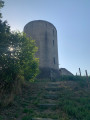
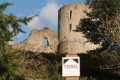
Standing 30 metres tall with a base diameter of 22 metres, the tower was likely the keep of the former Bridiers fortress, established in the late 13th century to reinforce the feudal mottes as part of a drive to assert and extend local authority. A testament to the former power of the Viscounty of Bridiers, the tower has been depicted in numerous documents over the centuries (engravings and later postcards) to the point of becoming a powerful and emblematic image of the Sostranian region. One such image, dating from the mid-19th century, shows the former keep still covered by a roof. Since then, due to a lack of maintenance, the roof has inevitably collapsed, leading to the deterioration of the interior. Restoration work has been underway since 1993, revealing the site’s ancient foundations and enabling the tower to be re-roofed and restored; it is now open to visitors during the summer.

The Saint-Marc Fountain
The Saint-Marc Fountain is a “healing fountain”. Also known as the Caesar Fountain – as it is said that the Roman general himself once watered his horse there – it was particularly renowned for curing abdominal ailments. As well as drinking its healing water, the technique involved rubbing one’s stomach against the fountain’s rim to bring about the miracle. Processions were once organised there to perform this ritual collectively, and it is only very recently that these have ceased. It was also believed to have the power to bring rain.

The village of Bridiers
The small village of Bridiers is a place of great historical significance, notably for having once been the seat of a powerful viscounty. It is one of the earliest recognised urban settlements in the region and has undergone numerous changes over the centuries and through the vicissitudes of history. Three distinct phases can be identified: first, a Gallic village (Second Iron Age), which gradually merged with the Gallo-Roman town of Brethum, founded later. This significant settlement (referred to as a ‘vicus’) endured until the mid-5th century, the period of the Great Invasions, during which it was likely plundered and destroyed. Subsequently, fortified strongholds built on mounds, known as motte-and-bailey castles, ensured the site’s survival to a greater or lesser extent until the 12th century. It was finally on the site of the old castle, where the tower still stands, that the seat of the viscount’s power was established; but by then the demographic centre of the region had already shifted to the town of La Souterraine, which was experiencing rapid economic growth, thus confirming the decline of what had been one of the most prosperous towns in Limousin during the Pax Romana.
The traces that remain from the medieval period have unfortunately been partly scattered, the stones reused over the centuries in the construction of new buildings. Thus, if you look closely at the façades of the buildings, you may spot certain rubble stones or supporting slabs discreetly carved or engraved with dates and inscriptions.

Boxwood paths
In granite terrain, the clustered presence of shrubs such as boxwood invariably indicates former human occupation. A plant likely introduced to Limousin by Roman colonisation, originating from Western Asia, boxwood thrives on a limestone substrate found here in the remains of ancient structures. It is therefore quite logical that you will encounter it as you walk through the ancient vicus of Bridiers. It is an evergreen shrub that can grow up to 8 metres tall, preferring cool soils and easily withstanding frost. Its distinctive scent begins to subtly perfume the air from May onwards.

Ancient Gallo-Roman aqueducts
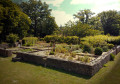
At a place known as La Voie Jolie, we are at the heart of the ancient vicus. So keep your eyes peeled, for even the smallest detail, seemingly insignificant, may prove to be a witness to the past. Proof of this can be seen in the few large stones piled up at the side of the path, which are in fact the remains of Gallo-Roman aqueducts. You can still make out the hollow, cylindrical shape on some of them. The ancient Gallo-Roman town is far from having revealed all its treasures, as the use of the land for grazing does little to encourage archaeological discoveries. However, the works carried out on the site during the construction of the RCEA145 expressway have brought to light significant structures, particularly thermal baths and necropolises, which point to a considerable heritage.

Reviews and comments

4.8 / 5
Based on 4 reviews

Reliability of the description
5 / 5
Ease of following the route
4.8 / 5
Route interest
4.5 / 5
Pascal92!
Pascal92!

Overall rating : 5 / 5

Date of your route : Aug 09, 2025
Reliability of the description : ★★★★★ Very good
Ease of following the route : ★★★★★ Very good
Route interest : ★★★★★ Very good
Very busy route : No

A very beautiful hike, completed in 1 hour and 32 minutes, but I cheated because I started my GPS watch at the end of kilometre 1 (at the end of the pond). I was afraid of walking through fields, but the route is really varied. There are lots of forest sections (sheltered from the sun), which are really pleasant. Doing it on my own, I could hear buzzards on the path... Unfortunately, I arrived at the Bridiers Tower at 7pm (closing time, I didn't check beforehand)... I'll have to come back :-)

Machine-translated

OT Pays Sostranien
OT Pays Sostranien

PLEASE NOTE: Due to preparations for and the staging of the ‘Fresque de Bridiers’ show, the ‘Randoguide Bridiers through the Ages’ route has been temporarily rerouted to avoid the entire castle area, which is closed to the public until 12 August. The end of the route involves a short return trip along the same path. Please follow the ‘Randoguide’ signposts carefully. The usual route will resume shortly after 15 August.

Machine-translated

TuckVortex
TuckVortex

Overall rating : 4.3 / 5

Date of your route : Jul 24, 2023
Reliability of the description : ★★★★★ Very good
Ease of following the route : ★★★★★ Very good
Route interest : ★★★☆☆ Average
Very busy route : No

We cut this walk short between points 3 and 5 because point 4 was too long for us.
However, the audio guide is very enjoyable and gives you a bit more insight into this fascinating heritage. Please note, however, that the tower is closed on Mondays.

Machine-translated

m-cecil
m-cecil

Overall rating : 4.7 / 5

Date of your route : Jul 23, 2023
Reliability of the description : ★★★★★ Very good
Ease of following the route : ★★★★☆ Good
Route interest : ★★★★★ Very good
Very busy route : No

An easy, very pleasant walk through woods and clearings, featuring one lovely viewpoint and a glimpse of a Gallo-Roman archaeological site. The highlight comes at the end of the route, where you can climb to the top of Bridiers Tower to admire the scenery and the castle ruins. Allow 2 hours 45 minutes to see everything; highly recommended in summer for the shade.

Machine-translated

madjack
madjack

Overall rating : 5 / 5

Date of your route : Jun 26, 2023
Reliability of the description : ★★★★★ Very good
Ease of following the route : ★★★★★ Very good
Route interest : ★★★★★ Very good
Very busy route : No

VERY INTERESTING, PEACEFUL AND A CHANCE TO EXPLORE THE RUINS AND BEAUTIFUL SPOTS

Machine-translated

Other walks in the area

For more walks, use our search engine .

The GPS track and description are the property of this route's author. Please do not copy them without permission.