Country:
 City:
City:


The walk starts in the centre of Villecresnes, opposite the town hall and the École des Merles.
(S/E) From Rue du Lieutenant Dagorno, turn right onto Rue du Réveillon and walk downhill for 500 metres to the river.
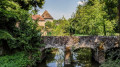
(1) In the heart of the valley, turn left onto the Liaison Verte, a picturesque footpath running alongside the river. After 300 metres, the path leads onto Rue de l’Arche. Use the attached map or the Visorando app to help you follow the route.
(2) Turn immediately right into the first tunnel, following the path alongside the river for 200 metres until you reach thesecond tunnel, which runs beneath the RN 19 and is known as the Pont de Brie.
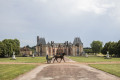
(3) As you emerge from the tunnel, turn immediately left, follow the path up to Avenue de Grosbois and continue to the roundabout. From the majestic entrance, guarded by two large carved stags, enjoy the beautiful view of Grosbois Castle, a17th-century residence, with the Forêt Notre-Dame in the background. Combining historical heritage with equestrian activities, the Domaine de Grosbois has, for nearly 60 years, served as the setting for an international training centre for horses competing in trotting races at Vincennes. In the immediate vicinity, the Bluegreen Golf Club in Marolles-en-Brie occasionally offers free participation in an introductory golf session, subject to prior registration.
(4) At the roundabout, turn right onto Avenue de Grosbois, heading towards the centre of Marolles-en-Brie. After the first roundabout, continue straight ahead along the avenue. At the second roundabout, admire the Church of Saint-Julien de Brioude on your left – the oldest church in Val-de-Marne, parts of which date back tothe 9th century.
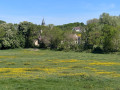
(5) Then carry on straight ahead along Rue de Brie. (After the boules court on your right – if you fancy a picnic, head down the tree-lined Chemin de la Vieille Rue aux Chevaux to relax near the Réveillon meadows.) Otherwise, turn slightly left onto Rue de la Fontaine Froide and carry on straight ahead along Rue du Réveillon. For just over 1 km, enjoy the natural, rural setting of this picturesque, gently winding road, where woods and wet meadows alternate. At the end of the street, at the Stop sign, carry straight on along Rue de la Fontaine, turning slightly right as you go, into the heart of Santeny’s old town centre. Near number 6 on this street, in a cul-de-sac on the right, you’ll find the covered washhouse, dating from the19th century.
(6) Continue along the Grande Rue and turn right onto Avenue du Général Leclerc to discover the Ferme des Lyons, a typical Briard farm, a testament to the area’s former agricultural activity.
(7) Turn right into the car park at Place Guillaume de Gondy and follow the small path at the far end of the car park. Take the footbridge on your left which spans the Réveillon, and turn left immediately afterwards to follow the path that runs alongside the riverbank. Turn left again to return to Avenue du Général Leclerc.As you pass, you’ll be able to admire the bridge and the dovecote.
(8) From the bridge, carry on straight ahead and pass Place Guillaume de Gondy again.
(7) Carry on up Rue de la Cavette. Take the steps on your left to see the rear of the Church of Saint-Germain d’Auxerre.
(9) Walk round the right-hand side of this19th-century building and head up Rue du Rocher. Halfway up, on your left, look through the gate to see the elegant Château de Santeny, built of limestone and slate in the19th century.
(10) Continue along the street. At the end of Rue du Rocher, head straight ahead towards the Voie aux Vaches, a pedestrian path leading from the rear of the small shopping centre. Walk alongside the stone wall of a property and take the narrow passage on your left at the second street lamp. The path winds its way through a wooded park, emerging onto Rue Henri Dunant. Turn right and then left onto Avenue du Rollet. The view opens out onto the Plat d’Etain, a vast stretch of farmland, with the edge of the Forêt Notre-Dame as a backdrop.
(11) At the roundabout, carry on straight ahead along Route de Marolles until the next roundabout. Continue to your left towards the centre of Marolles-en-Brie. After 700 metres, past the traffic lights on Avenue des Buissons, take a look to your left at the two entrance pavilions and the main gate, the last remaining features of the Château du Buisson.
(12) Then turn left into Rue Pierre Bezançon, a typical, old street with the dense, tightly packed housing typical of the centre of Marolles-en-Brie. Turn right and walk up Rue des Orfèvres, following the high walls of the former Ferme de Combault. Immediately after Rue de la Ferme aux Roses, opposite Chemin de Derrière les Clos, take Chemin Vert on your left – a grassy path that lives up to its name, leading to the rear of the detached houses’ gardens. At the next junction, discover the charming Demeure de la Belle Image. Dating fromthe 17th century and remodelled in the 18th century, its exceptional façades and roof have been listed as Historic Monuments since 1972.
(13) Then turn left into Rue du Pressoir, and at the end, turn right onto Rue Pierre Bezançon. As you walk down this old street lined with numerous stone houses, take a moment to admire the Ferme de Vaurichard, an imposing Briarde-style farmhouse built in the 18th century, which now houses the town hall of Marolles-en-Brie.
(14) Carry on and walk past the church.
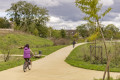
(5) Turn right at the roundabout onto Avenue de Grosbois. Continue down to the second roundabout, then on to the one opposite the entrance to the Domaine de Grosbois. Carry on along Avenue de Grosbois, which ends in a cul-de-sac, then take the path again leading to the tunnel under the RN19. After 150 metres, immediately after passing under the TGV line bridge, take the path on your right to reach the Végétal, a promenade specifically designed for non-motorised transport.
(15) Turn left onto Avenue Foreau, then right onto Rue du Général Leclerc, and left onto Rue du Lieutenant Dagorno to reach the centre of Villecresnes and the town hall (S/E). At the far end of the car park, near the police station, take a look at the Château Desmarais, known as ‘Le Fief’, a19th-century residence with a slate roof, set in extensive grounds. After the town hall, you can round off your visit with a stop at the Church of Notre-Dame de l’Assomption. Listed as a Historic Monument, this11th- and12th-century building, with its Romanesque façade, houses a sculpture of the Virgin and Child, as well as a copy of the painting *The Adoration of the Shepherds* by the Baroque painter Guido Reni.

 Local authority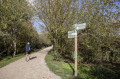
 Easy
Easy 
 Visorando Member
 Difficult