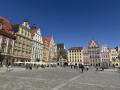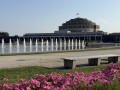
The Centenary Hall and Szczytnicki Park in Wrocław

To the east of Wrocław, the Centennial Hall displays its immense concrete dome, a masterpiece listed as a UNESCO World Heritage Site. This circular walk takes you around the entire site and the surrounding Szczytnicki Park. You’ll walk past the base of the great hall and the slender spire of the Iglica, reach a remarkable log church nestled amongst the trees, then stroll along the banks of the ponds and canals in the landscaped park. You’ll walk alongside the Four Domes Pavilion, passing under the vine-covered pergola whilst admiring the jets of the Multimedia Fountain, opposite the market hall.

Details

103366802
Creation:
Last update:
Last review:
  • Walking
    Activity: Walking
  • ↔
    Distance: 2.44 mi
  • ◔
    Average duration: 1h 10 
  • ▲
    Difficulty: Easy

  • ⚐
    Back to start: Yes
  • ↗
    Ascent: + 43 ft
  • ↘
    Descent: - 46 ft

  • ▲
    Highest point: 427 ft
  • ▼
    Lowest point: 371 ft

Photos

Description of the walk

The starting point is at the Zoo tram stop, at the foot of the Centenary Hall in the east of Wrocław, where a pay-and-display car park is adjacent to the stop.

(S/E) From the Zoo tram stop, walk alongside the tram tracks towards the Centenary Hall, then turn right to walk alongside the hall until you reach Iglica Square. The huge concrete dome and slender spire dominate the esplanade. Enter under the pergola.

(1) Turn sharply right to pass between the hall and the fountain. Make your way to the other end of the pergola. Go through it to reach Szczytnicki Park, which stretches to the east. Follow the path, cross a canal via a brick footbridge, then climb a few stone steps on the left. A little further on, opposite the bench, turn left then right until you reach Aleja Dąbska. Cross the pedestrianised avenue, turn left then immediately right.

(2) Walk round the wooden church, then return to Aleja Dąbska. Head left along it again. At the end, continue along Mikołaja Kopernika Street, turning left, and walk past the modernist WUWA housing estate.

(3) At the junction, near Skwer Steinmetza, carefully cross the tram avenue using the pedestrian crossings – first Adama Mickiewicza Street, then Mikołaja Kopernika Street. Then turn left to re-enter the park. Follow the paths, going straight on atthe first andsecond junctions, then turn left. Turn right after the Uważności monument. Further on, turn left just before the large column of Frederick William II. Continue straight on at the next three junctions, skirting a pond. The paved banks and reeds are home to ducks.

(4) Cross the park’s canal via the bridge. Turn immediately right, then go straight on at the junction. Cross a second stretch of water via a wooden footbridge, then carefully cross Adama Mickiewicza Street. Next, walk along the right-hand side of the Japanese Garden, which is enclosed by a fence. Rising above the meadows are the Four Domes Pavilion and the slender spire of the Iglica. Return to the vine-covered pergola and walk along it to the right.

(1) Head for the paved esplanade between the market hall and the Four Domes Pavilion, then walk alongside the market hall to the edge of the concrete footbridge spanning the tram tracks. Without crossing it, turn left just before the footbridge to walk alongside the tram tracks and return to the tram stop (S/E).

Waypoints

  1. S/E : mi 0 - alt. 384 ft - Zoo tram stop - Halle du Centenaire de Wrocław (Hala Stulecia)
  2. 1 : mi 0.23 - alt. 387 ft - Pergola et Fontaine Multimédia de la Halle du Centenaire (Wrocławska Fontanna)
  3. 2 : mi 0.6 - alt. 400 ft - Église en bois Saint-Jean-Népomucène de Wrocław
  4. 3 : mi 1.11 - alt. 400 ft - Crossing the tram avenue
  5. 4 : mi 1.78 - alt. 404 ft - Bridge over the park’s canal
  6. S/E : mi 2.44 - alt. 381 ft - Zoo tram stop - Halle du Centenaire de Wrocław (Hala Stulecia)

Notes

The park, the Centenary Hall esplanade, the pergola and the Multimedia Fountain are free to access.

The pay-and-display car park next to the stop costs around 6 zł (~€1.40) per hour and 60 zł (~€14) per day (2026 rates).

The journey begins at the Zoo tram stop, served by the Wrocław tram network (MPK). Tickets can be purchased from ticket machines, on board using a debit or credit card, or via a mobile app.

The Multimedia Fountain is only operational during the warmer months. A show takes place every hour, from 10.00 to 17.00 featuring water and music, and then from 18.00 to 21.00 with light displays, with the final performance at 21.40. Timetables vary depending on the season and events: please check the Centennial Hall website. The interior of the hall and the Museum of Contemporary Art, in the Four Domes Pavilion, require a separate ticket.

The Japanese Garden, which the route merely runs alongside, requires a ticket (standard admission 30 zł (~€7), concessions 20 zł (~€4.70), family ticket 80 zł (~€18.70), 2026 prices). It is open from 1 April to 31 October, from 9 am to 7 pm.

Short flights of steps are scattered along the route, which is not very suitable for pushchairs. These can be bypassed.

There are cafés and restaurants around the Centenary Hall.

Worth a visit

(S/E) The Centennial Hall, designed by architect Max Berg and built between 1911 and 1913, was constructed to mark the centenary of the 1813 uprising against Napoleon. Its reinforced concrete dome, with a span of around 65 metres, was one of the first large structures of its kind in the world. It has been a UNESCO World Heritage Site since 2006 and houses a visitor centre.

(1) The pergola, a long colonnade of reinforced concrete dating from 1913 and covered in climbing plants, encircles the basin of the Multimedia Fountain, which opened in 2009 and is one of the largest in Europe. In front of it stands the Iglica, a steel spire some 90 metres high, erected in 1948 for the Recovered Territories Exhibition. Nearby, the Four Domes Pavilion, designed by Hans Poelzig in 1912 and 1913, has housed the Museum of Contemporary Art – a branch of the National Museum in Wrocław – since 2016.

(2) The wooden Church of St John of Nepomuk, built from larch logs, was constructed around 1499 in Stary Koźle, Upper Silesia, and then reassembled in Szczytnicki Park in 1913 by the architect Theodor Effenberger. Now restored, it serves as a cultural venue.

Szczytnicki Park, one of the oldest and largest parks in Wrocław, features an English-style landscape dating from the late18th century, dotted with ponds, canals and sculptures. The Japanese Garden (Ogród Japoński), created for the 1913 exhibition and restored in 1996 and 1997 with the assistance of Japanese specialists, is open to visitors during the season and lies in the immediate vicinity of the route. Between (2) and (3), the route also runs alongside the WUWA, a modernist model city designed by the Werkbund and built for the 1929 exhibition.

For more walks, use our search engine .

The GPS track and description are the property of this route's author. Please do not copy them without permission.