Country:


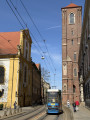
Head to the Renoma tram stop, at the foot of the department store of the same name, on Świdnicka Street.
(S) From the department store, cross Świdnicka Street and turn right. Cross Podwale Street, then turn left after the canal to enter the tree-lined Promenada Staromiejska.
(1) After passing the musical dwarves, continue straight on alongside the National Forum of Music, then turn right onto Krupnicza. Cross a small street, and at the large junction, cross Krupnicza to the left and then turn right onto Kazimierza Wielkiego Street to reach Plac Bohaterów Getta, where the Monument to the Heroes of the Warsaw Ghetto stands. Continue by crossing Psie Budypar, then climb a short flight of steps which, after passing through an archway, leads to Plac Solny with its flower stalls, before emerging onto the Rynek.
(2) On the Rynek, one of Europe’s largest medieval market squares, head towards the fountain sculpture, then turn right just before it to enter and walk through the heart of the Cloth Hall (Sukiennice). On the other side, turn left, then left again to walk around the buildings surrounding the square. Continue to the north-west corner of the Rynek.
(3) Leave the square via Odrzańska Street on the right, followed by Igielna Street on the right; then, at the end, turn left onto Kuźnicza Street and immediately turn right onto Kotlarska Street, continuing for about 300 metres.
(4) Cross Plac Nowy Targ diagonally; it is surrounded by post-war buildings. Leave the square on the left and head down towards the Odra via Piaskowa Street, crossing it before the Hala Targowa tram stop to reach, further down, the quay on Bulwar Xawerego Dunikowskiego, after crossing Ducha Świętego Street.
(5) Turn right onto Bulwar Xawerego Dunikowskiego, on the banks of the Odra, and follow the promenade along the river. After the large fountain steps, leave the promenade by climbing up to the right at the three-way junction, and reach the top of the hill.
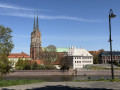
(6) From the Wzgórze Polskie hill, enjoy the view over the River Odra, towards Cathedral Island and the two spires of St John the Baptist’s Cathedral on the opposite bank. After this stop, head back down to the right onto Promenada Staromiejska and cross Jana Ewangelisty Purkyniego Street. Head towards Słowacki Park, passing the Lower Silesian Katyn Memorial, then turn right and right again to approach the Panorama Racławicka rotunda and the National Museum. At the three-way junction, head left, then turn left and finally right. Cross Jana Ewangelisty Purkyniego Street again, then head down to the Xawerego Dunikowskiego Boulevard quay, as far as the Most Piaskowy Bridge.
(7) Cross the Odra Południowa via the Most Piaskowy bridge to reach ‘Sand Island’ (Wyspa Piasek). Turn immediately right and walk along the quay. At the foot of the Gothic tower of St Mary’s Church on the Sand (NMP na Piasku), head back up to the Most Tumski bridge.
(8) Cross the Most Tumski, a green iron bridge covered in lovers’ padlocks, and enter Ostrów Tumski, Cathedral Island and the city’s oldest district. Walk up Katedralna Street, lined with gas lamps, to Plac Katedralny.
(9) In front of St John the Baptist’s Cathedral – which is open to visitors – walk round it and then head back down Katedralna Street. Facing the Most Tumski Bridge, turn right and continue along the riverbank via Bulwar Księdza Aleksandra Zienkiewicza.
(10) At Most Młyński Bridge, turn right and cross Świętego Marcina Street, then Henryka Sienkiewicza Street. Walk for about 500 metres along Generała Józefa Bema Street, then Księcia Józefa Poniatowskiego Street. Before the Jedności Narodowej tram stop, turn left onto Skwer Pionierów Wrocławskich, then onto Franklina Delano Roosevelta, crossing Księcia Józefa Poniatowskiego and Jedności Narodowej in turn. Pass under the archway on the left between numbers 6 and 8 on the street.
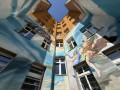
(11) Walk along the path lined with walls painted with large frescoes depicting landscapes and figures. Leave the courtyard via the other archway, between numbers 18 and 20. Continue along Franklina Delano Roosevelta to the left. At the junction, turn right to cross Franklina Delano Roosevelta, then follow Słowiańska. At the next major junction, continue right along Jedności Narodowej Street, staying on the same pavement.
(12) After crossing a small alleyway, enter the archway at No. 110 on the right. Walk around the inner courtyard, dotted with further frescoes and painted gables, in the ‘colourful courtyard’ (Kolorowe podwórko). Exit via the archway between nos. 106 and 108 and turn right again. Then head back down towards the Odra, following Księcia Józefa Poniatowskiego Street without ever crossing it, following the same route as the tram tracks.
(10) Cross the Odra Północna via the Most Młyński Północny bridge to reach Wyspa Słodowa, where you should turn right and then left after the Most Słodowy bridge. Walk along the riverbank, then turn left again onto the Kładka Piaskowa footbridge with its wooden decking. Follow the Profesora Stanisława Kulczyńskiego boulevard until you reach the next footbridge on the left.
(13) Head to Wyspa Daliowa via the footbridge, next to the ‘Sand Lock’ (Śluza Piaskowa). Walk round the island, then cross the footbridge again.
(13) Turn right, then cross the Most Piaskowy bridge to return to the left bank, then walk up Grodzka Street towards the University.
(14) Cross Grodzka Street, opposite the Mosty Uniwersytecki Bridge, and pass under the archway leading to Plac Uniwersyteckie. Cross the square and take Kuźnicza Street, which leads back to the Rynek.Turn right to walk along it once more and reach its north-west corner.
(3)Leave the square via Świętego Mikołaja Street, opposite. Follow this street, crossing Białoskórnicza Street, the tram tracks and Kazimierza Wielkiego Street. On reaching Plac Jana Pawła II, enter the underpass and, at the end on the left, emerge onto the main road, Legnicka Street.
(15) Follow Legnicka for about a kilometre, until you reach Plac Strzegomski.
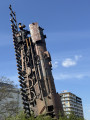
(16) On Plac Strzegomski stands the striking steam locomotive ‘Pociąg do nieba’ (‘The Train to Heaven’), positioned vertically on tracks that soar skywards. Head towards the Contemporary Art Museum and, opposite it, go down into the underpass leading to the Plac Strzegomski tram stop (E).
 Visorando Member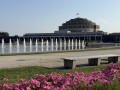
 Easy
Easy