The Soumartre Cave, the Faugères Mills and the Carabelles

Set in the heart of the Hérault heath, this route offers an immersion in a landscape typical of the southern Mediterranean, blending unspoilt nature with rural heritage. The walk begins at the Grotte de Soumartre, a natural formation comprising three distinct chambers, where you can admire beautiful limestone formations and spectacular stalactites, evidence of thousands of years of slow erosion. The route continues towards the Moulins de Faugères, former windmills historically used for grinding grain, the earliest traces of which date back to medieval times. Finally, the trail passes through a remarkable heritage of dry-stone construction, featuring agricultural terrace walls that once shaped the terraced fields, as well as ‘carabelles’ – small stone structures used as shelters or for agricultural tools – a legacy of traditional farming practices and the organisation of the region’s ancient gardens and crops.

Details

99620210
Creation:
Last update:
Last review:
  • Walking
    Activity: Walking
  • ↔
    Distance: 3.92 mi
  • ◔
    Average duration: 2h 25 
  • ▲
    Difficulty: Easy

  • ⚐
    Back to start: Yes
  • ↗
    Ascent: + 663 ft
  • ↘
    Descent: - 663 ft

  • ▲
    Highest point: 1,371 ft
  • ▼
    Lowest point: 1,020 ft

Description of the walk

The walk starts from the free car park at Les Moulins de Faugères, Chemin des Trois Tours. There is a picnic table, a water point near the Office du Moulin, and several parking spaces.

(S/E) From the car park, head towards the DFCI AVF8 track and take the second track on the left. Cross the heath heading north, then continue through the woodland until you reach a field running across the path.

(1) Cross the field along a barely visible path. Keep an eye out for the signposts and carry on straight ahead until you reach a more clearly marked path.

(2) Begin a short descent towards the inconspicuous entrance to the karstic cave of Soumartre. Follow the natural path to the bottom of the valley, where the entrance to the cave is located on the right, down a steep slope.
Karstic Cave of Soumartre: the cave entrance is inconspicuous and easy to miss. Access to the first chamber is usually via a metal ladder approximately 5 to 8 metres long. However, this ladder is now severely corroded and its stability can no longer be guaranteed. Any descent is undertaken entirely at your own risk. It is strongly recommended that you bring suitable equipment, including an abseiling kit, to access the cave safely. The cave consists of several chambers of impressive size, adorned with limestone concretions, stalactites and remarkable geological formations. The site also serves as a refuge for several species of bat.

(3) Return to the main path and head back up to a track.

(4) Turn left and head back to the car park.

(S/E) Climb the track, heading south towards the Moulins de Faugères, and make your way there.

(5) These three old windmills date from the 16th century and are one of the village’s main historical landmarks.
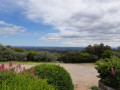
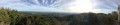
Head to the nearby orientation table. Enjoy a sweeping 360° panorama of the Mediterranean, the Cévennes and the Pyrenees.
Continue along the path heading south, then turn right shortly afterwards to reach a three-way junction.

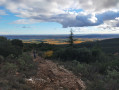
(6) Keep to the left and continue the descent through a maze of dry-stone walls, evidence of the area’s former agricultural layout. At the path, turn right and come out onto a track.

(7) Follow it for a few metres to the left, then take the path on the right. Cross a gully and climb up to a track. First turn left then right, and climb up to a fork in the paths.

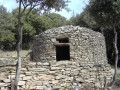
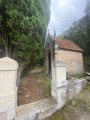
(8) Continue to the right, between woodland and heath, until you reach an unusual statue situated near several traditional carabelles. Join a forest track and follow it to the left until you come across the remains of an old, ruined carabelle.

(9) Carry on along the track, then turn onto the path on the right. After a 90° bend to the right, you’ll reach another carabelle that blends perfectly into the landscape.

(10) Carry on along the path and, at the track leading to the Trois Moulins, head down to the car park (S/E).

Waypoints

  1. S/E : mi 0 - alt. 1,257 ft - Starting point: car park
  2. 1 : mi 0.7 - alt. 1,273 ft - Cross the field, following the barely visible path in the middle
  3. 2 : mi 0.95 - alt. 1,224 ft - Follow the path, then descend to the unobtrusive cave entrance
  4. 3 : mi 1.1 - alt. 1,020 ft - Follow the nature trail to the bottom of the path
  5. 4 : mi 1.47 - alt. 1,220 ft - Follow the track to the car park
  6. 5 : mi 2.23 - alt. 1,365 ft - Faugères Mill – The Three Towers
  7. 6 : mi 2.57 - alt. 1,178 ft - Turn left into the heath
  8. 7 : mi 2.88 - alt. 1,089 ft - At the junction, take the path straight ahead
  9. 8 : mi 3.15 - alt. 1,243 ft - Between the Carabelle and the forest, an unusual statue
  10. 9 : mi 3.39 - alt. 1,243 ft - Forest track and ruined cart shed in the woods
  11. 10 : mi 3.54 - alt. 1,253 ft - Final route and Carabelle
  12. S/E : mi 3.92 - alt. 1,257 ft - Back to Start Car park

Notes

Water point available behind the Office du Moulin; 2 free car parks; picnic table available next to the first car park and the orientation table, plus disabled parking.

Important information: although the walk is short and accessible, great care must be taken when accessing the karstic cave, Aven-Grotte de Soumartre. The metal ladder shows significant signs of corrosion and should not be regarded as reliable . A helmet, torch and suitable equipment are strongly recommended for any visit to the cave.

Worth a visit

(5) Restored to their original state, the mills—with their sails open to the 13 winds—stand at an altitude of 417 metres, offering a breathtaking panorama that will delight visitors: a 360° orientation table carved into the stone shows, to the south, the coastline and the sea, then the mountains stretching from the Cévennes to the Pyrenees, and to the north, the mountains of Lozère and Aveyron.

The Faugères mills (grain mills) date from the 16th century and were restored in the 1990s. The mill, which is still in working order, is fitted with the original millstones from the time of the Rivière brothers (who were millers at the site between 1829 and 1849). One of the towers now serves as a visitor centre for the Tourist Office during the summer. We invite you to explore this exceptional site at your leisure – all year round – or to join one of the guided tours during the season.

  • Pets welcome
  • Accessibility

Tours

Languages of guided tours: French, English

  • Duration of tours: 40 mins
  • Guided tours available on request

These ‘drystone huts’, commonly known as drystone shelters, have many local names.

In Faugères, they are called “carabelles” (according to the writings of Émile Ségui and the accounts of the village elders).

Dry-stone architecture is an ancient technique, timeless and boundless, which involves building walls or huts without any binding material (sand, cement or lime) and joining the stones together solely through the force of their interlocking.

They are linked to agro-pastoral activity. Why are there so many such structures in Faugères? Firstly, stone is plentiful!

The redistribution of land following the Revolution of 1789 enabled many peasants and shepherds to become small landowners in a region ill-suited to large-scale farming. Mont Marcou, the vast hill overlooking the village, was therefore, amongst other things, the site of a massive land-clearing project; it is thought that most of our ‘carabelles’ date from this period. Through a massive clearing of stones – to cultivate the land or provide pasture – these farmers and shepherds marked out their plots, built walls and low walls to retain the soil, erected shelters and constructed ‘carabelles’ of various shapes and sizes.

This type of architecture demonstrates humanity’s adaptation to the natural environment, employing skills that remain respectful of the landscape – a landscape shaped by intense geological activity over the centuries.

“Pierres Sèches”: preserving the heritage of the Hauts Cantons. (Association)

(3) The Soumartre Karstic Cave
Located approximately 2 km north of Faugères, the Soumartre Karstic Cave lies hidden in the heart of the heath behind a discreet entrance that is easy to miss. Access is via a ladder of around 5 to 8 metres, leading down to a first large, sloping chamber. A few natural steps then lead into the heart of the cave, where a vast underground chamber of surprising dimensions opens up. Numerous nooks and crannies, beautiful stalactites and various limestone formations bear witness to the site’s geological activity. The cave also provides a refuge for several species of bat. The contrast between the unassuming entrance and the sheer scale of the underground chambers makes Soumartre one of the most remarkable natural sites in the area around Faugères.

Other walks in the area

For more walks, use our search engine .

The GPS track and description are the property of this route's author. Please do not copy them without permission.