The Templar Commandery near Ensigné

At the edge of the Aulnay Forest, the history of the Knights Templar, pilgrims, salt workers and winegrowers comes to life through the old paths, vineyard plots and the Commandery.
This walk takes you past the rest areas at La Chaume and La Chauvière, the church at Ensigné, the Chemin de Contré and the Chemin Saunier, the Templar Commandery, the oaks of Fief-Louis, the stork well at Le Lac and the Trou de l’Ormeau.

Details

746818
Creation:
Last update:
Last review:
  • Walking
    Activity: Walking
  • ↔
    Distance: 6.85 mi
  • ◔
    Average duration: 3h 15 
  • ▲
    Difficulty: Moderate

  • ⚐
    Back to start: Yes
  • ↗
    Ascent: + 98 ft
  • ↘
    Descent: - 89 ft

  • ▲
    Highest point: 338 ft
  • ▼
    Lowest point: 210 ft
  • ⚐ Country: France
  • ⚐ City: Ensigné (79170)
  • ⚑
    Start/End: N 46.088474° / W 0.241805°
  • ❏
    IGN map(s): Ref. 1629SB
  • Hour-by-hour weather

Photos

Description of the walk

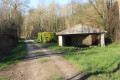
Parking is available opposite the church, near a picnic area.

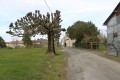
(S/E) Start the walk by taking the Impasse de l’Église in front of the church. The Church of Sainte-Radegonde, built in 1845, is unusual in that its main door faces east. The cul-de-sac turns into a narrow lane and bends to the left. As soon as possible, turn right towards a sort of square (under construction at the time of the walk). Cross this area and join the Grand Rue, turning right onto it.

(1) Turn immediately left into Rue du Puits. Continue straight on until you reach a T-junction. Turn right into Rue des Jardins and continue to the junction with Rue du Puy de Bouin.

Turn left and immediately right onto Chemin des Échénes, which bends sharply to the right a little further on to serve some houses. At the bend, take the farm track that branches off to the left towards the south-west. Turn right at a right angle onto the farm track, then continue straight on to head away from Ensigné.

(2) At this junction of farm tracks, turn right onto Chemin de Contré. Further on, the farm track joins the D109 road: cross it and continue along the road opposite, immediately ignoring a farm track branching off to the left. From the junction and for a few hundred metres through the hedge, you can see the Commanderie des Templiers on your right.

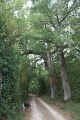
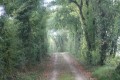
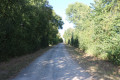
(3) At the junction of roads and farm tracks (with a triangular patch of land in the centre), take the road on the left. About 450m further on, take the first farm track on the right, which is quite shaded. Then cross the junction of farm tracks, continuing straight on until you reach a T-junction.

(4) Turn right and continue straight on until you reach the D309.

(5) Cross the road and continue straight on along the farm track. When the track bends sharply to the right, continue straight on along a new track which joins Chemin Saulnier at a right-hand bend. Continue straight on along this track (which comes from La Rochelle), cross a road and continue straight ahead on the same track.

(6) At the next junction of farm tracks, turn right onto Chemin du Fief Louis, which climbs slightly after an initial flat section. Continue straight on until you reach a T-junction on the plateau. Turn left onto the farm track heading south-east.

(7) Pass a downhill farm track on your right (alternative route available for a shorter route – see the Practical Information section) and continue straight on along an unshaded farm track towards Les Chagnasses (oaks). At the next junction, turn right and continue straight on to the hamlet of Le Lac, where the track becomes a road just before a Y-junction

(8) At the junction with the Chemin de la Cigogne (named after an old stork used to draw water from the wells at the hamlet known as Le Lac), turn right and, immediately after the bend, take a farm track on the right which joins another, fairly shaded farm track further on; take this track by turning right towards the north. You will come to a T-junction.

(9) Turn left onto the shaded, winding track. Continue straight on until you reach the road from Juillé to Ensigné at a bend. Take this road on the left towards Ensigné.

(10) Shortly afterwards, turn left onto the path leading to the Trou de l'Ormeau, a local landmark.

(11) Return to the main path.

(10) Turn left to reach the car park, which marks the end of this walk (S/E).

Waypoints

  1. S/E : mi 0 - alt. 253 ft - Parking opposite the church
  2. 1 : mi 0.19 - alt. 279 ft - Grand'Rue – Rue du Puits junction, turn left
  3. 2 : mi 0.81 - alt. 256 ft - Crossroads of farm tracks, on the right
  4. 3 : mi 1.37 - alt. 246 ft - Crossroads, turn left
  5. 4 : mi 2.26 - alt. 220 ft - T-junction, turn right
  6. 5 : mi 2.81 - alt. 243 ft - D309, opposite
  7. 6 : mi 3.87 - alt. 233 ft - Crossroads of farm tracks, on the right
  8. 7 : mi 4.57 - alt. 331 ft - Crossroads, straight ahead
  9. 8 : mi 5.22 - alt. 295 ft - Y-junction, turn right
  10. 9 : mi 5.85 - alt. 266 ft - T-junction of farm tracks, left
  11. 10 : mi 6.46 - alt. 243 ft - Turn left onto the path to Trou de l'Ormeau
  12. 11 : mi 6.6 - alt. 246 ft - Trou de l'Ormeau
  13. S/E : mi 6.85 - alt. 249 ft - Parking opposite the church

Notes

This hike over varied terrain requires suitable footwear.

The route is marked in yellow (short-distance hiking trail). It deviates from the markings in a section of Ensigné.
You must be careful between the (6) and the (9) as parts of this route overlap with the Cabanes de Vignes route near Asnières en Poitou (and one section runs in the opposite direction).

Alternative route:
At point (7), turn right onto a straight farm track heading south. At the next junction of farm tracks, turn right onto a farm track which, after a slight bend to the left, leads to point (9). From there, follow the standard route of the walk. The walk is then 10.5km long.

The return trip to the Trou de l'Ormeau covers a distance of 0.5 km, which can be omitted if desired.

Combining this alternative route with the omission of the return trip to Trou de l'Ormeau, the hike is then 10 km.

Worth a visit

The Templar Commandery
The Commandery (private residence) was founded in the 12th century by Hugues de Payns, the first Grand Master of the religious and military Order of the Temple, established to defend pilgrims in the Holy Land. The Templars amassed great wealth through their numerous estates and fortresses, acting as a bank for pilgrims and later for kings. Facing widespread hostility, the Order of the Templars was dissolved in 1312 by Pope Clement V. The Commandery subsequently came under the protection of the Hospitallers until the Revolution.
Of the complex of buildings, which were altered in the 18th and 19th centuries, only the manor house remains (a tall structure flanked by two massive 12th-century cylindrical towers, a square tower on its main façade and, at the rear, a 15th-century stair tower) and the Romanesque chapel with a broken barrel vault, which has been converted into a barn. Its listing on the register of historic monuments (1933) has done nothing to halt its deterioration.

The Trou de l'Ormeau
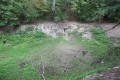
This “hole”, undoubtedly man-made, fills with water as the water table rises in autumn. The overflow gives rise to the intermittent stream known as the Boudoire. By late spring, the stream dries up and, by late summer, the Trou de l’Ormeau, completely empty, reveals itself as a wide, deep crater.

The Chemin Saunier
Coming from La Rochelle, the Chemin Saunier led towards central France. Carried on the backs of donkeys or mules, the salt was subject to the gabelle, the symbolic tax levied from the 14th century until the Revolution. Consequently, rogue salt carriers engaged in salt smuggling. The presence of a ditch on the upstream side of the path attests to the quality of its construction.

Ensigné
The history of the village is closely linked to that of the Knights Templar. Indeed, Ensigné is home to a commandery (now privately owned) comprising buildings, a chapel and a castle.
The commandery, which includes the chapel and the castle, has two separate owners. Only the castle has been restored.
Since 1994, the village has belonged to the Val de Boutonne community of municipalities.
Separated from Charente-Maritime by the Forest of Aulnay, which covers more than 30% of its territory, it is bordered by the communes of Asnières-en-Poitou, Juillé, Villefollet and Villiers-sur-Chizé.
Situated on the Way of St James, it was once a powerful town with its own Commandery of the Knights Templar and was designated the county town after the Revolution.

Reviews and comments

5 / 5
Based on 3 reviews

Reliability of the description
5 / 5
Ease of following the route
5 / 5
Route interest
5 / 5
Mathé Thierry
Mathé Thierry

Overall rating : 5 / 5

Date of your route : Jun 15, 2026
Reliability of the description : ★★★★★ Very good
Ease of following the route : ★★★★★ Very good
Route interest : ★★★★★ Very good
Very busy route : No

A lovely walk along quiet, shaded paths – very peaceful. The route is described very clearly. Thank you

Machine-translated

DAUTET
DAUTET

Overall rating : 5 / 5

Date of your route : May 26, 2023
Reliability of the description : ★★★★★ Very good
Ease of following the route : ★★★★★ Very good
Route interest : ★★★★★ Very good
Very busy route : No

Hello, we’ve just been on this walk in the sunshine – a lovely walk along white or grassy paths, very peaceful. The route is very well described and clearly signposted, which isn’t always the case; it’s impossible to go wrong.
Thank you

Machine-translated

pgetrochon
pgetrochon

Thank you for your comment
Enjoy your walks

Machine-translated

guiton13
guiton13

Overall rating : 5 / 5

Date of your route : May 13, 2019
Reliability of the description : ★★★★★ Very good
Ease of following the route : ★★★★★ Very good
Route interest : ★★★★★ Very good

A really lovely walk along some lovely, shaded and peaceful paths. The route is described very clearly in the comments – it’s impossible to get lost.
Well done and thank you.
Guillaume

Machine-translated

Other walks in the area

For more walks, use our search engine .

The GPS track and description are the property of this route's author. Please do not copy them without permission.