Saint-Saturnin Church in Bégadan
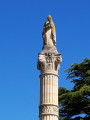
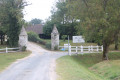
The church, which once belonged to Vertheuil Abbey, retains its beautiful Romanesque apse. The rest of
the building was destroyed in the 19th century and rebuilt with a bell tower topped by a spire, all in the Neo-Romanesque style, under the supervision of the architect Abadie. The semi-circular apse on the inside has five sides on the outside. At the base of the choir, two solid turrets served as buttresses. The capitals of the columns are adorned with foliage or fantastical animals. On the exterior, the projecting corners of the polygon are concealed beneath groups of three engaged columns, the central one topped by a capital. The upper storey consists of blind mullioned windows. Two of the capitals are made of marble, likely reused from an ancient monument. The choir and apse are listed as Historic Monuments (1906).
The port of By
The Port of By is characterised by its thriving commercial activity in the Gironde estuary.
In the 18th and 19th centuries, the port of By was very busy and served as a transit point, particularly for the grain trade. Until 1939, the port of By maintained a commercial activity centred on wine. Gabarres thus transported barrels of wine to Bordeaux, returning laden with various goods destined for Bégadan and, above all, Lesparre. Other port activities, such as fishing and oyster farming
were practised until 1985.
Château du Tour de By
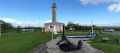
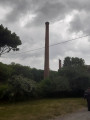
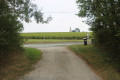
Built on the ruins of a wheat mill in 1825, the By lighthouse became a lifeline for fishermen and sailors navigating the estuary, which was close by on foggy nights. We are 300 metres from the Gironde, on land situated 15 metres above sea level. Vines have been cultivated here for several centuries. It is here that this magnificent family-run vineyard is situated on a ridge of Gironde gravel, between the Atlantic Ocean and the Gironde estuary.
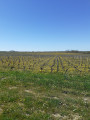
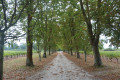
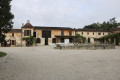
Château La Tour de By is a 94-hectare family estate situated on a ridge of Gironde gravel, between the Atlantic Ocean and the Gironde estuary. Built in 1876 at the very end of a beautiful avenue lined with tall trees, this wine estate is distinguished by its old lighthouse. La Tour de By has
very ancient roots. Among its notable owners were Pierre Tizon, Lord of the Fief of By in the 16th century, Count Louis de Gramont in the 18th century, Monsieur de Lignac and then his son-in-law Alfred Rubichon, who had the current château built in 1876 near the Tour de By. In the early 20th century, Julien Damoy (a delicatessen merchant in Paris) bought the property and entrusted it to his son-in-law, Mr Chaumont… Before selling it in 1961 to a Member of Parliament, Mr Kaskoreff. In 1965, three returnees from Tunisia acquired it, including Marc PAGES. In 1999, Marc PAGES became the sole owner, along with his children.
Fishing with a square net
In the Médoc, a land of traditions, square net fishing is practised along the Gironde Estuary, known as ‘the River’
as it is known to those in the know. Whilst the name ‘carrelet’, derived from ‘carrel’, meaning ‘tile’, refers to a square net, it has come to be used by extension to describe these fishing huts, perched on slender stilts above the foreshore (the part exposed at low tide), equipped with a large net suspended from the end of a mast, operated by a winch from inside the hut. Carrelet fishing is a form of casual fishing practised, in tune with the tides, by nature lovers who come to enjoy a convivial moment, with family or friends, between sky and water. Their installation is regulated. On the left bank of the estuary, it is subject to authorisation from the ‘Grand Port Maritime de Bordeaux’, which manages the public river domain.
Château de Greyssac
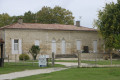
A beautiful 18th-century residence. Facing both north and south, the estate’s red wine vines are planted on the gravelly soil of the hamlet of By. For over 40 years, a succession of passionate figures have taken the helm here. Captains of industry in the aeronautics and luxury car sectors, they have brought their vision to this quality-driven project and to the estate’s development. Since 2012, Jean Guyon, a former interior designer and already the owner of several châteaux, notably the Domaine Rollan de By, has taken over Château Greyssac, a Médoc cru bourgeois.
By Natura 2000 Site
This site covers an area of approximately 23,000 hectares and spans 16 communes in the Médoc, including Bégadan. It is characterised by a remarkable diversity of natural habitats that provide a home for birds (ponds, wet meadows, hedgerows, etc.). Its location on a major European migratory route makes this collection of habitats a site of national and international importance for birdlife. It is used as a nesting site, a stopover point during migration and a wintering ground for numerous species of birds that nest directly amidst the ‘mares de tonnes’ (half-barrel ponds), on small islets. The ‘mares de tonnes’ take their name from a traditional hunting practice dating back to the 19th century: this involved hiding near a body of water inside an upturned half-barrel. Lying in wait, the hunter could thus shoot waterfowl landing nearby through an opening cut into the barrel. Today, the barrels have been replaced by permanent structures, known as ‘tonnes’, which are better suited to long periods of waiting, at night and in very cold weather. Buried or semi-buried, varying in size and layout, these structures are camouflaged to blend into the surroundings.
The Noisettines of the Médoc
The village of Blaignan remains associated with the name Noisettines du Médoc, an artisan confectionery whose
the recipe has been in use since 1649.
Free tour and tasting.
Open all year round from Monday to Saturday
From 1 October to 31 May: 10am–12pm and 2pm–6.30pm.
From 1 June to 30 September: 9am–12.30pm and 2pm–6.30pm
Tel.: +33(0)5 56 09 03 09
Source: "Circular walk of the Tour de By - Bégadan" walking guide published on the website www.tourisme-coeurmedoc.com



 Country:

 City:
City:




 Visorando Member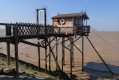
 Moderate