Country:

 City:
City:


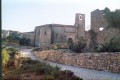
Parking at the eastern entrance to Fontjoncouse, on Avenue de Saint-Victor.
(S/E) From the car park, take the steps leading to the path overlooking the car park. On your left, you will see a passage between the houses; take it. Cross Avenue Saint-Victor and take the path to the wash house opposite, between two low walls bordering vegetable gardens. Pass in front of the wash house dating from 1895. Then follow Rue de la Source to the left for a few metres (there is a fountain a little further south).
(1) Turn right, then left onto Rue du Château. You will arrive in front of a 12th-century gate, behind which a beautiful stone staircase leads to the Church of Sainte-Léocadie. Go around the church on the right, join the road that leads to the cemetery and follow it to the right for a few dozen metres.
(2) Turn left (west) onto the path that climbs towards the Moulin des Amarels. Join a concrete road and follow it to the left. On the flat section, don't miss the mill 20 metres from the road on the right.
(3) Turn back and take the road on the right (south), which becomes a carriageway, and continue to a crossroads.
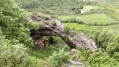
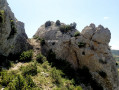
(4) Continue right towards the Lost Arch (sign). Follow the marked and cairned path, first to the southwest. Then turn northwest (follow the markings) and reach the arch, which was recently discovered and highlighted in 2016.
(5) Turn back to the previous junction.
(4) Turn right onto the carriageway heading south.
(6) At the fork, turn right and continue south-west, then south.
(7) In a hairpin bend to the right, take a small path that starts on the left towards Les Palats (sign). This path takes you across the Plateau des Monédières (the mountains where the first rays of daylight appear), and through the heath you will see the remains of the intense pastoral activity that followed the forest (imposing sheepfolds).
Follow this path winding through the heath to the Gallo-Roman lime kiln (remains of the forestry and wood energy industry and construction of the Roman agricultural estate "Les Palats" (the Palaces), where a sign will tell you how it worked.
(8) When you reach the door of the kiln, you are on the path that continues (follow the cairns) until you reach a track suitable for vehicles.
Turn left and continue along the path that descends towards the Col de Guira. Descend towards the vineyard on your left and follow it until you reach the D123 road
(9) Take the road on the right for 20 m, cross it and turn left to follow the track that starts after the bridge towards the south, then towards the east.
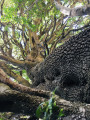
You will be walking along a track suitable for vehicles and will pass a hunters' hut on your left. 80 m after this hut, you will see a very old tree on your left (perhaps 200 years old or more). It is a "phillyrea latifolia" (broad-leaved phillyrea) from the Oleaceae family. This tree grows very slowly, so it is certainly several centuries old.
(10) At the fork, near a building, turn left and follow the north-east path, then east, which leads to a road.
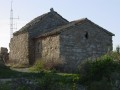
(11) Turn right and take the road towards Saint-Victor. Turn left before a row of yew trees and start climbing (there are shortcuts that cut some of the corners). There are no difficulties until you reach the Hermitage, where you will find two orientation tables, a geodetic marker, a watchtower and a telephone pylon (you can't miss it).
(12) To descend, you have to take a tricky passage against a small solid building (you will need to use your hands), which is signposted "Retour". The path winds through a tall forest that shades the stony path. The trail joins another trail that climbs up to the Hermitage: ignore it and continue downhill until you reach a square on the right with a letterbox decorated with a wooden sculpture.
(13) Follow the D123 to the left. After 300 metres, turn right and follow a path that climbs up to the plateau and joins the old path that used to pass through a vineyard, now fenced off. Follow this path as it winds and climbs gently until you reach a carriage road at the top.
(14) Follow the track for 260 metres and you will find the start of a path marked by a large cairn on your left.
(15) Turn left and walk about 100 m south. This track leads to the pastoral shelter known as the "Grotte du Beurre" (Butter Cave).
(16) This shelter was used by the first shepherds of Fontjoncouse. It is a partially filled sinkhole covered by heath. This means that you only see it at the last moment, so be very careful when approaching. The sinkhole is on your right as you walk along the path: there is a high risk of falling. The path passes 0.5 m from the edge of the hole.
A torch is useful.
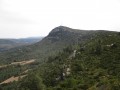
There is a beautiful view of the Mediterranean, Pic Saint-Victor and the Pyrenees with Canigou.
Turn back to the previous crossroads.
(15) Turn left and head towards Fontjoncouse. Pass the honey farm (the road becomes paved). Turn left onto the main street, pass a restaurant and return to the car park where you started (S/E).
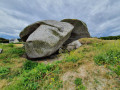

 You have to be determined to get there, as the signs are a bit unreliable and the cairns are randomly placed. But what a treasure you discover when you find this lost arch...
 Very pleasant hike!


 Visorando Member

 Very difficult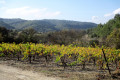
 Difficult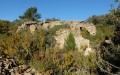
 Association / Club / Walk leader
 Easy
Easy