Country:

 City:
City:


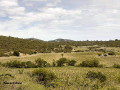
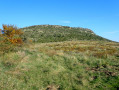
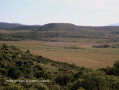
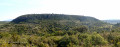
The starting point is the car park in the village of Fontjoncouse, on the right-hand side of the D323 when coming from Portel.
(S/E) Enter the village on foot via Avenue Saint-Victor, passing the town hall (on your left) and then a restaurant (on your right).
(1) Turn left, then right, and continue along the main road, Avenue de Coustouge.
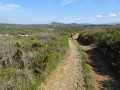
(2) At the last house in the village (on the right-hand side), just before the village exit sign, turn left onto a path that runs alongside a meadow. This leads to a poorly maintained asphalt road. Follow this road straight ahead (west-southwest) for about one kilometre. Look for the sign on the left indicating the Fontjoncouse climbing site.
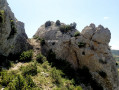
(3) Then turn left onto the path that climbs (south-east) at the foot of the cliffs of the climbing site.
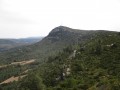
You will see a small canyon; climb up it heading south-east. A chain helps you to cross a sloping slab. Inside the canyon, continue on the left, following the path that climbs upwards. At the top, to exit the canyon, turn left heading north-east. Reach the Devès plateau, following the path and cairns carefully.
Be careful not to approach the edge of the cliffs, as there is a risk of falling.
(4) Pass under the Arche Perdue and continue along the path through the heath towards the south-east.
(5) You will come to a farm track; follow it to the left. You will reach a crossroads with a track suitable for vehicles (on the left, you can return directly to the village if necessary).
(6) Follow the track on the right, heading south. Stay on this track for 1.4 km and ignore the turnings on the left. You will reach a crossroads at an elevation of 311 metres.
(7) Take thesecond path on the left (signposted "Palats"), heading south-southeast. This is the old Monédiaire path. Follow it for 900 m to cross the Monédiaire plateau. Pass some ruined sheepfolds, then a Gallo-Roman lime kiln. You will reach a track. Follow it to the left to descend to the Col de Guira.
(8) Descend to the right towards the south-west, towards a vineyard and ploughed fields. This is the Pallats plain: in the centre, you will see a tumulus topped by a dolmen. At a fork, turn left towards the dolmen, taking the path that leads to the vineyards.
(9) Take the path on the right between the vineyards to reach the Dolmen de Palats. Retrace your steps.
(9) Continue along the path on the right (east-southeast). After about 400 metres, the path turns left. Shortly afterwards, at a three-way junction, take the path on the left. You will reach a fenced vineyard; go around it on the left. Then squeeze between two vineyards and you will come out in an abandoned meadow (magnificent view of the Saint-Cristol plain on the right and the summit of Saint-Victor topped with antennas).
Please note: at the top of this meadow, there is an apiary for harvesting rosemary (only in spring).
Cross the meadow straight ahead (north-northeast), heading towards a "wall" of broom in which a passage has been created. Continue and cross the Saint-Cristol stream (source).
(10) After crossing the stream, first turn left then right and continue to follow the track and cairns in a north-easterly direction. You will come to an abandoned vineyard on your left. Pass it and join the farm track that leads to it. Follow this track to the D123 road (be careful, this track is full of fossils).
(11) At the end of the path, you will reach a carriage road. Turn right and continue for 220 metres until you reach the D123 road. Cross the road to the right and take the carriage road opposite (dirt track). Enter the Saint-Cristol plain, site of an ancient Visigothic chapel. Pass in front of a hunters' hut.
(12) A hundred metres or so further on, note a very old tree on the left (perhaps 200 years old or more) and continue along the path. Further on, you will see the entrance to a rally company (no entry). Continue along the carriage road through the vineyards, ignoring the paths on the left and right.
(13) At elevation 297, the road makes a hairpin turn to the right and begins the descent into the Saint-Victor valley (concrete road). You will reach a crossroads.
(14) Turn right, heading south, for 200 m, pass the sign for "Bergeries de Saint-Pierre" and turn sharply left, heading east, onto the renovated and asphalted farm track that climbs up to the Hermitage of Saint-Victor.
(15) At the top, where the Hermitage of Saint-Victor is located, head north to take the downhill path (small sign marked "retour"). This 2 km long path follows the ridge called "La Cadorque", which runs roughly north-northwest. Pass through an area with a sharp limestone pavement, continue along the path until you reach the D123 road. Follow this road westwards, cross the small stone bridge over the Barras stream and continue for 70 m.
(16) Turn right onto a dirt track heading north. Continue for about 270 m until you come to a fenced vineyard. Go around it on the left for 10 m, following the fence, then turn completely left to climb up some rocks. (This detour leads to the other end of the fenced vineyard).
Reach a path leading to the final plateau of the hike: the Selve plateau. Follow this path for about 800 m until you reach a carriage track. Turn left towards the west and follow this track for 260 m.
(17) Turn left onto a path marked by a large cairn. This path leads to the pastoral shelter known as "Caune du Beurre" (100 m to the south), a shelter used by the first shepherds of Fontjoncouse.
Caution: This shelter is a partially filled chasm, covered by heath. This means that you only see it at the last moment, so you must be very careful when approaching it. The chasm is on your right-hand side as you walk along the path: there is a high risk of falling. The path passes 0.5 m from the edge of the hole. A torch is useful.
Return to the track.
(17) Continue south-west for about 650 m until you reach a crossroads. At the crossroads, turn left, heading south-west, onto the path towards Fontjoncouse.
(18) Pass in front of the Fontjoncouse honey farm, continue straight ahead and enter the village via the main street (Avenue Saint-Victor).
(1) Turn left and you will reach the starting point (S/E).



 Visorando Member

 Very difficult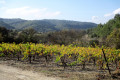
 Difficult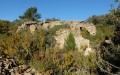
 Association / Club / Walk leader
 Easy
Easy