


 Country:
 City:
City:


Start: Kreuznaaf bus stop
(S) We continue our hike on the Kölner Weg on the B484 from the Kreuznaaf stop. The K takes us into the village and leads to a road that curves to the right through the village. We walk to the K34, where we turn left.
(1) After about 100 metres, we leave the K34 again and turn right onto a small asphalt road that takes us into the Naafbach valley.
The Naafbach rises at an altitude of 291 metres on the southern flank of the Heckberg. Since around 1930, there have been plans to dam the Naafbach and build a drinking water reservoir to supply Cologne and Bonn. However, these plans were thwarted by public protests. The Naafbach valley and its side valleys have been a nature reserve since 1982. In this valley, criss-crossed by numerous hiking trails, we encounter oak, beech, alder and ash trees alternating with willows and meadows.
After a while, our path branches off to the left, then to the right into the Ürmichbach Valley.
(2) We continue our hike, slowly climbing uphill. Later, meadows accompany us on the right side of the path until, after a longer climb, we arrive at a small village square in Deesem.
Deesem can look back on a long history of mining. Below the village, in the Wenigerbach valley, there are remnants of old mine workings and tunnel entrances. A tunnel from the 16th century, dug by hand with hammer and iron, which probably served to drain water from the Walpot mine, has been uncovered. This mine, not far from Deesem, has been partially reopened. The mine was mainly used to extract lead, zinc and copper ores as well as pyrite.
(3) We then walk through the village, pass a half-timbered house from 1822 and arrive at Oststraße. There we pass a wayside shrine from 1879. A little later, we leave Deesem via Nordstraße. At the end of the village, there is a wide view over the Bergisches Land and the church of Seelscheid. Soon we continue on a field path, which later nestles against the edge of a forest. To the right, rolling meadows rise up and give this section its special charm.
The path winds its way through a large forest area until we reach open terrain again shortly before Heister.
(4) A little later, we cross Buscher Straße and head towards the B56. On the other side of the B56, we continue along Heisterstraße. After a few metres, a sign points to a riding stable and Brita's Oase.
Our path continues straight ahead on Heisterstraße, from which we eventually turn right. Shortly afterwards, we cross another deciduous forest. Finally, we emerge from the forest and the tranquil path leads us along the edge of the forest. We turn left, with meadows on our right.
(5) Soon after, we enter another forest and pass several fish ponds. Finally, we reach an open space and come to the L189.
(6) We cross this road and continue on a beaten path on the other side.
We have reached the Wahnbach Valley. A small grassy path leads along the stream.
The Wahnbach is a stream about 26 kilometres long that feeds the Wahnbach Dam.
(7) After about 150 metres, we cross the Wahnbach via a small iron bridge and continue on the other side of the stream. We follow it to a point where the Wendtal valley joins the Wahnbach valley from the left. The Wendtal is a small, charming stream valley.
(8) We continue straight ahead and come to a fork where the Kölner Weg branches off to the left, but the A3 hiking trail continues towards the Wahnbach Dam.
We follow the K into a narrow forest valley and, after a steep climb, reach Neunkirchen-Dahlerhof.
(9) There we reach Dahlerhoferstraße, which we follow to the right and then Walzenrather Straße, where we turn left.
The name Walzenrath has a historical background: in 1220, the Heide estate was divided into the Walzenratherhof and Wiedenhof estates. The vicars of the parish of Neunkirchen derived their income from leasing the Walzenratherhof.
(10) From there, it is a short walk to the main road, where we turn right towards the parish church of St. Margareta. The Hotel Zum Kurfürst is located on the main road, about 200 metres behind the church. However, Kölner Weg branches off to the left before the church into the street Im Thomasgarten. A short detour to the church is worthwhile.
Neunkirchen was first mentioned in a document in 1178. The parish church of St. Margareta in its present form dates from the 12th century. Its Romanesque ceiling frescoes are said to be unique north of the Alps. Wilhelm Herchenbach (1818-1889) was born in Neunkirchen. He was an important writer in the 19th century. Because of his fantastic stories, he was also known in his homeland as "Lüchherchenbach". In one of his legends, he describes how the knight Göttscheid arranged for the completion of the previously unfinished church tower of St. Margareta. The church was the ninth in the area, which is how Neunkirchen got its name.
We return from our detour to St. Margareta and, coming from this direction, turn right into Im Thomasgarten, which soon becomes Jahlsquelle. Passing the cemetery, we continue along a shady path to a small gravel area. Here we turn half-right onto a path-like trail, follow it to a staircase and turn right onto a cross path.
(11) A little later, we turn right again onto an asphalt road. After a few hairpin bends, we now hike downhill into the Dreisbachtal valley. We cross the Dreisbach stream, hike along the stream, pass fish ponds and later follow a gently ascending forest path to Ohmerath.
(12) There, we turn right onto Ohmerather Straße. The K then leads us downhill in a winding path to Ingersau in the Bröltal valley. Our path turns into a small road that leads to the B478, which we cross immediately and turn right.
Ingersau, first mentioned in documents in 1379, is a tiny village at the confluence of the Dreisbach and Bröl rivers. Although only a small village, it belongs to two municipalities. The former course of the Bröl formed the border between Ruppichteroth and Neunkirchen-Seelscheid.
(13) We cross the Bröl via a bridge and continue along the road Im Höfchen. Here we leave a section of countryside with many hills, small and large wooded areas, wide meadows and fields, and many half-timbered farms. From now on, the landscape becomes more expansive, with fewer frequent ascents and descents into the valleys; instead, we have to tackle larger ascents, but also hike longer distances on the heights or in the valley.
On the left side of the path, we pass a factory. The path then turns left and heads towards Winterscheiderbröl, a village with some beautiful half-timbered houses.
(14) We then reach the road Am Brunnen and pass a crossroads. We walk to the end of the small road and climb steeply uphill across a meadow towards a forest, crossing a road twice and continuing uphill along the edge of the forest until we reach the Wendelinus Chapel.
(15) We then enter an oak forest, emerge into the open again and see Winterscheid ahead of us.
(16) Our path finally joins Wendelinusstraße, which leads us up to Winterscheid and the Agatha Chapel. Behind the chapel on the left-hand side of the road, we turn left onto the main road and walk towards the church in Winterscheid.
(E) On our way, we pass several beautiful half-timbered houses and reach today's destination at the Church of St. Servatius.
Winterscheid lies at an altitude of 220 metres. The area around Winterscheid was mainly developed during the great clearing between the 11th and 13th centuries. The village was first mentioned in documents in 1131. Due to a decree by Emperor Napoleon I in 1808, Winterscheid became an independent municipality in 1815, but did not receive its own administration. It shared this with Ruppichteroth. In 1969, the municipality's independence finally came to an end, and since then Winterscheid has formed the municipality of Ruppichteroth together with other small villages. The parish church dedicated to St. Servatius is worth seeing. The church tower dates from the 12th century; the church was rebuilt in 1685, but the tower was retained in its original form. The nave was rebuilt again between 1765 and 1781.
 Association / Club / Walk leader
 Visorando Member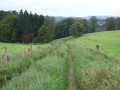
 Difficult
