


 Country:
 City:
City:


Start: Königsforst stop
(S) From the Königsforst stop, we first follow the K into Rösrather Straße, then turn right onto Rather Mauspfad into Forsbacher Straße, which leads us straight into Königsforst. Shortly afterwards, a 4-kilometre-long forest nature trail branches off to the left. A soil nature trail also begins here.
The Königsforst was already settled in the Iron Age. This conclusion can be drawn from numerous burial mounds found between Cologne-Rath and Forsbach. In the 10th century, the Archbishop of Cologne, Bruno I (953-965), received the forest from his brother, Emperor Otto the Great. During secularisation, the Königsforst became the property of the Grand Duchy of Berg. During the Napoleonic era, the Königsforst was almost completely devastated because the oak trees were felled and shipped to France for use as timber. At the Congress of Vienna in 1815, the Grand Duchy of Berg and thus also the Königsforst were awarded to Prussia. From this point on, Prussia began to systematically reforest the severely damaged forest.
(1) A good 50 metres after the Schiefer Hauweg/Forsbacher Straße junction, Forsbacher Straße forks into Rath-Forsbacher Weg and Steinbruchsweg. At this crossroads, we pass a shelter and follow the K sign into a forest path to the right. The Kölner Weg winds its way through deciduous forest until we reach a place called Dicker Stock.
(2) We first turn right and then, a little later, left in front of a shelter. Finally, we cross the Rennweg.
The name "Rennweg" may be derived from the fact that iron ore was mined and smelted in the Königsforst forest in prehistoric times. This is evidenced by ancient mine and slag finds. The ore was smelted in Rennöfen (smelting furnaces), some of which have also been excavated in the Königsforst forest.
East of Rennweg, the terrain rises continuously. We have reached the western edge of the Bergisches Land. Shortly afterwards, we cross Wolfsweg, turn left onto Lützelerweg and finally arrive at a water treading pool.
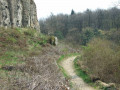
(3) There we continue straight ahead until we reach Steinbruchsweg, where we turn right. Shortly after the crossroads, we notice a small sunken path on the left that leads to an abandoned quarry.
(4) We then pass the Großer Steinberg, at 131 metres the highest natural elevation in Cologne. After a while, our path turns left.
(5) At the next intersection, we turn right and reach the Kaisereiche(Emperor's Oak).
The oak tree we see today is not the original Kaisereiche. It was planted in 1908 in honour of Emperor Wilhelm I (1797-1888). After the First World War, the tree was used by French troops for shooting practice, which it did not survive. However, on the opposite side of the path stood another oak tree, which has been considered the Kaisereiche ever since.
(6) After about 500 metres, we turn left and arrive at location 4 of the Königsforst educational trail.
In this area, there is a stand of red oaks about 50 years old, interspersed with sycamore maples and European larches. This is a typical example of post-war reforestation. The planting of fast-growing tree species was intended to compensate for the overexploitation of the forest during the Second World War.
(7) After a long stretch, the Kölner Weg turns right and we cross the former railway line from Bensberg to Rösrath. At the next crossroads, we turn left and soon reach the L288.
(8) We turn left and walk along it for 120 metres before crossing the road and passing a barrier to enter the forest on the right. We now walk through the tranquil Wahlbachtal valley.
(9) Finally, we come to the historic Brüderstraße, where we turn right.
Brüderstraße was a medieval trade route connecting Cologne with Siegen. It ran almost entirely along the heights and only rarely through the impassable river valleys. With the construction of modern roads since the Napoleonic era, such as the Köln-Olper Chaussee (1823-1834), Brüderstraße lost its importance. However, it is still preserved in some sections, such as here from Bensberg to Steinenbrück.
(10) From Brüderstraße, we soon turn right onto a wide forest path that climbs steadily. We pass the Tütberg, at 212 metres the highest point in the Königsforst.
(11) At a shelter, we turn right and later come to Villa Tütberg, which was built after the First World War by a Cologne banking family. From here, we hike along a sandy path with sharp bends to Lehmbach and the L284. The Lehmbacher Hof is just a few steps to the left.
(12) However, we follow the K to the right onto the L284 and cross the Sülz a little later.
(13) On the opposite bank, we turn right and walk to Rösrath-Sülze.
(14) The K leads along the Sülzer Burg road past Scheltensülz Castle.
According to recent findings, the castle of the Schelte family was probably built around 1470. Today, the castle is privately owned and cannot be visited.
Soon we reach the L284, the Bergische Landstraße, and thus the destination of our stage.
(E) If we turn right onto the L284, we come to the Sülzer Burg stop.
 Association / Club / Walk leader
 Visorando Member
 Difficult
