(S/E) The Calvary has stood for centuries on a rocky outcrop facing the village and overlooking the Sarthe valley from a height of around thirty metres. It was erected on the last foothill of the Armorican Massif by the Leclerc family of Juigné to mark the birth of their daughter Anne in 1828. A Neolithic settlement (more precisely dating from around 4,000 BC), protected by a rampart that has since disappeared, stretched out behind the cross on the edge of the Croix-Sainte-Anne plateau. As flint from a ‘vein’ located in what is now the commune of Vion was worked there, it yielded a collection of tools including polished axes, arrowheads, scrapers, awls and hundreds of retouched blades. Dr Dufossé, a doctor from Sabol, discovered them in 1895 after ploughing: “They were everywhere. I filled my pockets with them and, when they were too full, I lamented that my professional dignity prevented me from filling my top hat.”
(3) Near the D252 county road, to the north-west of the village, stand the two lime kilns of Clos Chauvin. One is square and the other circular. Another important site for lime production was Port-Étroit, the first continuous-burning kiln in the Sarthe region in 1808, which remained in operation until 1963. Their role was to lime acidic and waterlogged soils, which enabled cereal yields to be doubled or tripled. These old brick chimneys evoke the region’s mining past, as in the 19th century the anthracite extracted there fuelled these lime kilns, which were among the largest in the region alongside those at Les Chauvières in Auvers-le-Hamon. The limestone used to fuel them came from the marble beds located immediately behind, such as here along the stream that runs alongside the footpath. 250 kg of coal is needed to calcine one tonne of limestone. Consequently, as the old saying goes, ‘Lime enriches the father but ruins the son’; as excessive liming had depleted the soil, many kilns closed around 1860.
Continuing along the D239: the former Sanguinière mine, operated from 1917 to 1928 and then from 1943 to 1950 to supply the Kodak-Pathé company in Vincennes. Its annual output was 30,000 tonnes.
(4) At the Place du Grand-Jardin: where there is a castle garden, there must be a castle.
This is situated a stone’s throw from the town hall, at the end of Rue Haute, in the heart of a wooded park laid out in the ‘French style’.
The Château de Juigné-sur-Sarthe was built at the end of the 17th century on the edge of the old road that linked Sablé-sur-Sarthe to Le Mans. Although its façades are now rendered, fine cut stone surrounds the doors and windows. Local grey-blue marble can also be found there. The main building has been remodelled on numerous occasions, most recently shortly before the Second World War. A monumental wrought-iron gate and outbuildings (farm buildings, a stud farm, a barn and an orangery) were added at that time. At the start of the 20th century, ‘the Château’ was the village’s largest employer, with around sixty people living on the estate: from maids to the estate manager, including dog handlers, private guards, cooks and coachmen... As for the marquis during the Second World War, Jacques-Auguste Marie Le Clerc, he was also the mayor.
Points of interest on Rue-Haute from the Place du Grand-Jardin (numbers 9, 10, 17, 18, 31 and 39):
- The first house on the right, at 39 Rue Haute, belonged to one of the town’s leading families, the Le Clerc de Juigné family. This family converted to Protestantism, hence their name. This house also served as a burial place.
- Opposite the church, number 9 Rue Haute is known as “Le Prieuré”. Only the northern half of this 17th-century dwelling remains. Originally, the octagonal turret occupied the centre of the main façade. The spiral staircase has retained its moulded core in the lower section. The southern half was demolished in the 19th century and converted into workshops. The dormer window on the attic floor, topped by a triangular pediment, remains in its original state. The interior rooms retain two 17th-century fireplaces, dating from the period when the market town was developing. In the priory courtyard, you can see a turret covered with shingles (wooden tiles).
- The weavers’ houses, with their characteristic cellar doors, are located at 18 Rue Haute.
- At 17 Rue Haute, this section of the building dates from the 15th century. On the front façade, a covered gallery on the upper floor flanks the staircase turret, with its polygonal roof, which connects the main building to the rear wing. The building underwent extensive alterations in the 18th century. The south-facing façade of the Grand-Villiers allowed for the installation of a sundial in the 18th century, a period when the art of gnomonics flourished with the publications of Dom François Bedos de Celles. Dom Segrétain, prior of Solesmes in 1837, became an expert himself in the craft of making and installing these dials. The morning and evening hours are painted in Roman numerals. The shadow of the iron gnomon, positioned on the site’s meridian plane, moves across the dial in an anti-clockwise direction. Its length varies throughout the year depending on the seasons and the sun’s altitude.
- At 31 Rue Haute, the Petit-Villiers has a hexagonal stair tower.
- At the École des Prés-Hauts, two plaques commemorate the Second World War. One relates to the deportation of Elizabeth Cohen from Antwerp. Born in 1874 into a family of Parisian Jewish bankers, she took refuge in her chauffeur’s house at Clôteau de Maupertuis in Juigné-sur-Sarthe. Although she converted to Catholicism at the age of 20, the Germans arrested her on 26 January 1944 and she died on 15 April 1944 whilst being transported from Drancy to Auschwitz. The second commemorative plaque pays tribute to Emile Chaudemanche, first deputy mayor, and to Pierre Chimidlin, a refugee and blaster at the Sanguinière mine, who defused the explosives intended to destroy the village, which had been laid in 1944 by the Wehrmacht (the same German company as that based in Ouradour). Only the church was set on fire.
- On the other side, on the façade of number 10, a third plaque commemorates the fact that it was here that the Ringeard couple hid Ragnard Gustfason, an American pilot (navigator of a bomber) who was shot down on 17 June 1944 at Torcé Vivier in Charnie, for about a month.
(5) At the end of Rue Haute:
- The Priory of Juigné-sur-Sarthe (Cour du Prieuré):
Built at the same time as the church, the priory surrounded it to the north and south. The south wing has long since disappeared. The remaining north wing was rebuilt between the 15th and 17th centuries and again after 1843. On the north façade, the turret with a conical roof of the former wing houses a spiral staircase leading to the upper floor, which retains a 17th-century fireplace.
- The church at Juigné-sur-Sarthe (Place de l’Église):
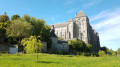
As early as the 12th century, when the church dedicated to Saint Martin of Tours was built, a priory existed. The detached bell tower, covered with a hipped roof, dates from this same construction phase. At the end of the 16th century, the sacristy was added to the north. It was converted into a chapel for the Juigné family after 1815, leading to the construction of a new sacristy. The nave, which had already been enlarged in 1866, was remodelled and rebuilt in 1923–1924 by the Leclerc de Juigné family. The stained-glass windows were crafted by master glassmakers from Lyon in the 19th century. Inside, the oldest surviving work is a crowned Virgin Mary (14th century), carved from oak, which has lost its polychromy. The reverse is flat; the Virgin’s feet and right hand are missing. On the left-hand wall, a cedar wood sculpture, carved by Raymond Dubois of Juigné, depicts the Sacred Heart and the village. Above the entrance door, a statue of Saint Barbara, patron saint of miners, bears witness to the village’s mining activity. An 18th-century pulpit surmounted by a varnished wooden canopy, with a staircase featuring a wrought-iron banister in the Louis XV style, and a sanctuary lamp in brass and bronze adorned with interlacing foliage, cherubs and fruit are also visible.
When observing the church’s overall architecture, note the use of local stone: a bluish-grey marble that appears as such when left in its raw state or when cut, as seen in the corner bonding of the north-west corner. This marble, which turns black with white veins when polished, is used here for the altarpiece of 1787 (oil on canvas depicting the Apotheosis of Saint Martin, two terracotta statues of Saint Yves and Saint Charles Borromeo, and twin marble columns), the holy water font and the baptismal font with a baluster base, covered by a wooden lid surmounted by a cross. This limestone-marble, known as Sablé or Juigné marble, was quarried and cut locally, for example at Port-Étroit, which has profoundly altered the appearance of the hillside downstream from the village.
- In a low wall bordering the church square on the river side, just before the steep slope of Rue des Sœurs, which offers a unique view of the Sarthe Valley and Solesmes Abbey, a 1.10-metre-long polishing stone has been incorporated into the masonry of a low wall bordering the church square on the river side. These sandstone blocks were used in the Neolithic period (3rd millennium BC) to polish hard stone or flint axes. This one features 21 grooves or polishing marks. It was the repeated rubbing of stone tools that carved the grooves into the sandstone. Water and sand were used as abrasives. It probably comes from the first Juigné ‘village’ at Croix-Sainte-Anne.
Near lock no. 13 and its weir:
- In the gardens near the lock, a small building with a conical roof housed the hydraulic ram. This device allowed water to be raised to a certain height without any other energy
than the force of the water itself, supplied the village with running water. It was invented at the end of the 18th century by Joseph Montgolfier and improved by Ernest Bollée. Its installation in Juigné by the Marquis de Juigné dates from 1898. The cast-iron ram’s drop column stands at the end of the path, by the roadside.
- Flour mill and the former mill manager’s house (1881)
The medieval mill on the River Sarthe was destroyed in 1838 and replaced shortly afterwards by new buildings modelled on the large English-style flour mills then being built along the river. The second largest in the department, the Juigné mill operated day and night, and its highly prized flour was transported by water to Bordeaux and Marseille. Fourteen people living in Juigné, mainly in the areas of Le Bourg, Port-de-Juigné and Les Saulneries-Maupertuis, were employed there. It ceased operations on the eve of the First World War. In 1866, the mill was equipped with 14 pairs of millstones and a wheel 8 metres in diameter, and then with 18 pairs of rollers in 1936. After being occupied during the Second World War by British and then German forces, the mill was destroyed a few years later. This is why only the ruins of the mill remain, along with two pillars of the entrance gate near the lock-keeper’s house and the buildings dating from 1881: the manager’s house, built of brick, tuffeau limestone and sandstone in its ‘blue-white-red’ style, and the offices and workers’ accommodation.
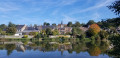
- Further on, continuing towards "Marigné", outside the village, the manor house of Vrigné, built between 1492 and 1588, is visible from the River Sarthe.



 Country:
 City:
City:



 Visorando Member
 Moderate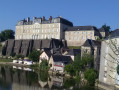
 Tourist office