


Refine your search for walks in Jardin des Plantes de Paris
Jardin des Plantes de Paris walks


 Following the Bièvre in Paris
 Visorando Member
 3.94 mi
 +72 ft
 -138 ft
 1h 50
1h 50
 Easy
Easy
 Departure from Paris
This third and final section of the Bièvre walks follows the course of the river, which is now underground, through the 13th and 5th arrondissements of Paris. The hike takes you along small streets, through lively neighbourhoods such as the Butte aux Cailles and Rue Mouffetard, and through numerous gardens, including the former Petite Ceinture railway line and the famous Jardin des Plantes.
From Porte Dauphine to Bercy
 10.25 mi
+105 ft
-138 ft
4h 50
10.25 mi
+105 ft
-138 ft
4h 50
 Moderate
Departure from Paris
Moderate
Departure from Paris
A walk through Paris exploring the Left Bank and its quartiers.
From Paris to Bry-sur-Marne via the Bois de Vincennes and along the Marne
 Association / Club / Walk leader
 15.57 mi
+177 ft
-154 ft
7h 20
15.57 mi
+177 ft
-154 ft
7h 20
 Difficult
Departure from Paris
Difficult
Departure from Paris
In the eastern suburbs of Paris, along the route taken by Saint Columbanus, we find all the signs of the Columbanian influence that shaped our countryside and landscapes.
The first part of our 26km route through the Île-de-France region is flat, allowing us to take the time to visit the jewels revealed by the churches of Paris, as well as the towns that witnessed the birth of the monasteries that punctuate the route.
Retrace Bourvil and Gabin’s walk through Paris
6.11 mi
+269 ft
-59 ft
3h 05
Easy
Departure from Paris
Retrace the steps of Bourvil and Jean Gabin in Claude Autant-Lara’s film. Of course, all this remains rather imaginary, as very little of the film was shot on location. But there is still the route from Rue Poliveau to Rue Lepic and the pleasure of strolling through the streets of Paris. There is one more filming location that lies too far off the main route: 158 Boulevard Hausmann, now the Jacquemart-André Museum, where the scenes of the arrival at the Kommandantur were filmed.
The Bestiary of the Latin Quarter
 5.78 mi
+210 ft
-207 ft
2h 50
Easy
Departure from Paris
5.78 mi
+210 ft
-207 ft
2h 50
Easy
Departure from Paris
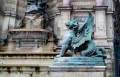
This urban route takes you on a journey of discovery through animal representations in the streets of the 5th arrondissement and through the Jardin des Plantes in Paris: sculptures and building ornamentation await you. It is also an opportunity to stroll through a lively neighbourhood, home to several renowned universities and schools.
The bestiary of Paris
 146.53 mi
+2,999 ft
-2,625 ft
33 days
Easy
Departure from Paris
146.53 mi
+2,999 ft
-2,625 ft
33 days
Easy
Departure from Paris
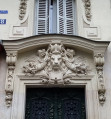
This guide brings together around thirty urban routes that allow you to discover representations of animals in the capital: sculptures, building decorations, murals, etc.
From Châtelet to Austerlitz
 4.21 mi
+138 ft
-135 ft
2h 05
Easy
Departure from Paris
4.21 mi
+138 ft
-135 ft
2h 05
Easy
Departure from Paris
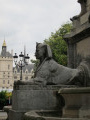
A walk between Châtelet and Austerlitz, along picturesque streets rich in Parisian history with many points of interest: gardens, monuments, building facades, etc. Depending on your pace and curiosity, the route can take between two and four hours.
Grand tour of Île-de-France in 34 stages on the GR®11
 528.35 mi
+22,037 ft
-22,156 ft
34 days
Difficult
Departure from Paris
528.35 mi
+22,037 ft
-22,156 ft
34 days
Difficult
Departure from Paris
This marked GR® route around the Île-de-France region (with a few forays into neighbouring departments and regions) complements its "little brother", the GR®1, by forming a circular route around Paris, generally with a slightly larger radius.
It follows the same overall pattern: first, a radial section starting from Paris (more precisely from the Pont d'Austerlitz, near the former confluence of the Bièvre and the Seine), going up the entire Bièvre valley, then continuing to Villiers-Saint-Frédéric, in the Yvelines. From there, it is a circular route that loops around the Île-de-France region, close to its borders with neighbouring regions.
The route passes through beautiful regions, often untouched by intensive urbanisation, regional nature parks and other protected natural areas, and takes in some architectural wonders.
Paris Pont d'Austerlitz - Massy
 14.65 mi
+361 ft
-180 ft
7h 05
Difficult
Departure from Paris
14.65 mi
+361 ft
-180 ft
7h 05
Difficult
Departure from Paris
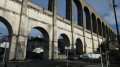
First stage of the Grand Tour of Île-de-France via the GR® 11, starting from the former confluence of the Bièvre and the Seine at the Pont d'Austerlitz in Paris, to the Massy-Palaiseau station in Essonne. It consists of climbing up the lower part of the Bièvre valley, where the river flows mainly underground but is sometimes exposed to the open air following rehabilitation programmes.
Green spaces in Paris’s 5th arrondissement
 4.70 mi
+177 ft
-157 ft
2h 20
Easy
Departure from Paris
4.70 mi
+177 ft
-157 ft
2h 20
Easy
Departure from Paris
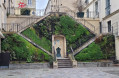
Just like Paris’s oldest arrondissement, the gardens of the fifth evoke the past: the Cluny Medieval Garden, Square Viviani, where the capital’s oldest tree, the famous black locust, has watched Paris transform for over 400 years; the Arènes de Lutèce or the Jardin des Plantes, the Royal Garden of Medicinal Plants. A tour through bustling neighbourhoods, blending bookshops, student cafés and ancient alleyways in an authentic, timeless atmosphere that embodies the intellectual soul of Paris.