


Refine your search for walks in Grande Mosquée de Paris
Grande Mosquée de Paris walks


 Following the Bièvre in Paris
 Visorando Member
 3.94 mi
 +72 ft
 -138 ft
 1h 50
1h 50
 Easy
Easy
 Departure from Paris
This third and final section of the Bièvre walks follows the course of the river, which is now underground, through the 13th and 5th arrondissements of Paris. The hike takes you along small streets, through lively neighbourhoods such as the Butte aux Cailles and Rue Mouffetard, and through numerous gardens, including the former Petite Ceinture railway line and the famous Jardin des Plantes.
Le Quartier Latin and Sainte-Geneviève Mountain
3.78 mi
+131 ft
-164 ft
1h 50
Easy
Departure from Paris
Le Quartier Latin is a labyrinth of streets, each as important as the next, as there is a strong history behind. The Sainte-Geneviève Mountain is home to several prestigious schools, and the presence of numerous students adds to the atmosphere of this magnificent suburb.
From Paris to Bry-sur-Marne via the Bois de Vincennes and along the Marne
 Association / Club / Walk leader
 15.57 mi
+177 ft
-154 ft
7h 20
15.57 mi
+177 ft
-154 ft
7h 20
 Difficult
Departure from Paris
Difficult
Departure from Paris
In the eastern suburbs of Paris, along the route taken by Saint Columbanus, we find all the signs of the Columbanian influence that shaped our countryside and landscapes.
The first part of our 26km route through the Île-de-France region is flat, allowing us to take the time to visit the jewels revealed by the churches of Paris, as well as the towns that witnessed the birth of the monasteries that punctuate the route.
Grand tour of Île-de-France in 34 stages on the GR®11
 528.35 mi
+22,037 ft
-22,156 ft
34 days
Difficult
Departure from Paris
528.35 mi
+22,037 ft
-22,156 ft
34 days
Difficult
Departure from Paris
This marked GR® route around the Île-de-France region (with a few forays into neighbouring departments and regions) complements its "little brother", the GR®1, by forming a circular route around Paris, generally with a slightly larger radius.
It follows the same overall pattern: first, a radial section starting from Paris (more precisely from the Pont d'Austerlitz, near the former confluence of the Bièvre and the Seine), going up the entire Bièvre valley, then continuing to Villiers-Saint-Frédéric, in the Yvelines. From there, it is a circular route that loops around the Île-de-France region, close to its borders with neighbouring regions.
The route passes through beautiful regions, often untouched by intensive urbanisation, regional nature parks and other protected natural areas, and takes in some architectural wonders.
Paris Pont d'Austerlitz - Massy
 14.65 mi
+361 ft
-180 ft
7h 05
Difficult
Departure from Paris
14.65 mi
+361 ft
-180 ft
7h 05
Difficult
Departure from Paris
First stage of the Grand Tour of Île-de-France via the GR® 11, starting from the former confluence of the Bièvre and the Seine at the Pont d'Austerlitz in Paris, to the Massy-Palaiseau station in Essonne. It consists of climbing up the lower part of the Bièvre valley, where the river flows mainly underground but is sometimes exposed to the open air following rehabilitation programmes.
Green spaces in Paris’s 5th arrondissement
 4.70 mi
+177 ft
-157 ft
2h 20
Easy
Departure from Paris
4.70 mi
+177 ft
-157 ft
2h 20
Easy
Departure from Paris
Just like Paris’s oldest arrondissement, the gardens of the fifth evoke the past: the Cluny Medieval Garden, Square Viviani, where the capital’s oldest tree, the famous black locust, has watched Paris transform for over 400 years; the Arènes de Lutèce or the Jardin des Plantes, the Royal Garden of Medicinal Plants. A tour through bustling neighbourhoods, blending bookshops, student cafés and ancient alleyways in an authentic, timeless atmosphere that embodies the intellectual soul of Paris.
Walks near Grande Mosquée de Paris
Retrace Bourvil and Gabin’s walk through Paris
6.11 mi
+269 ft
-59 ft
3h 05
Easy
Departure from Paris
Retrace the steps of Bourvil and Jean Gabin in Claude Autant-Lara’s film. Of course, all this remains rather imaginary, as very little of the film was shot on location. But there is still the route from Rue Poliveau to Rue Lepic and the pleasure of strolling through the streets of Paris. There is one more filming location that lies too far off the main route: 158 Boulevard Hausmann, now the Jacquemart-André Museum, where the scenes of the arrival at the Kommandantur were filmed.
From the Pont d’Austerlitz to the Port de Javel along the banks of the Seine
 5.22 mi
+10 ft
-30 ft
2h 25
Easy
Departure from Paris
5.22 mi
+10 ft
-30 ft
2h 25
Easy
Departure from Paris
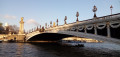
An urban route that allows you to enjoy the fully pedestrianised left bank of the Seine in Paris! You walk pleasantly along the river and pass by some of the capital’s most famous landmarks: Île Saint-Louis, Île de la Cité and Notre-Dame Cathedral, Pont Neuf, the Louvre Museum, the Musée d’Orsay, the Grand Palais and the Eiffel Tower.
Adjust your route according to the water levels of the Seine: see the practical information section.
The Bestiary of Bastille, Popincourt and République
 5.64 mi
+43 ft
-39 ft
2h 40
Easy
Departure from Paris
5.64 mi
+43 ft
-39 ft
2h 40
Easy
Departure from Paris
A south-to-north walk through the 12th, 11th and 10th arrondissements of Paris, in search of depictions of animals. The Port de l’Arsenal and several narrow passages add a picturesque touch to this route.
From Italie to Didot via Butte-aux-Cailles and Petit Montrouge
 5.01 mi
+138 ft
-138 ft
2h 25
Easy
Departure from Paris
5.01 mi
+138 ft
-138 ft
2h 25
Easy
Departure from Paris
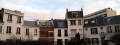
A journey through the 13th and 14th arrondissements of Paris, through lively neighbourhoods with diverse architecture. Numerous "villas" lined with old workshops and pretty townhouses, the remains of two aqueducts, including a Gallo-Roman one, heritage from the first half of the 20th century and a few street murals await you.
The Philippe Auguste enclosure and the covered passages of the Sentier
 4.71 mi
+26 ft
-23 ft
2h 10
Easy
Departure from Paris
4.71 mi
+26 ft
-23 ft
2h 10
Easy
Departure from Paris
This route on the right bank of the Seine takes us on a journey from medieval times to Art Nouveau. First, we discover the most important remains of Philippe Auguste's city walls and former mansions. We then wind our way through the Sentier district to explore several of its covered passages.
This walk is best done during the week, as the covered passages are closed on certain days.
The murals of the 13th arrondissement
 4.14 mi
+62 ft
-75 ft
1h 55
Easy
Departure from Paris
4.14 mi
+62 ft
-75 ft
1h 55
Easy
Departure from Paris
Paris’s 13th arrondissement is renowned for its abundance of murals and for the sheer scale of some of these works, which cover walls up to sixty metres high. This urban trail offers the chance to discover no fewer than forty of them, including some of the most spectacular. For street art enthusiasts!
From Gare de Lyon to Porte d'Auteuil
 11.35 mi
+259 ft
-249 ft
5h 25
11.35 mi
+259 ft
-249 ft
5h 25
 Moderate
Departure from Paris
Moderate
Departure from Paris
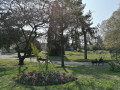
This walk, part of the GR® 75, allows you to discover a large number of parks situated on the edge of Paris’s southern ring road. It serves as an intermediate stage and allows you to explore the southernmost section of the GR®. There are many notable spots along theGR® and in the surrounding area, such as the Butte aux Cailles, Montsouris Park and the Jardin des Serres d’Auteuil. As you pass through the many parks, you’ll feel as though you’re far removed from the city.
The Passages of Paris
7.51 mi
+75 ft
-16 ft
3h 30
Moderate
Departure from Paris
In Paris, the term ‘passages’ refers to covered walkways through which one goes from one street to another by passing through one or more buildings, and which are intended solely for pedestrians. The shops there are splendid, well-stocked, but somewhat expensive. In bad weather, like the Palais-Royal, they serve as promenades and meeting places. They are generally lit by gas.
On the French Revolution routes in the heart of Paris
 3.31 mi
+72 ft
-69 ft
1h 35
Easy
Departure from Paris
3.31 mi
+72 ft
-69 ft
1h 35
Easy
Departure from Paris
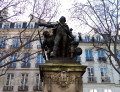
An urban circular walk in search of the French Revolution routes in two Parisian sites: the Bastille, whose capture had a very strong symbolic impact, and the Odéon suburb, where several key figures of the period lived, worked and gathered, including Marat and Danton. It's also an opportunity to discover the signs of other insurrectionary episodes (July 1830, May 1968) and a superb heritage ranging from the Gallo-Roman to the Middle Ages period.
The Village Saint-Paul, Île Saint-Louis and Île de la Cité
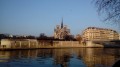 3.13 mi
+26 ft
-26 ft
1h 30
Easy
Departure from Paris
3.13 mi
+26 ft
-26 ft
1h 30
Easy
Departure from Paris
The last stage of this journey takes us to the historic heart of Paris, where we discover a rich heritage. The labyrinthine streets of the Village Saint-Paul are followed by the Île Saint-Louis and its 17th-century mansions. The Île de la Cité is a delight in itself, with Notre-Dame as its highlight. And the Seine is always in the background...
The route and description take into account areas closed to the public following the Notre Dame fire in April 2019.