


Refine your search for walks in Gare de Paris-Lyon
Gare de Paris-Lyon walks


 From Île de la Cité to Porte de Charenton
 Visorando Member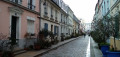
 4.51 mi
 +69 ft
 -33 ft
 2h 10
2h 10
 Easy
Easy
 Departure from Paris
From the heart to the outskirts of the capital, an urban route that first crosses the Île de la Cité and the Île Saint-Louis. It continues along the banks of the Seine and then the Port de l'Arsenal. After passing by the Gare de Lyon, the route briefly follows the Coulée verte René Dumont. The walk ends via Square Saint-Éloi, the former Gare de Reuilly and Place Félix Éboué with its lion fountain.
From Gare de Lyon to Porte d'Auteuil
 11.35 mi
+259 ft
-249 ft
5h 25
11.35 mi
+259 ft
-249 ft
5h 25
 Moderate
Departure from Paris
Moderate
Departure from Paris
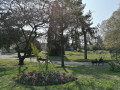
This walk, part of the GR® 75, allows you to discover a large number of parks situated on the edge of Paris’s southern ring road. It serves as an intermediate stage and allows you to explore the southernmost section of the GR®. There are many notable spots along theGR® and in the surrounding area, such as the Butte aux Cailles, Montsouris Park and the Jardin des Serres d’Auteuil. As you pass through the many parks, you’ll feel as though you’re far removed from the city.
From Porte de la Villette to Gare de Lyon
 10.98 mi
+249 ft
-285 ft
5h 15
Moderate
Departure from Paris
10.98 mi
+249 ft
-285 ft
5h 15
Moderate
Departure from Paris
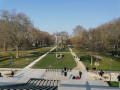
This urban route allows you to discover a large number of parks situated on the edge of the ring road in eastern Paris. Serving as an introduction tothe GR®75, it runs partly through the Bois de Vincennes and passes close to several other notable sites such as the Philharmonie, the Cité des Sciences and the Père Lachaise Cemetery. As you pass through the many parks, you might feel as though you’re far from the city, even though it’s only a stone’s throw away.
The Paris circuit via the GR®75
 32.61 mi
+614 ft
-636 ft
3 days
Moderate
Departure from Paris
32.61 mi
+614 ft
-636 ft
3 days
Moderate
Departure from Paris
TheGR®75is one of the most accessibleGR® routes in France. It allows anyone to try their hand at hiking whilst passing through dozens of parks, gardens and public green spaces in the capital. These spaces offer a real breath of fresh air, just a stone’s throw from the city centre. At 50 kilometres long, some people complete it in a single day. However, to get the most out of the route, it’s best to spread it over several days
Walks near Gare de Paris-Lyon
Paris Pont d'Austerlitz - Massy
 14.65 mi
+361 ft
-180 ft
7h 05
14.65 mi
+361 ft
-180 ft
7h 05
 Difficult
Departure from Paris
Difficult
Departure from Paris
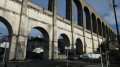
First stage of the Grand Tour of Île-de-France via the GR® 11, starting from the former confluence of the Bièvre and the Seine at the Pont d'Austerlitz in Paris, to the Massy-Palaiseau station in Essonne. It consists of climbing up the lower part of the Bièvre valley, where the river flows mainly underground but is sometimes exposed to the open air following rehabilitation programmes.
Grand tour of Île-de-France in 34 stages on the GR®11
 528.35 mi
+22,037 ft
-22,156 ft
34 days
Difficult
Departure from Paris
528.35 mi
+22,037 ft
-22,156 ft
34 days
Difficult
Departure from Paris
This marked GR® route around the Île-de-France region (with a few forays into neighbouring departments and regions) complements its "little brother", the GR®1, by forming a circular route around Paris, generally with a slightly larger radius.
It follows the same overall pattern: first, a radial section starting from Paris (more precisely from the Pont d'Austerlitz, near the former confluence of the Bièvre and the Seine), going up the entire Bièvre valley, then continuing to Villiers-Saint-Frédéric, in the Yvelines. From there, it is a circular route that loops around the Île-de-France region, close to its borders with neighbouring regions.
The route passes through beautiful regions, often untouched by intensive urbanisation, regional nature parks and other protected natural areas, and takes in some architectural wonders.
The Bestiary of Bastille, Popincourt and République
 5.64 mi
+43 ft
-39 ft
2h 40
Easy
Departure from Paris
5.64 mi
+43 ft
-39 ft
2h 40
Easy
Departure from Paris
A south-to-north walk through the 12th, 11th and 10th arrondissements of Paris, in search of depictions of animals. The Port de l’Arsenal and several narrow passages add a picturesque touch to this route.
From the Pont d’Austerlitz to the Port de Javel along the banks of the Seine
 5.22 mi
+10 ft
-30 ft
2h 25
Easy
Departure from Paris
5.22 mi
+10 ft
-30 ft
2h 25
Easy
Departure from Paris
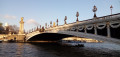
An urban route that allows you to enjoy the fully pedestrianised left bank of the Seine in Paris! You walk pleasantly along the river and pass by some of the capital’s most famous landmarks: Île Saint-Louis, Île de la Cité and Notre-Dame Cathedral, Pont Neuf, the Louvre Museum, the Musée d’Orsay, the Grand Palais and the Eiffel Tower.
Adjust your route according to the water levels of the Seine: see the practical information section.
The René Dumont greenway
 3.12 mi
+49 ft
-43 ft
1h 30
Easy
Departure from Paris
3.12 mi
+49 ft
-43 ft
1h 30
Easy
Departure from Paris
The René Dumont greenway is built on the platform of the former railway line that ran from the Gare de la Bastille. After briefly following the Canal Saint-Martin before it flows into the Seine, you follow this green space through the city, first at a height and then at ground level or through short tunnels. The Jardin de Reuilly, Square Charles Péguy and the Friche Ferroviaire at the junction of the former Petite Ceinture line add to the charm of this route.
On the French Revolution routes in the heart of Paris
 3.31 mi
+72 ft
-69 ft
1h 35
Easy
Departure from Paris
3.31 mi
+72 ft
-69 ft
1h 35
Easy
Departure from Paris
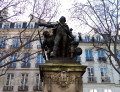
An urban circular walk in search of the French Revolution routes in two Parisian sites: the Bastille, whose capture had a very strong symbolic impact, and the Odéon suburb, where several key figures of the period lived, worked and gathered, including Marat and Danton. It's also an opportunity to discover the signs of other insurrectionary episodes (July 1830, May 1968) and a superb heritage ranging from the Gallo-Roman to the Middle Ages period.
A timeless stroll through the hidden corners of the Marais
 3.05 mi
+13 ft
-20 ft
1h 25
Easy
Departure from Paris
3.05 mi
+13 ft
-20 ft
1h 25
Easy
Departure from Paris
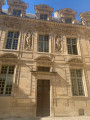
A short walk through the Marais, which may take a little longer for a photographer… A detour via the National Archives (Hôtel de Soubise and its gardens) is possible, and indeed recommended. However, some parts of the gardens will be closed in 2025 due to building works.
The Philippe Auguste enclosure and the covered passages of the Sentier
 4.71 mi
+26 ft
-23 ft
2h 10
Easy
Departure from Paris
4.71 mi
+26 ft
-23 ft
2h 10
Easy
Departure from Paris
This route on the right bank of the Seine takes us on a journey from medieval times to Art Nouveau. First, we discover the most important remains of Philippe Auguste's city walls and former mansions. We then wind our way through the Sentier district to explore several of its covered passages.
This walk is best done during the week, as the covered passages are closed on certain days.
Retrace Bourvil and Gabin’s walk through Paris
6.11 mi
+269 ft
-59 ft
3h 05
Easy
Departure from Paris
Retrace the steps of Bourvil and Jean Gabin in Claude Autant-Lara’s film. Of course, all this remains rather imaginary, as very little of the film was shot on location. But there is still the route from Rue Poliveau to Rue Lepic and the pleasure of strolling through the streets of Paris. There is one more filming location that lies too far off the main route: 158 Boulevard Hausmann, now the Jacquemart-André Museum, where the scenes of the arrival at the Kommandantur were filmed.
The bestiary of Charonne, Ménilmontant and Belleville
 3.76 mi
+285 ft
-16 ft
2h 00
Easy
Departure from Paris
3.76 mi
+285 ft
-16 ft
2h 00
Easy
Departure from Paris
A south-north crossing of the 11th and 20th arrondissements of Paris, in search of animal representations. Several alleys and passageways bear witness to the former presence of numerous workshops in these neighbourhoods.