Country:
 City:
City:


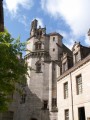
Parking is available on Boulevard des Frères Maillet near the MJC de Kerfeunteun, except on Friday afternoons (organic market).
In this case, you can park in the adjacent streets.
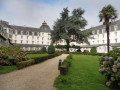
(S/E) From the back of the car park, cross the boulevard to go down into the public garden and follow the main path on the right, which leads to Rue Jeanne d'Arc. Turn left into this street, pass a square on your right and continue straight ahead along Rue Jean Moulin.
Take the first staircase on the left and continue along Rue de la Duchesse Anne, which ends opposite the wall of Saint-Joseph Cemetery. Turn left and walk along the wall to the crossroads. Turn right (there is a rubbish bin on your right) and head towards the car park entrance.
(1) Look for a small green gate on the left and cross the street to go through it. Follow the path between the buildings until you reach a secondary school. Follow this steeply sloping street. At the school entrance, look for a ramp overlooking the railway line and go down Rue de Brest near the level crossing. Cross this street and take the secure passageway opposite that runs alongside the railway line.
At the end (near the Frout stream), turn right, cross the level crossing and take the first street opposite a bar with a terrace. At the traffic lights, cross Boulevard Amiral de Kerguelen, pass Pont Firmin, one of the two bridges that crossed the Odet in the Middle Ages, and follow the riverbank to the right until you reach the theatre bridge.
(2) Cross the boulevard at the pedestrian crossing and enter the garden (one of the oldest gardens in Quimper). On your left, you will see the "Novomax", a new building dedicated to music and cultural activities, and on your right, the Max Jacob theatre, which dates back to 1904.
Stroll through the garden at your leisure, admiring remarkable trees such as the Virginia tulip tree, the ginkgo biloba (tree of forty crowns) and the giant sequoia.
At the end of the garden, exit on the left to go around the old municipal gymnasium dating from 1905. Under the pediment, look for the city's coat of arms. Enter again on the right through the educational garden, exit on the left of the theatre and cross Boulevard Dupleix to walk along the left bank of the Odet.
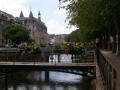
Go past a footbridge, take the one on the right with a green archway entrance and you will come out in front of the building known as "Ty Kodak", built in 1936 by the architect Olivier Mordrelle, who advocated Breton architecture integrated with contemporary trends. Cross again via the next footbridge and go past Rue Théodore Le Hars.
(3) Opposite the "Ouest-France" newspaper sign, take the Max Jacob footbridge on the right, the most recent one dating from 1994. It is notable for its wrought iron lacework. You will come out opposite the small garden at the foot of the last remains of the ramparts. Walk along them on the left, go around the former episcopal palace, now the Breton Museum, and turn right. On your left, you will see the Pont Saint-Catherine, the second bridge built to cross the Odet in the Middle Ages, and the prefecture buildings.
Enter the inner courtyard of this palace: view of the south side of the cathedral and the Rohan Tower of the palace. In this inner courtyard, you will see two Iron Age steles and a row of tombstones from the former Cordeliers Convent, which was ruined during the 1789 revolution and demolished in 1845.
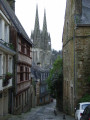
Exit via the south porch and turn right in front of the central west porch of the cathedral. Look up to see the equestrian statue of King Gradlon between the two spires of the cathedral, which were only completed at the end of the 19th century (the cathedral is open to visitors).
With your back to the porch, take Rue Kéréon, a shopping street where you can still see several half-timbered houses. Also note the several statuettes high up on some of these houses, such as at No. 9. Remember to turn around for a beautiful view of the cathedral.
Turn left onto Rue Saint-François, walk along the right-hand side of the market halls, which were rebuilt after the terrible fire of 1976, and reach the riverbank again after crossing Rue du Parc at the traffic lights. Follow the Odet river on the right-hand side. Cross Rue du Parc again and turn left behind the bus stops.
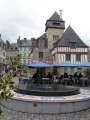
(4) Follow the path along the left bank of the Steïr, a tributary of the Odet. Pass by the bust of Jean Moulin, hero of the Resistance. This part of the river was covered with a concrete slab that was removed after the floods of 2000. At the end, turn left to reach Place Terre au Duc and go around the recent fountain (2011). Follow Rue de la Herse, cross the Médard bridge and continue on the other bank of the river (view of the spillway). Continue along Rue de Pen Ar Stéïr until you reach the first staircase on the right, marked by a mirror.
Climb these steps to enter a small wooded area called Petite Montagne, then turn right at the first set of steps, then left at the top and follow the flat path straight ahead.
A final staircase leads you to a street; continue straight ahead along the cobbled Rue Auguste Brizeux. Note the row of houses on your right. Cross a small wooded square (Place Mesgloguen) and take a small cobbled street on the right, Rue Saint-Nicolas (statuette in a small niche above), which descends steeply to Rue des Gentilshommes, which you follow to the left.
(5) At No. 7 ter, turn right into a passage called Rue Treuz (cross street). This street was renovated in 2006, revealing a house that is over six centuries old. Exit and take the street opposite that leads to Place au Beurre.
Turn left into the first street going uphill (beautiful view of the former high school, now a college) and turn right in front of the Hôtel de Boisbilly, former residence of the eponymous canon, now the Maison du Patrimoine, to reach Rue Élie Fréron. Walk up this street for about a hundred metres. On your left, you will see the back of the Chapelle de La Tour d'Auvergne, now an auditorium.
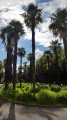
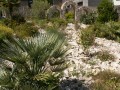
(6) Enter the Jardin de la Retraite, which is divided into three areas in the order of the suggested route: large-leaved tropical plants, dryland plants and palm gardens. Here too, wander around at your leisure. Head to the Tour Névet, the only remaining tower of the five watchtowers on the ramparts, and reach the Jardin de la Paix, the newest of Quimper's gardens. Rocks are everywhere and plants of Mediterranean origin are gradually taking root, including Aleppo pines.
On your way out, cross Rue des Douves at the pedestrian crossing and enter through the gate of the Quimper Conservatory of Music and Drama at No. 5. Walk about 20 metres and take a path that leads to a small outdoor lounge in front of a statue of Saint Anne. The school that used to stand here bore this name, which explains the presence of the statue.
Retrace your steps, cross Rue des Douves again and go down the stairs on the left into the old moat and walk along a section of the ramparts that is still visible. At the roundabout, cross Rue de Douves, pass through a small car park and turn left into the narrow Rue Feuntenic Ar Lez, which climbs up and crosses the railway line. Opposite the entrance to the school, turn right and go down the small Rue Créac'h-al-Lan.
At the bottom, turn left and take Allée du Verger, a footpath that runs alongside the school, cross a residential area, take the central staircase to the left of the fire brigade access sign and turn left to reach Rue Virginie Hériot, which you follow to the left until you reach Rue de Créach-al-Lan. Turn right for this final climb and, at the crossroads, turn right onto Jeanne d'Arc, which you follow down to the small public garden. Cross it to find the Boulevard des Frères Maillet via a staircase and, on the right, the starting car park (S/E).



 Visorando Member

 Moderate