Country:
 City:
City:


Park in the free car park at Place de la Tourbie, a former fairground, opposite the Collège la Tour d'Auvergne.
Access by bus: Tourbie stop, lines 05, 08, 09, 22.
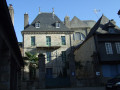
(S/E) With your back to the car park, walk along the ramparts that still serve as a fence for the college and at the end, turn left and follow the wall of the former Mesgloaguen prison, which closed in 1990 and is now occupied by the Finistère regional architecture and heritage service. If the gate is open, you can go inside to see the old prison buildings and part of the Collège la Tour d'Auvergne, a former Jesuit college.
Walk along the buildings to exit through the next gate. On your right, note the beautiful row of colourful houses.
Turn left towards Place Claude le Coz, where you will find the Auditorium de la Tour d'Auvergne, the former chapel of the Jesuit college. On your left, note the old entrance to what was a secondary school until 1965 (Lycée inscribed on the pediment).
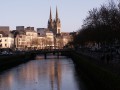
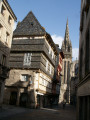
Go down Rue du Lycée on your right (superb view of the cathedral spires) and note the former Jules Ferry Primary School on your right (inscription Écoles de garçons), where you can see a former manor house dating from 1537, which was used to house the cathedral canons.
(1) Turn left into Rue (ruelle) ar Barz Kadiou, then right towards Place au Beurre. On your left is the 17th-century mansion known as "Hôtel de Boisbilly", which now houses the heritage department.
Go around this small square, now famous for its crêperies, and continue along Rue du Sallé with its half-timbered houses. At the junction with Rue des Boucheries, turn right and walk up about twenty metres before turning left and walking down Rue des Gentilshommes for about thirty metres.
(2) Turn left onto Rue Treuz, go down the steps to a recently developed small square where you will find the oldest Breton house, dating from the 13th century. Go back up Rue des Boucheries, go down and turn left into Rue du Guéodet, where you will see the curious Maison des Cariatides, also known as the Maison des Têtes, dating from the 16th century. You will come out onto Place Saint-Corentin, surrounded on the left by the Museum of Fine Arts and the Town Hall and on the right by Saint-Corentin Cathedral.
Continue along the cathedral on Rue du Frout, named after a tributary of the Odet river, which is now underground. At the traffic lights, turn right and walk along part of the old ramparts again, with the post office on the other side of the street.
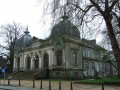
Cross at the traffic lights and walk up along the Odet to cross at the third footbridge to reach the old theatre called Théâtre Max Jacob, built between 1902 and 1904. Walk past the imposing façade to enter the garden at the rear (one of the oldest gardens in Quimper).
(3) On your left, you will see the "Novomax", a new building dedicated to musical and cultural activities. Stroll through the garden at your leisure and admire its remarkable trees, such as the Virginia tulip tree, the ginkgo biloba (tree of forty crowns) and the giant sequoia.
At the end of the garden, exit on the left via the steps to go around the old municipal gymnasium dating from 1905. Under the pediment, look for the city's coat of arms. Re-enter on the right via the educational garden and exit on the left via Allée Couchouren (barrier).
Turn right onto Rue Théodore le Hars, pass the police station and cross Boulevard Dupleix at the traffic lights.
Turn left to follow the Odet river and, opposite the "Ouest-France" newspaper sign, take the Max Jacob footbridge on the right, the most recent one dating from 1994. It is notable for its wrought iron lacework. You will come out opposite the small garden at the foot of the last remains of the ramparts. Cross Boulevard Amiral de Kerguelen with caution, walk along the gardens on the left, then go around the former episcopal palace, now the Musée Breton, and turn right. On your left is the Pont Saint-Catherine, the second bridge built to cross the Odet in the Middle Ages, and the prefecture buildings.
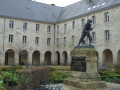
Enter the inner courtyard of this palace: view of the south side of the cathedral and the Rohan Tower of the palace. In this inner courtyard, you will see two Iron Age steles and a row of tombstones from the former Cordeliers Convent, which was ruined during the 1789 revolution and demolished in 1845.
Exit via the south porch and turn right in front of the central west porch of the cathedral. Look up to see the equestrian statue of King Gradlon between the two spires of the cathedral, which were only completed at the end of the 19th century (the cathedral is open to visitors).
With your back to the porch, turn into Rue Kéréon opposite, a shopping street where you can still see several half-timbered houses. Also note the several statuettes high up on some of these houses, such as at No. 9. Remember to turn around for a beautiful view of the cathedral.
(4) At the crossroads (small garden), turn left into Rue Saint-François, then go around the left side of the market halls, which were rebuilt after the terrible fire of 1976, to reach Quai du Steïr. Walk along this tributary of the Odet, now in the open air. The slab that covered it was removed following the floods of 2000. At the end, go around Square Jean Moulin, where a bronze bust of this great resistance fighter has been installed. Continue along the path between the Monoprix store and the river. At the junction with the cross street, turn left and then left again into Rue René Madec.
Turn right into the first street, Rue Laénnec, and walk past the Saluden gallery, a cheerful jumble of collectors, art and toys that has been there since 1907.
At the side street, turn right to cross at the traffic lights near Crédit Agricole and head right towards the Alain Gérard Media Library, named after a former mayor. It has been housed since 2008 in what was originally an Ursuline convent. Opposite, note the Saint-Mathieu Church, rebuilt between 1895 and 1897 on the site of a 15th- and 16th-century building.
(5) At the end of the building, turn right and head for the gardens behind the media library (view of the rear of the building, which has retained much of its original façade with its arches). Facing the Théâtre de Cornouaille with its wooden cladding, turn right and cross the Esplanade François Mitterrand towards Rue Saint-Marc, which you take on the right.
Cross Rue de Douarnenez at the traffic lights and continue along the street opposite, with the Centre des Congrès du Chapeau Rouge on your right. Turn left into the shopping centre of the same name, cross a side street and join the weir on the Steïr near the early childhood centre.
Walk along the river towards the bridge, then turn right and almost immediately left to reach Place Terre au Duc, where the dukes exercised their suzerainty. They established their power here in opposition to that of the bishops on the other bank, with a court of justice, a prison, a mill and communal ovens. Note the building now occupied by the Crédit Mutuel bank and the recent fountain decorated with Henriot-style motifs (2011).
Return to the banks of the Steïr and take the small Rue de la Herse back to the Pont Médard bridge, which you cross (there is a beautiful watchtower on the right). This bridge was the only link between the two sides of the town crossed by the Steïr.
Go around the left side of the square of the same name with its poorly maintained fountain and go up Rue des Gentilshommes, which takes its name from the many mansions it once housed. At the restaurant, turn left into a small cobbled street, Rue Saint-Nicolas (with a small statue in a niche above), which climbs steeply with a few steps.
Cross the small wooded square (Place Mesgloguen) and walk along the beautiful row of houses. At the junction with the cross street, turn left to reach the car park (S/E).
.


 Visorando Member

 Moderate