Country:

 City:
City:


On the RD986, coming from Saint-Gély-du-Fesc, at the roundabout, turn left towards Viols-en-Laval. After 2 km, look out for Cambous Castle on your right; continue for 500 m and turn right towards the Roussières departmental estate. Follow the ‘parking’ sign.
(S/E) Take the path to the south-west of the car park, follow it due north for 250 m and cross the RD32.
After the barrier, the path veers westwards and, 250 m further on, passes right next to a karstic cave.
(1) After this karstic cave (which you can climb down into with some care), continue for 100 m, turn left (yellowPR®® markings) and cross the access road to the Cazarils estate (2 barriers).
Follow this pleasant path due west to the next crossroads.
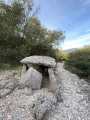
(2) At the four-way junction (picnic table), turn right, heading due north (red and yellowGRP®® signposting), and follow the stony drovers' road to the Dolmen de la Draille.
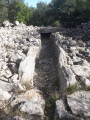
(3) A corridor of flagstones leads into (or rather, requires you to crawl through) the oval chamber.
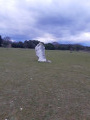
Continue along this drovers' road due north for about a hundred metres until you reach a stone marker. 10 metres further on, turn right (PR®® markings) to make a return trip from this point to the Neolithic tombs, situated 150 metres away. The two tombs are 80 metres apart. Follow the PR®® path.
(4) At the second tomb, turn back towards the drovers' road and rejoin it on the right (GRP®®).
Follow this stony track northwards until it joins the track suitable for vehicles.
Continue along this track in the same direction; at the green gate, go straight on. 350 metres further on, make a short detour towards the lavogne (or lavagne) – a sheep trough – which you can see on the right.
The track then climbs towards the Cazarils estate.
(5) At the Y-junction, follow the ascending path to the right, which, after 50 metres, leads to an enclosure.
Note a pretty well inside this enclosure (vegetable garden) before heading back down to the right along the path which is circular in direction and goes north-east. Ignore the track on the right and continue the descent for 200 metres.
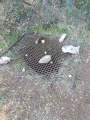
Just before the well (secured by a grille at ground level), leave the track and take the path on the left.
After 100 m, let a track branch off to the left and continue down the path towards the north-east.
At the bottom of the descent, at the crossroads, take the path opposite which leads uphill, making two hairpin bends before running along the ridge, due east.
At the wooden post set in concrete, continue due east along the ridge path, running alongside a conifer plantation on the left. When the path descends again, turn right onto the track blocked by three boulders and descend until you reach the departmental road.
(6) Cross the RD32 and join the footpath running parallel to the road about ten metres away.
It then veers away from the road and splits into a Y-junction marked by a large wooden post; turn left. After 200 m, at another wooden post, turn left again for 100 m, heading due north, then follow the path to the right, lined with 5 or 6 small cairns.
The route runs through lovely woodland here and reaches a cross near the Fontaine de Termenou. Go round it to the right to discover the spring.
(7) At the fountain, rejoin the path you left at the cross and follow it eastwards up to the pass, 350 m away, where a magnificent view opens out over the Pic Saint-Loup and the Hortus. Continue climbing to the right to discover a stunning panoramic view of the Cévennes at the summit.
The very stony path then descends. When you reach the point overlooking the RD986, keep to its right, follow the road and join it at the point where the path meets it before branching off. Just opposite the junction with the RD122E8, turn right towards the south-west. Here, in April, it’s a realm of asphodels…
To the left of the track, raised hunting posts labelled P1, P2… have been set up. 20 metres past post P7, look out for a cairn on the left marking the start of a path. A multitude of small cairns mark this path, which leads 100 metres to the Aven de Gennevaux. Caution – this is an 18-metre-deep shaft (unsecured) which provides access to the karstic cave of the same name.
Retrace your steps and rejoin the path, turning left. After 250 m, it emerges into a much more open area.
(8) At the small cairn, take the path on the left heading towards the undergrowth.
Follow this path as it winds through the oak woodland, then passes in front of a karstic cave secured by a gate at ground level.
160 metres further on, old red and white markings on a large stone on the ground indicate the start of a path on the left. Ignore this and continue for 250 metres.
Look out for an old red mark on a rock and a cairn. Take the path leading off to the right; it leads to the entrance to Vidal Cave 40 metres away. It is possible to enter this cave, but Caution – Take care
Return to the path, heading towards the cairn, and continue to the right.
On the map, the route passes very close to the Vidal karstic cave. Its entrance has been blocked off.
Continue through the woodland on the clearly marked path. The path splits into a Y-junction with a small cairn: turn left, walk 30 metres and, at another small cairn, turn left again heading south-east. The path crosses a clearing and, shortly afterwards, joins a wide track.
(9) Follow it to the left and, at the cairn, turn right, skirting the groves of holm oaks. After 250 m, the route leads to the archaeological site.
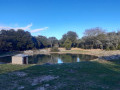
(10) In front of the gate in the fence surrounding the prehistoric village of Cambous, turn right, heading due west, onto the path which leads, 400 m further on, to a lovely clearing.
(11) Facing the pond, turn left onto the path heading due south and, 40 m past the wooden gate, just before the corner where the two walls meet, take the path on the right which runs alongside the entire north wall of Cambous Castle. Continue to an old corner tower, then gradually descend to the bottom of the slope where the path meets the “drovers' road” (PR®® yellow markings).
Turn left to join this route; the markings lead to the Roussières departmental estate.
(12) Enter the Roussières departmental estate, cross the courtyard and pass under the porch before reaching, on the left, the starting point (S/E).


 Visorando Member
 Very difficult
 Association / Club / Walk leader
 Tourist office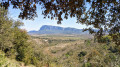
 Easy
Easy 
 Difficult