
A stroll through Bielsko-Biała, from the old town to the cartoon heroes

Bielsko-Biała was formed by the merger of two towns separated by the River Biała: Bielsko in Silesia and Biała in Galicia. This circular route connects their two centres. On the hill in the old town, you’ll discover the Rynek and its arcades, St Nicholas’s Cathedral with its bell tower inspired by Italian campaniles, and the only statue of Martin Luther in Poland. Across the river, the old town of Biała reveals the façades of the ‘little Polish Vienna’, its imposing town hall and the statues of Bolek, Lolek and Reksio, heroes from the country’s oldest animation studio. In the evening, the illuminated monuments and neon lights on the Biała Bridge add to the atmosphere, though the circular route is well worth a stroll at any time of day.

Details

104590805
Creation:
Last update:
Last review:
  • Walking
    Activity: Walking
  • ↔
    Distance: 2.93 mi
  • ◔
    Average duration: 1h 25 
  • ▲
    Difficulty: Easy

  • ⚐
    Back to start: Yes
  • ↗
    Ascent: + 66 ft
  • ↘
    Descent: - 69 ft

  • ▲
    Highest point: 1,122 ft
  • ▼
    Lowest point: 1,004 ft

Photos

Description of the walk

Park along Generała Władysława Sikorskiego Street, at the foot of the Old Town hill.

(S/E) Walk up the street for about a hundred metres, then turn right onto Schodowa Street, a staircase-like street leading up to the Old Town. You’ll emerge onto Plac Świętego Mikołaja, in front of the entrance to St Nicholas’s Cathedral.

(1) Walk past the cathedral’s gateway and go round it to the left. Follow the cobbled street that runs alongside it to its end, then turn left to reach the Rynek.

(2) Cross the square diagonally to the opposite corner, then turn immediately right into a narrow alleyway, Kręta Street. This leads to a small square: take the passage on the right which winds down between old stone walls, alongside some benches. At the bottom, cross the road carefully and continue straight ahead, facing the statue of Martin Luther.

(3) Go round the statue on the left and continue uphill towards the Church of the Saviour. Walk past its entrance, turn right at the next junction and go down Andrzeja Frycza Modrzewskiego Street, continuing straight on at the junction in between.

At the bottom, at the T-junction, turn right and then left twice (there are public toilets in between) to reach Adama Mickiewicza Street, which is paved with red bricks. Follow it straight on for about 500 metres, crossing several streets. At the start of a shared space zone, marked by a sign, turn right onto Jana Matejki Street, which slopes downwards. Take the steps below and go through the underpass beneath the road. At the exit, turn left: the station is in sight. Head to the station entrance to visit the concourse.

(4) On leaving the station, walk along the front of the building to the left, then turn left just after the building to take the tunnel that runs under the tracks. Exit via the stairs onto the car park at the rear of the station. Walk along it to the end, turn right just before the last building, then right again onto Rue Podwale. At the ‘Stop’ sign, cross carefully to turn onto the small street on the left, then turn right onto Gazownicza Street. Just before the roundabout, cross carefully – using the pedestrian crossings – the road on the left, then go straight across the next one, and finally cross the main road on the right. The statue of Bolek and Lolek is just beyond, in front of the large shopping centre.

(5) Walk along the side of the shopping centre to the left and cross the Biała via the Most Włókniarzy Bridge: this takes you into the old town of Biała. On the other side, veer slightly to the right, cross the small street leading to the car park and walk alongside it along the cobbled Cyniarska Street. This leads onto Wojska Polskiego Square.

(6) Walk round the square to the left. At number 12, on the street that branches off immediately to the left, the Kamienica pod Żabami displays its musical frogs. Then cross the square, passing a fountain adorned with a frog playing the flute, and leave it straight ahead on the opposite side by entering the pedestrianised Ratuszowa lane. At the end, carefully cross the main road to reach Plac Ratuszowy, at the foot of the imposing town hall.

(7) Walk alongside the town hall and, just past it, veer to the right, then turn right just before the footbridge. Go down the few steps and follow the paved walkway that runs alongside the Biała through the Park za Ratuszem. Continue straight on to the end of the paths, still following the riverbank, then go up the small cobbled slope and carefully cross Księdza Stanisława Stojałowskiego Street to arrive opposite a fountain: the statue of Reksio is hidden just behind it.

(8) Turn left as soon as you’ve passed the statue and cross the Biała River again via the footbridge on 11 Listopada Street. Continue straight on to the end of the walkway and climb the staircase opposite. At the top, turn left along the wide dual carriageway: the Sułkowski Castle comes into view on the right, on the other side. Stay on the same pavement, cross one road at the pedestrian crossing and then, carefully, a second one which has no crossing. At the foot of the Polski Theatre, turn left onto 1 Maja Street, a pedestrianised street paved with herringbone bricks, then turn right a little further on under a graffiti-covered archway that runs through the building. You’ll emerge into the park at Plac Żwirki i Wigury and go up the steps straight ahead. At the top, continue along the extension of the road past the old textile buildings, cross a road after a small car park, then, at the traffic lights on the right, carefully cross the main road to reach the car park (S/E).


Waypoints

  1. S/E : mi 0 - alt. 1,070 ft - Car park on Generała Sikorskiego Street
  2. 1 : mi 0.1 - alt. 1,106 ft - Katedra św. Mikołaja (cathédrale Saint-Nicolas)
  3. 2 : mi 0.21 - alt. 1,106 ft - Rynek
  4. 3 : mi 0.38 - alt. 1,099 ft - Pomnik Marcina Lutra (Statue de Martin Luther)
  5. 4 : mi 1.18 - alt. 1,017 ft - Gare de Bielsko-Biała Główna
  6. 5 : mi 1.75 - alt. 1,010 ft - Pomnik Bolka i Lolka (Statue de Bolek et Lolek)
  7. 6 : mi 1.99 - alt. 1,024 ft - Wojska Polskiego Square
  8. 7 : mi 2.19 - alt. 1,037 ft - Hôtel de ville de Bielsko-Biała
  9. 8 : mi 2.4 - alt. 1,030 ft - Pomnik Reksia (Statue de Reksio)
  10. S/E : mi 2.93 - alt. 1,070 ft - Car park on Generała Sikorskiego Street

Notes

There are several flights of steps along the route, which is not suitable for pushchairs.

The circular route can be walked at any time of day: in the evening, the monuments and the Biała Bridge are illuminated. The area around the station, the underpass beneath the railway tracks and the portico on Plac Żwirki i Wigury are less inviting after dark.

Pay-to-use public toilets (2 zł (~€0.45), 2026 rates) are located between (3) and (4), at the T-junction at the bottom of Modrzewskiego Street. The shopping centre next to the Bolek and Lolek statue (5) offers toilets, catering and shops.

There are plenty of cafés and restaurants around the Rynek and the squares of old Biała.

Parking

The start point is located within Bielsko-Biała’s paid parking zone: paid parking applies from Monday to Friday, 8 am to 5 pm; free in the evenings and at weekends. The charge is 4.50 zł (~1.05 €) for thefirst hour, 5.00 zł (~1.15 €) forthe second, 5.50 zł (~1.30 €) forthe third, and 4.50 zł for each subsequent hour (2026 rates from the municipal operator MZD). These rates are revised regularly, so check them before setting off. Payment can be made at parking meters (coins, card, BLIK) or via the moBilet and SkyCash apps.

Access

The Plac Żwirki i Wigury bus stop, on the main road at the starting point, is served by city buses on the MZK network. Bielsko-Biała Główna railway station (4), on the route, offers regional and national services.

Alternative

The detour via the railway station (4) extends the circular route through areas that are not always particularly inviting: it can be skipped. To do so, between (3) and (4), turn right onto Jarosława Dąbrowskiego Street, which runs perpendicular to Adama Mickiewicza Street. At the end, cross 3 Maja Street, go down the steps and continue opposite along Wałowa Street to the roundabout opposite the shopping centre, where the statue of Bolek and Lolek stands (5). This shortens the route by about 1 km.

Worth a visit

(1) St Nicholas’s Cathedral (Katedra św. Mikołaja), founded in the 15th century by the Dukes of Cieszyn, owes its current appearance to the reconstruction carried out in the early 20th century by the Viennese architect Leopold Bauer. Its tower, inspired by Italian bell towers, dominates the entire city.

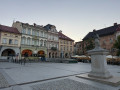
(2) The Rynek, the heart of Bielsko’s old town, was redeveloped in the early 2000s: it features the Neptune Fountain, a statue of Saint John of Nepomuk, a 17th-century stone well and, beneath a ground-level glass canopy, the foundations believed to be those of the former municipal weigh house, unearthed by archaeologists.

(3) The statue of Martin Luther, the work of the Viennese sculptor Franz Vogl and unveiled in 1900, is the only one of its kind in Poland. It stands in front of the Church of the Saviour, in the heart of ‘Syjon bielski’, Bielsko’s historic Protestant quarter.

(4) Bielsko-Biała Główna railway station, built in 1890 in the style of Austrian provincial stations, conceals a hall featuring Pompeian polychrome decorations painted by a Viennese workshop and restored in the late 1990s.

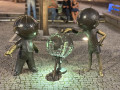
(5) (8) Bolek and Lolek standing by their globe, followed by Reksio standing on his hind legs, one paw outstretched towards the fountain: the heroes of the Studio of Animated Films (Studio Filmów Rysunkowych), which has been based in the city since 1947 and is Poland’s oldest animation studio, have their own bronze statues. The bench dedicated to Lechosław Marszałek, creator of Reksio, stands next to the fountain at (8). Other characters, such as the Wawel Dragon, Bartolini and Don Pedro, the spy from the Land of Rain, are hidden away between (6) and (7).

(6) Wojska Polskiego Square, formerly Biała’s market square. At No. 12 stands the Kamienica pod Żabami (1903), an Art Nouveau building designed by the architect Emanuel Rost Jr.: two frogs seated at a table play the mandolin and smoke pipes, whilst carved beetles climb up the façade.

(7) Bielsko-Biała Town Hall, built in 1897 for the town of Biała by the same Emanuel Rost Jr., is in a Neo-Renaissance style inspired by Viennese palaces. Its clock tower is superbly illuminated after dark.

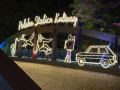
Between (8) and the return to the car park, the bridge on 11 Listopada Street bears the neon sign ‘Polska Stolica Kultury’: in 2026, Bielsko-Biała will take up the title of Poland’s first Capital of Culture. A saxophone, a glider, a film camera and a small Fiat 126p – long produced in the city – sum up its emblems.

The Sułkowski Castle, the city’s oldest monument (14th century), lies on the other side of the main road between (8) and the return route. It houses the Historical Museum of Bielsko-Biała.

On Plac Żwirki i Wigury, the Stara Fabryka, a museum housed in a former factory, bears witness to the wool-weaving past of a town that was once one of the major textile centres of the Habsburg Monarchy. The Monument to the aviators Żwirko and Wigura stands in the square and, just beyond the park, a large sepia-toned mural brings the Bielsko of yesteryear back to life, complete with trams and biplanes.

For more walks, use our search engine .

The GPS track and description are the property of this route's author. Please do not copy them without permission.