Country:
 City:
City:



The presence of metro stations along the route also means you can complete this walk in several stages (see Practical Information).
Starting point: Porte des Lilas – Metro access: lines 3bis and 11. Exit no. 5 “Square du Docteur Variot” – Tram access: line T3b.
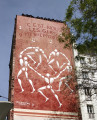
(S) On leaving the metro, turn round and enter Square du Docteur Variot. Walk the full length of the square, keeping to the right. Exit onto Rue Antoinette Fouque, cross the street and continue straight ahead down Avenue Gambetta. Walk past the imposing Georges Vallerey Swimming Pool building, cross Rue des Tourelles on your left, and at the junction turn left onto Rue Saint Fargeau. A little further on, turn right into Square Paule Minck, where the wall is adorned with a long fresco, some fifty metres in length, entitled “Sources Urbaines”, composed of urban elements in relief forming large labyrinths, evoking the city’s water and vegetation.
Walk to the far end of the square, and opposite a small pond, take the dirt path on the left to reach the entrance to the square. Turn right onto Rue Saint-Fargeau, which leads uphill, cross Boulevard Mortier and the tram tracks at the pedestrian crossing, and continue straight ahead onto Rue du Guébriant. Pass Rue des Fougères on your right, continue straight on; the street changes its name to Rue Léon Frapié. A little further on, turn right into Square Léon Frapié.
(1) Walk straight ahead along the single path, passing two ball courts on your left; go down a few steps, leaving a playground and some table tennis tables on your right, and pass under some large pergolas. Take the cobbled path on the right, lined with a row of trees and benches in the centre, running alongside two large tree-lined lawns on your left. At the end of the playground on your right, turn left onto a sandy path and leave the square via Rue Noisy-le-Sec. Cross the Promenade Roland Castro and enter Square Frida Kahlo opposite.
Turn left and take a small paved path immediately on the right. At the end of this winding path, go down a flight of steps, pass a small community garden and an exit on your right, and turn left. Facing the skatepark, turn left to go round it. At the end of the path, pass an exit on the right (the one you came in through) and turn left. Continue along the footbridge, and when you reach a circular square, take the sandy path on the right. Carry on straight ahead along this path, which further on has a grassy strip running down the centre. At the end of the path, pass an exit opposite and turn left. You will then enter Square Émmanuel Fleury.
(2) Walk past the Amicale Bouliste de Ménilmontant on your left and take the path immediately to the left, passing a book box on your right. Then take the wide path on the right and continue along this winding path. At the end of the path, turn left, pass some table tennis tables on your right and leave the square. Cross Rue le Vau at the pedestrian crossing on the left and continue downhill to the left. When you reach Rue Dulaure (the fifth street on the right), cross the road and turn right to enter Square Séverine on your left.
(3) Go down a few steps, head to the right, passing a large playground on your right. Then take a curved path on the right which forms a semicircle to the right. At the very end of the path, opposite a street lamp, turn left then right and leave the park. Return to Rue Dulaure on the left and turn right onto Boulevard Mortier, heading uphill. Pass Rue Victor Dejeante on your right, and just before Rue Maurice Berteaux on your right, cross Boulevard Mortier and the tram tracks to the left at the traffic lights and the pedestrian crossing. Continue to the right, pass Rue du Capitaine Ferber on your left and climb a flight of steps a little further on to the left.
At the top of the steps, enter the Jardin de la Justice directly opposite, which consists mainly of a beautifully landscaped community garden featuring a mural on the theme of nature. Walk around the square; on leaving, continue along Rue de la Justice. At the corner of No. 22, turn left into Passage Boudin, which is lined with houses, then right into Rue Alphonse Penaud, signposted further on. At the end of the street, cross Rue Alphonse Penaud at the pedestrian crossing, then cross Rue Étienne Marey and turn left into the next street, the downhill Rue du Surmelin.
Turn right to stay on Rue Surmelin. Note the mural on the left at the entrance to Rue du Capitaine Marchal, depicting a magnificent blue cockatoo. Rue Surmelin becomes a pedestrianised street along this stretch and features long green verges on one side. Cross Rue Pelleport at the pedestrian crossing on the left. Pass the Pelleport metro station on your right and turn left onto Avenue Gambetta, which slopes downwards, running alongside the Tenon Hospital on your left. Cross Rue de la Chine at the pedestrian crossing and head left to enter Square Edouard Vaillant on your right.
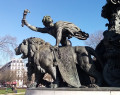
(4) Pass a group of sculptures behind a flowerbed on your right, and continue straight on, running parallel to Rue de la Chine. Pass between an entrance to Tenon Hospital on your left and a bandstand and table tennis tables on your right. At the end of the path, opposite a playground, turn right, passing a greenhouse on the right and a first exit on the left. Continue along this path and take the next exit on the left. Exit onto Avenue Gambetta, turn right, cross Avenue Gambetta at the pedestrian crossing by the traffic lights and continue straight ahead onto Rue de la Chine.
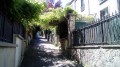
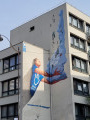
Cross Rue Orfila, turn left onto Rue Villiers de l’Isle Adam, and note a mural on the side façade of No. 57 entitled “L’oiseau de Claire”. Go down the steps opposite, noting a painting on the left-hand wall depicting a goldfish with a shark’s fin. Continue right up Rue des Pyrénées. Turn right into Passage des Soupirs, which begins with a flight of steps. Continue along this cobbled passageway lined with houses. At No. 9, look out for a mural by Anthéa Missy, then pass No. 18 , in front of the Jardin partagé des Soupirs. At the end of the passageway, turn right onto Rue de Chine and then left back onto Rue Villiers de l’Isle Adam. Turn left into the small Rue Hélène Jacubowicz. Turn right into Square Pierre Seghers. Walk round the square, then on exiting, turn right back onto Rue Hélène Jacubowicz. At the end of the street, cross Rue de Ménilmontant at the pedestrian crossing and enter Square des Saint-Simoniens.
(5) Pass a playground on your left, then turn left into a curved path that forms a semicircle to the right. Pass the first exit on your left and continue slightly uphill. Walk along the right-hand side of a small, welcoming area featuring benches, draughts and chess tables, a book box and flowerbeds surrounding a fountain. Then take the exit on the left. Turn right into Rue de la Duée, then right again into Rue Taclet, cross Rue Pelleport at the pedestrian crossing on the right and continue straight ahead along Rue Deveira.
At the end of the street, take thesecond left onto Rue du Télégraphe. Walk past the Belleville cemetery on your right, then the Télégraphe boules court, and when you reach the end of the street, turn right into Square Belleville-Télégraphe. Walk past a playground on your right, pass an exit and a book box on your left, go round a lawn surrounded by benches on the right, and take the exit down a flight of steps.
(6) On leaving Square Belleville-Télégraphe, turn left (from the “Télégraphe” metro station, exit no. 3 “Cimetière de Belleville”, turn round) then cross Rue du Télégraphe and continue straight ahead along Rue de Belleville. Note the “Lecture immersive” mural at no. 236. Cross Rue Pelleport, noting on the left, on the side façade of a nearby building (at165bis on the street), a mural depicting the faces of children in fancy dress. Turn left onto Rue Pixérécourt, noting a mural by Handicap International on the corner. After No. 79, turn right into Square Léon Zyguel.
(7) Walk around this small square, then head right back onto Rue Pixérécourt. Pass Rue du Soleil on your right, cross Rue Pixérécourt and turn right into the Jardin Mario Soare. Walk the full length of the garden; on exiting, turn right and head left back onto Rue Pixérécourt. At the junction, carry straight on. At the next junction, turn right, cross Rue Olivier Metra, and enter the Emmi Pikler Garden. Walk through this tiny garden, go down a few steps and exit ontoRue des Rigoles. Turn right, then left onto Rue Guignier. At the end of the street, cross Rue des Pyrénées at the pedestrian crossing and continue left, heading uphill. Turn right onto Rue de Ménilmontant and enter the Jardin Carré de Baudouin on your right.
(8) Walk around the garden and rejoin Rue de Ménilmontant on the right, heading downhill. Turn right onto Rue de l’Ermitage and, opposite No. 47bis, go down the steps on the left onto Rue Fernand Raynaud, then turn left into the Jardin des Petites Rigoles. Walk around this small garden; on leaving, turn left down Rue Fernand Raynaud and then left onto Rue des Cascades, leaving the Saint-Martin manhole behind you. As you walk along the street, you’ll see numerous murals and, on the left on the garden wall, a fountain depicting a dark red lion’s head. At the end of the street, turn right onto Rue de Ménilmontant, then left onto Rue Sorbier . When you reach a Fork in the road, head onto the central reservation and enter the Square du Sergent Aurélie Salel.
(9) Walk the full length of the square; on the back wall, you’ll see a mural depicting a wolf. Exit at the far end on the right, climbing a few steps. Turn left onto Rue Sorbier , then left again onto the small, uphill Rue Villiers de l’Isle Adam; at the junction with Rue Bidassoa, turn right into Square du Docteur Grancher.
(10) Facing a playground, turn left to go round the left-hand side of a large, enclosed, landscaped area, then turn left to go down a flight of steps and leave the square. Return to Rue Sorbier on the left. Cross Rue Orfila and continue straight ahead along Place Martin Nadaud, where the road surface is marked with coloured stripes.
At the end of the square, cross Avenue Gambetta at the pedestrian crossing (which has no traffic lights, so proceed with caution), turn left and then immediately right to enter Square Samuel de Champlain at the corner of the street. Walk the full length of the square, taking either the upper path, which runs parallel to the wall of Père Lachaise Cemetery, or the lower path, which runs parallel to Rue Gambetta. In both cases, walk past the “Wall to the Victims of Revolutions” monument and take the last exit on the right. Turn left onto Avenue Gambetta, continue to the traffic lights, cross the avenue and then a small central reservation at Place Auguste Métivier, and turn right onto Rue des Amandiers. Enter Square Jacques Grynberg on the right.
(11) Cross the square, exit at the far end onto Rue Fernand Léger and turn right up the hill. Then turn left into the small Rue des Pruniers, noting the murals on the left, and enter Square des Mûriers. Cross the square; after descending a flight of steps, you’ll emerge onto a small square adorned with a bright yellow Wallace fountain: Place Joseph Epstein. Cross Rue des Partants to the left and take the next left onto Rue Raoul Duffy. Continue straight on to reach Rue Elisa Borey. Note an eagle design opposite and a decorated staircase on the left.
Cross the street and go down a few steps to enter Square Élisa Borey, with the bell tower of Notre-Dame de la Croix in your sights. Walk around the square, exiting to the left between the playground equipment on the left and a dog park on the right. Turn right onto Rue Elisa Borey; at the end of the street, cross Rue des Amandiers, walk a few metres to the right and then turn immediately left to enter the Jardin Toussaint-Louverture.
(12) Cross the garden, exit onto Rue Duris, turn right and take the small pedestrianised Rue Marx Ernst on the right. At the end, turn left onto Rue des Amandiers, cross Rue des Panoyaux, pass Rue des Plâtrières on your right and continue to the end of the street. Turn right to cross Rue de Ménilmontant at the pedestrian crossing, noting the mural ‘Les gars d’Ménilmontant’ high up on a blank wall on the right. Cross a small traffic island, then Rue de la Mare – a cobbled alleyway – and enter Square Notre-Dame de la Croix opposite.
(13) Cross the square, exit onto Rue Eupatoria, turn left; at the end of the street, cross Rue Julien Delacroix at the pedestrian crossing on the right and take thefirst right, Rue du Liban, a small cobbled street with colourful bollards. At the end of the street, turn left onto Rue des Maronites, cross Rue du Pressoir to the right and immediately enter the Jardin Maronites-Pressoir. Cross the garden, exit onto Rue du Pressoir and turn left onto it. At the end of the street, turn right onto Rue des Couronnes, then left onto Rue Bisson, then right onto Rue Pali Kao and turn right into the Jardin Gabriële Buffet.
(14) Cross the first area, which features a pond, climb a flight of steps and, when you reach a coloured wall, turn right and walk along the right-hand side past the climbing frames and table tennis tables. Leave the garden via Rue Julien Lacroix and enter the Parc de Belleville opposite.
Take thefirst path on the left, then climb the steps on the right. Cross a small circular square and go up the steps opposite. Then walk alongside a rectangular pond and climb a final flight of steps. Facing a large building, turn right, leaving a fountain and a double flight of steps leading uphill on your left, and a flight of steps leading down under a pergola on your right. Continue along the small path opposite. A little further on, walk alongside the vineyards on your left. Leave the park, passing a cobbled lane leading downhill on your right, and take the path further to the left. Walk past the table tennis tables and keep left into the Jardin des Couronnes.
Cross a playground with a sandpit and take the path at the far end on the left, which leads uphill, to leave the park. When you reach a small square, turn left and walk along the left-hand side of Square Alexandre Luquet (which is actually a sports ground, consisting solely of a multi-sports court). You’ll arrive at a square with a blue Wallace fountain. Continue straight ahead along Rue Piat (you can take a break at the viewpoint to enjoy the view of Paris and the paintings and mosaics, which are, sadly, in a state of disrepair).
Turn left again into Parc de Belleville, pass a flight of steps leading down to the left, turn right and then keep to the right. Cross a small square, ignore a flight of steps leading uphill on the right and carry on straight ahead. Finally, leave the park for good, turn left onto Rue Piat (signposted further on) then turn right onto the uphill Rue de Belleville. At the next junction, you’ll reach the Pyrénées metro station. (E).

 Visorando Member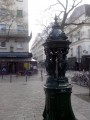
 Easy
Easy