Country:
 City:
City:



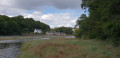
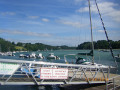
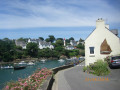
(S/E) Take the Sirène III ferry to reach the Pouldu quay on the right bank of the Laïta. TheGR®®34(marked in white and red) climbs up a flight of steps to the right of the white building and the blue garages at the edge of the Pouldu quay, where the ferry operates.
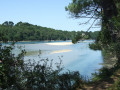
(1) Turn right at the top to walk beneath the trees, overlooking the river and its row of moored boats. Walk round Stervilin Cove, then head north beneath the chestnut trees, oaks, Douglas firs and spruces, with numerous views of the river and its sandbanks at low tide.
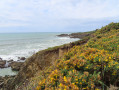
(2) You reach Porsmoric with its small beach (featuring a beautiful old shipwreck) and its jetty for dinghies. You turn round for a final glimpse of the estuary and Le Pouldu. You then head back, often under cover, with a fine view of the Beg Nénez mill on the opposite bank.
(3) We reach the Stêr Fankec dyke, which encloses the marshy confluence of the Quinquis stream. The path then becomes steeper until we reach the car park at the Saint-Maurice bridge.
(4) Head down to the right to pass under the bridge and follow the river; then climb back up through the woodland before descending again to a headland from which you can see the site of the former Abbey of Saint-Maurice. Finally, climb back up to reach a Fork in the road.
(5) You can either turn right to take some steep steps – which can be slippery in wet weather – leading down to the crêperie along the River Laïta, or go straight on to join the road about 200 metres before the entrance to the site (recommended option).
(6) The abbey site is extensive and well worth a visit. You then retrace your steps, turn left to reach the crêperie on the riverbank, and climb the steps until you rejoin the path you took on the way there.
(5) Turn right, then immediately left onto a wide path that cuts across the circular loop at the headland.
(4) You’ll reach the Saint-Maurice bridge, which you cross.
(7) Turn left just after the crash barriers. Walk straight up gently through the woodland along aPR®® (yellow markings), then through a Douglas fir forest, ignoring the two paths branching off to the right. You’ll come to a path branching off to the left towards a hillock called “Ar Butten”, heading towards the chapel (signpost).
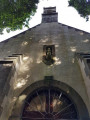
(8) The modern chapel, erected in memory of the De Polignac couple, overlooks the Laïta beneath beech and chestnut trees. Head back down to rejoin thePR®® trail, which you then follow to the left. Continue along flat ground until you reach the mill path (signpost).
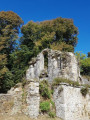
(9) Turn left and descend along a path, which is sometimes steep, towards the ruins of Bénoal Mill. Cross the stream via a footbridge and head back up the opposite bank of the tidal pond; you’ll see the dyke at the end of the path before climbing back up to a track suitable for vehicles. Turn left onto this track to pass through a gate as you head down towards the Laïta.
(10) You will then find yourself facing the site of Saint-Maurice Abbey on the banks of a circular bend in the river. A ferryman used to take people across here. Retrace your steps to pass beneath the hamlet of Kerhoat Benoal along a small road.
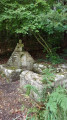
(11) You reach the Saint-Michel fountain to the left of the road. Continue along the road until, after 300 metres, you find a path that crosses the stream on the left and heads up to the left between two low walls towards the Saint-Michel Chapel.
(12) It stands on the edge of the forest and is the venue for a pilgrimage on the last Sunday in September. We retrace our steps to the small road, which we follow to the right for 80 metres before turning left onto thePR®®. We follow this path to the Saint-Maurice bridge.
(7) Cross the road to rejoin theGR®®34opposite, heading downhill. You then follow the Laïta river swiftly southwards. Leave the shelter of the trees and turn left onto a farm track which joins a small road; follow this down to the right for 60 metres before taking the path on the left (gates) which leads down to the Beg Nénez mill.
(13) Leave this tidal mill via a small embankment heading south. TheGR®® veers right onto a narrow path just after the embankment. This path is quite steep and the facilities (stairs, footbridges), which are always in good condition, are often necessary. You leave the banks of the Laïta once to go round a small private property. The views are fascinating at the end of the day until you return to the starting point (S/E).

 Visorando Member
 Easy
Easy