


Refine your search for walks in Église Saint-Louis (Villemonble)
Église Saint-Louis (Villemonble) walks


 The Parc des Coteaux d'Avron and the Lamarque Trail
 Visorando Member
 4.04 mi
 +194 ft
 -253 ft
 2h 00
2h 00
 Easy
Easy
 Departure from Villemomble (Seine-Saint-Denis)
This short urban hike is divided into three stages. First in Villemomble, after stopping at the foot of the church's tall bell tower, you cross a residential area and climb up to the Plateau d'Avron. You then descend, zigzagging through the Parc des Coteaux d'Avron. The route ends on a footpath that runs almost straight through Neuilly-Plaisance.
Walks near Église Saint-Louis (Villemonble)
Crossing Gagny
 4.41 mi
+213 ft
-197 ft
2h 15
Easy
Departure from Gagny (Seine-Saint-Denis)
4.41 mi
+213 ft
-197 ft
2h 15
Easy
Departure from Gagny (Seine-Saint-Denis)
A city route that takes you through several neighbourhoods of Gagny. Gustave Courbet Park, the Saint-Fiacre Aqueduct embankment and the Bois de l'Étoile Arboretum add touches of greenery and a few viewpoints.
The banks of the Marne and the Haute-Ile Departmental Park
 5.91 mi
+197 ft
-16 ft
2h 55
Easy
Departure from Neuilly-Plaisance (Seine-Saint-Denis)
5.91 mi
+197 ft
-16 ft
2h 55
Easy
Departure from Neuilly-Plaisance (Seine-Saint-Denis)
This route makes us forget that we are in one of the most densely populated and urban departments in France! Most of the route is on footpaths, shared in places with cyclists, along the Marne and in the Parc de la Haute-Ile, which promotes the preservation of biodiversity.
From Bobigny to Le Raincy via the Canal de l’Ourcq
 4.71 mi
+164 ft
-108 ft
2h 20
Easy
Departure from Bobigny (Seine-Saint-Denis)
4.71 mi
+164 ft
-108 ft
2h 20
Easy
Departure from Bobigny (Seine-Saint-Denis)
An urban route that runs alongside the Canal de l’Ourcq for the first half. The route then moves through a residential area, culminating in the Church of Notre-Dame de l’Assomption du Raincy, which was decidedly modern when it was built in the aftermath of the First World War.
From Bry-sur-Marne to Lagny-sur-Marne
 Association / Club / Walk leader
 12.42 mi
+46 ft
-13 ft
5h 45
12.42 mi
+46 ft
-13 ft
5h 45
 Difficult
Departure from Bry-sur-Marne (Val-de-Marne)
Difficult
Departure from Bry-sur-Marne (Val-de-Marne)
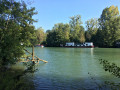
The spread of Columbanian rule led to the establishment of more than forty monasteries in Western Europe. Queen Bathilde founded one of the most important women's abbeys in France in Chelles.
This second journey, or path of exile, was travelled by Columbanus and his compatriots between 610 and 613, from Paris to Rebais. It marked the beginning of a new journey eastwards to Bregenz on Lake Constance and then Bobbio.
From Noisy-le-Grand to Gagny and Mont Guichet
 11.80 mi
+338 ft
-453 ft
5h 45
11.80 mi
+338 ft
-453 ft
5h 45
 Moderate
Departure from Noisy-le-Grand (Seine-Saint-Denis)
Moderate
Departure from Noisy-le-Grand (Seine-Saint-Denis)
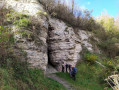
A surprising walk which, on the map, looks very urban, but which, with very few exceptions, avoids tarmac roads. You’ll come across many remarkable buildings, passing from one green space to another – some landscaped (the Croissant Vert) and others wild (the Haute-Île) – and finish with a circular route along well-marked trails through the former gypsum quarries of Mont Guichet, which have been abandoned for decades.
From Noisy-le-Grand to Villiers-sur-Marne via the Arènes de Picasso
 3.91 mi
+30 ft
-82 ft
1h 50
Easy
Departure from Noisy-le-Grand (Seine-Saint-Denis)
3.91 mi
+30 ft
-82 ft
1h 50
Easy
Departure from Noisy-le-Grand (Seine-Saint-Denis)
A short urban walk taking us from Seine-Saint-Denis to Val-de-Marne. Along the way, the Arènes de Picasso with two buildings featuring cylindrical façades, residential areas and two public gardens.
From Nogent-sur-Marne to Noisy-le-Grand
 6.75 mi
+197 ft
-89 ft
3h 15
Moderate
Departure from Nogent-sur-Marne (Val-de-Marne)
6.75 mi
+197 ft
-89 ft
3h 15
Moderate
Departure from Nogent-sur-Marne (Val-de-Marne)
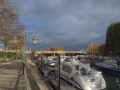
From Nogent-sur-Marne RER station to Noisy-le-Grand Mont-d’Est station (Line A), passing along the banks of the Marne and its bridges. You can reach the start or finish points by taking Bus 120, which runs between the two stations (allow around 45 minutes). You can also break off your route towards Neuilly-Plaisance by heading to the RER station located very close to the route.
The Parc départemental du Plateau and the banks of the Marne
 3.74 mi
+108 ft
-217 ft
1h 50
Easy
Departure from Villiers-sur-Marne (Val-de-Marne)
3.74 mi
+108 ft
-217 ft
1h 50
Easy
Departure from Villiers-sur-Marne (Val-de-Marne)
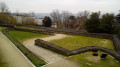
An urban route that first passes through a residential area and then runs alongside a commercial area. Crossing the Parc du Plateau, in several sections, allows you to enjoy some greenery and provides an opportunity to visit a few memorial sites. The walk ends with a pleasant stroll along the Marne and its islands.
From Mairie des Lilas to Bagnolet via the parks and forts
 11.76 mi
+633 ft
-755 ft
5h 55
Moderate
Departure from Les Lilas (Seine-Saint-Denis)
11.76 mi
+633 ft
-755 ft
5h 55
Moderate
Departure from Les Lilas (Seine-Saint-Denis)
An original walk from metro station to metro station, covering 19 or 16 km. It offers a rather surprising exploration of Seine-Saint-Denis, which is green for much of the route as it makes the most of the numerous parks and green spaces, skirting the forts of Romainville, Noisy and Rosny. Discover beautiful monuments, remarkable trees and interesting buildings, with superb views of Paris and its suburbs.
From Montreuil to Les Lilas through alleys, paths and gardens
 3.76 mi
+243 ft
-66 ft
1h 55
Easy
Departure from Montreuil (Seine-Saint-Denis) (Seine-Saint-Denis)
3.76 mi
+243 ft
-66 ft
1h 55
Easy
Departure from Montreuil (Seine-Saint-Denis) (Seine-Saint-Denis)
A route that, in a highly urbanised environment, favours alleys and other passageways, as well as public parks, and runs alongside several areas of shared or allotment gardens. It is also an opportunity to pay tribute to the mathematicians and activists Josette and Maurice Audin, victims of the abuses that took place during the Algerian War.