


Refine your search for walks in Église Notre-Dame (Torfou)
Église Notre-Dame (Torfou) walks


 From Étréchy to Lardy via the hillsides on the left bank
 Visorando Member
 10.69 mi
 +433 ft
 -384 ft
 5h 20
5h 20
 Moderate
 Departure from Étréchy (Essonne) (Essonne)
This walk from station to station leaves the Juine valley and climbs higher. After leaving the small town of Étréchy, the first part of the walk takes place mainly amongst cultivated fields. From the village of Mauchamps, the route becomes more varied and runs partly through woodland. There are several beautiful churches to see in Étréchy, Mauchamps and Torfou, not to mention the superb church of Saint-Sulpice-de-Favières, for which a detour is suggested.
From Lardy to Dourdan
20.31 mi
+1,322 ft
-1,260 ft
10h 30
 Very difficult
Departure from Lardy (Essonne)
Very difficult
Departure from Lardy (Essonne)
This stage of the GR®1 is one of the most difficult on this GR®. It is 32 km long and has an elevation gain of over 400 m. It is also one of the most beautiful. Starting from Lardy, this hike takes you past magnificent monuments such as the Church of Saint-Sulpice, the Church of Saint-Yon, the Church of Sermaise and the Château de Dourdan. There are other monuments to visit in this town. Most of the route is in the countryside, with several ascents and descents into the valleys. The route passes through numerous villages of varying sizes.
GR®1: Tour of Île-de-France
 363.31 mi
+17,464 ft
-17,103 ft
21 days
Very difficult
Departure from Paris
363.31 mi
+17,464 ft
-17,103 ft
21 days
Very difficult
Departure from Paris
Over 500 km long and with more than 4,000 m of elevation gain, this hike is accessible to everyone if broken down into several stages. Beautiful, rural and fairly close to Paris, it is suitable for anyone who wants to try their hand at hiking. There are many points of interest along this route. History and heritage enthusiasts, as well as nature lovers, will find something to enjoy.
Walks near Église Notre-Dame (Torfou)
From Lardy to Ballancourt via the Marais d’Itteville
 8.92 mi
+33 ft
-135 ft
4h 10
Moderate
Departure from Lardy (Essonne)
8.92 mi
+33 ft
-135 ft
4h 10
Moderate
Departure from Lardy (Essonne)
The final stretch follows the River Juine to its confluence with the River Essonne, which is, however, not accessible. The route alternates between built-up areas and paths through fields and woods. The Marais d’Itteville, with its ponds, reed beds and birdwatching hides, is the highlight of this walk.
From Étréchy to Dourdan through the fields and woods of Hurepoix
 14.03 mi
+801 ft
-682 ft
7h 10
14.03 mi
+801 ft
-682 ft
7h 10
 Difficult
Departure from Étréchy (Essonne) (Essonne)
Difficult
Departure from Étréchy (Essonne) (Essonne)
A hilly route from station to station, mainly through farmland for the first two-thirds, then through more wooded areas. Beautiful churches and rural heritage can be found in the villages along the way. In Dourdan, the walk along the Orge river, the 12th-13th century church and the fortified castle provide a superb finishing touch.
From Étréchy to Lardy via the Juine Valley
 6.83 mi
+174 ft
-164 ft
3h 15
Moderate
Departure from Étréchy (Essonne) (Essonne)
6.83 mi
+174 ft
-164 ft
3h 15
Moderate
Departure from Étréchy (Essonne) (Essonne)
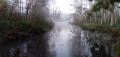
This walk, which takes place mainly on tarmac roads, forms a transitional stage in this journey along the Juine. Passing through a few pretty villages, two old mills, a beautiful church and a geological curiosity add to the charm of this route.
From Étréchy to Saint-Chéron, from the Juine to the Orge through the Hurepoix
 15.96 mi
+955 ft
-971 ft
8h 10
Difficult
Departure from Étréchy (Essonne) (Essonne)
15.96 mi
+955 ft
-971 ft
8h 10
Difficult
Departure from Étréchy (Essonne) (Essonne)
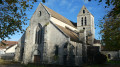
Thirty-first stage of the Grand Tour of Île-de-France via the GR®11, linking Étréchy in the Juine Valley to Saint-Chéron in the Orge Valley, via the Renarde Valley. It winds its way through the Hurepoix and the southern edge of the Beauce, offering varied landscapes, from plateaus to valleys and fields to forests. It is notable for its numerous ascents and descents between plateaus and valleys.
La Roche Turpin from Égly station
 11.90 mi
+453 ft
-476 ft
5h 50
Moderate
Departure from Égly (Essonne)
11.90 mi
+453 ft
-476 ft
5h 50
Moderate
Departure from Égly (Essonne)
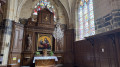
The main aim of this walk is to reach La Roche Turpin from a station (RER C). La Roche Turpin is a magnificent natural area consisting of a sandstone plateau and its slopes, covered by a beautiful forest mainly populated by oaks (including some superb specimens), chestnut trees and Scots pines.At the start, you can enjoy the path around the Bassin de Trévoix (Retenue de l'Orge). You then make a pleasant walk through the village of Bruyères-le-Châtel via a dense network of well-maintained footpaths. Next comes the beautiful forest of Bruyères-le-Châtel (although there are long straight stretches due to fences enclosing large areas).
Following the Orge from Arpajon to Sainte-Geneviève-des-Bois.
 8.47 mi
+69 ft
-102 ft
3h 55
Moderate
Departure from Arpajon (Essonne)
8.47 mi
+69 ft
-102 ft
3h 55
Moderate
Departure from Arpajon (Essonne)
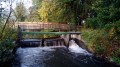
A hike from station to station, mostly following the Orge river or its secondary branch, the Grande Boële, and along a few large reservoirs. There is a rich heritage to discover, in Arpajon at the start of the hike and, as a highlight, at the Basilica of Longpont.
From Arpajon to Saint-Chéron via the Bassin de Trêvois and the Château de Baville
 8.45 mi
+272 ft
-246 ft
4h 05
Moderate
Departure from Arpajon (Essonne)
8.45 mi
+272 ft
-246 ft
4h 05
Moderate
Departure from Arpajon (Essonne)
A hike from station to station, along the Orge and its tributary, the Rémarde, as well as the Bassin de Trêvois. A small menhir and a Louis XIII-style castle add a nice touch of heritage.
Following the Orge from Saint-Chéron to Arpajon
 8.22 mi
+128 ft
-138 ft
3h 55
Moderate
Departure from Saint-Chéron (Essonne) (Essonne)
8.22 mi
+128 ft
-138 ft
3h 55
Moderate
Departure from Saint-Chéron (Essonne) (Essonne)
A walk from station to station in the Orge Valley, exploring two large ponds home to numerous birds. A picturesque route in the first half, which then sees the proportion of urban sections increase. Heritage sites along the way: a well-restored old mill, a few churches, a small menhir, a wash house...
From Saint-Chéron to Dourdan via the hillsides on the left bank
 8.18 mi
+646 ft
-518 ft
4h 20
Moderate
Departure from Saint-Chéron (Essonne) (Essonne)
8.18 mi
+646 ft
-518 ft
4h 20
Moderate
Departure from Saint-Chéron (Essonne) (Essonne)
A walk from station to station along the hillsides on the left bank of the Orge. The route ends in Dourdan, which boasts a rich heritage, notably its fortified castle and Gothic church.
From Saint-Chéron to Saint-Rémy-lès-Chevreuse, from the Orge to the Yvette
 16.45 mi
+814 ft
-784 ft
8h 15
Very difficult
Departure from Saint-Chéron (Essonne) (Essonne)
16.45 mi
+814 ft
-784 ft
8h 15
Very difficult
Departure from Saint-Chéron (Essonne) (Essonne)
Thirty-second and penultimate stage of the Grand Tour of Île-de-France via the GR®11. It starts in Saint-Chéron in the Orge Valley and ends in Saint-Rémy-lès-Chevreuse in the Yvette Valley, thus completing the crossing of the Essonne via its main valleys. After starting off towards the west, the route heads due north across the Hurepoix plateaus.