From Obermatten to a path along the Rotbaechel

A pleasant walk combining the countryside east of Bischwiller and a pretty path along the Rotbaechel. This route allows you to discover various curiosities such as the boiler of an old steam engine and a wash house on the Rotbaechel.

Details

14479144
Creation:
Last update:
Last review:
  • Walking
    Activity: Walking
  • ↔
    Distance: 4.99 km
  • ◔
    Average duration: 1h 30 
  • ▲
    Difficulty: Easy

  • ⚐
    Back to start: Yes
  • ↗
    Ascent: + 14 m
  • ↘
    Descent: - 14 m

  • ▲
    Highest point: 144 m
  • ▼
    Lowest point: 127 m
  • ⚐ Country: France
  • ⚐ City: Bischwiller (67240)
  • ⚑
    Start/End: N 48.769863° / E 7.861883°
  • Accessible from the train station Gare de BISCHWILLER (VESTRA).
  • ❏
    IGN map(s): Ref. 3815E
  • Hour-by-hour weather

Photos

Description of the walk

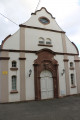
The parking point is located in the car park at Place de l'Église in Bischwiller.
This hike is (mostly) marked with red rings.

(S/E) Leave the car park by crossing the motorhome area in a north-easterly direction. Continue through the Parc du Château and turn right until you reach the street that runs behind the Super U supermarket. Turn left onto this street. The path crosses the Erlengraben and heads north along a beautiful lane that crosses the Obermatten. This area is bordered by the Moder River to the east.
Further on, the path becomes a road, Impasse de l'Obermatt, at the Haras de la Moder.

(1) At the end of Impasse de l'Obermatt, turn left onto the cycle path shared with pedestrians. This runs alongside Rue de l'Obermatt, crosses the Erlengraben river and then climbs up through a wooded area on the left.
Shortly afterwards, Rue des Casernes is on the left. Cross Rue de l'Obermatt carefully near a roundabout and continue along the street that leads to the riding club, Haras des Bussières. This road passes a reception area on the left and the waste collection centre on the right (a short distance away).
In front of the entrance to SAS Vita Compost, continue along the road that passes to the left of this company and quickly leads to the Haras du Moder.
Just around the corner after passing the stud farm, continue straight ahead onto a path blocked by a barrier. This path crosses a clearing where it meets a crossroads.

(2) Turn onto the path on the left heading south. It joins Rue de l'Obermatt.
Cross Rue de l'Obermatt with caution and continue straight ahead onto Rue du Stade. At Rue du Lycée on the left, follow the path on the left-hand side of the street and go around the stadium to continue along Rue de la Piscine until you reach Rue de Florival on the right.

(3) Cross Rue de la Piscine with caution and take Rue de Florival, walking alongside the cemetery on your left. When Rue de Florival turns right at a right angle, continue straight ahead, staying close to the cemetery wall (Chemin des Bleuets).
At the corner of the cemetery, cross Rue du Carmel carefully at the triangular crossroads. Walk along Rue de Haguenau on the east side and, when you reach the park, turn left towards a small courtyard housing an old steam engine from the Schwebel-Schmidt cloth factory, then the Wenger Fils carded wool spinning mill.

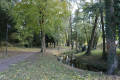
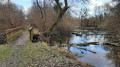
(4) Go around the south side of the courtyard and join the beautiful path that runs alongside the Rotbaechel stream.
Further on, cross Rue du Capitaine Chérifi and continue to the right along the path that continues to run alongside the stream. The path crosses the Rotbaechel and further on joins Rue de l'Étang. Take this road on the left, cross Rue du Moulin carefully and take Rue du Lavoir opposite.

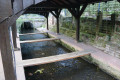
(5) At the beginning of the street, you will see the wash house on your left. Further on, at the junction with Rue du Diaconat, turn right into this street and walk for about 100 metres before turning left into an alleyway that runs alongside the Rotbaechel. Continue to Rue Profonde. There, turn left onto Rue Profonde, cross the stream and continue to the junction with Rue de l'Église.
Cross Rue de l'Église carefully and head to the car park, which marks the end of this route (S/E).

Waypoints

  1. S/E : km 0 - alt. 130 m - Parking: Church square
  2. 1 : km 1.64 - alt. 130 m - Impasse de l'Obermatt junction - cycle path - Moder (rivière)
  3. 2 : km 2.53 - alt. 143 m - Crossroads after the Haras des Bussières
  4. 3 : km 3.28 - alt. 143 m - Crossroads Rue de la Piscine - Rue Florival
  5. 4 : km 3.71 - alt. 139 m - Courtyard - Old steam engine boiler
  6. 5 : km 4.45 - alt. 131 m - Wash house
  7. S/E : km 4.99 - alt. 130 m - Parking: Church square - Musée de la Laub à Bischwiller

Notes

Hike suggested bythe Pays de Haguenau Tourist Office, this is the poets' trail.

This hike covers varied terrain and requires suitable footwear.

In addition, it is advisable to follow the directions in the description and on the map, while also paying close attention to the landscape. Waypoints (with their GPS coordinates and distance from the starting point) are helpful for hikers who are new to the route.

Markings: CV.

Hike completed by the author on 21 October 2021.

Worth a visit

Bischwiller
First factories (1815-1842)
The political and military instability of the final years of the Napoleonic Empire had a detrimental effect on the textile industry in Bischwiller. In order to survive, clothiers and investors pooled their capital and created the city's first factories, such as Leroy et Compagnie, Goulden et Compagnie and Heusch et Weiss. In 1818, the latter operated 18 looms.

These early companies introduced mechanisation. In 1810, Goulden equipped its spinning mill with a Douglas-type wool carding machine. This equipment reduced labour and manufacturing costs. Two men on a carding machine replaced the manual labour of nearly forty workers. The dynamism of these entrepreneurs meant that sales of cloth rose from 1 million francs in 1815 to 2.6 million in 1840. While there were thirty-five manufacturers in 1818, by 1840 there were sixty-four, specialising in heavy black-dyed cloth.

The golden age of textiles in Bischwiller (1842-1870)
In 1842, the manufacturer Kunzer was the first in Bischwiller to install a steam engine to replace an ox or horse-drawn mill. Other manufacturers soon followed suit: Ruef and Picard in 1842, Bourguignon-Schwebel in 1843, Pierson in 1848, Voelckel and Kablé in 1853, etc. This new energy enabled the diversification of industrial activities. Weaving workshops were joined by spinning mills, fulling mills and dye works. The production of coarse cloth was supplemented by other products such as zephyrs, amazones and wool satins. With the development of business, these textile activities spread to other localities near Bischwiller, in Weyersheim, Drusenheim and Haguenau. In 1855, this trade benefited from the opening of the Haguenau-Strasbourg railway line. In Bischwiller, the population doubled in less than thirty years, from 5,721 inhabitants in 1841 to 11,500 in 1869. In 1870, nearly 5,000 workers, including 2,000 weavers, were employed in Bischwiller's factories. To meet the demand for labour, 2,200 workers arrived every morning from neighbouring villages, while others emigrated from Germany (Baden, Württemberg, Palatinate).

Religious heritage
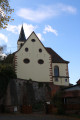
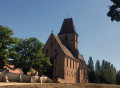
Protestant church built around 1300, damaged several times and modified in 1722 (organ by André Silbermann, 1724, rebuilt by Stiehr-Mockers in 1867 - listed as a Historic Monument).
Neoclassical Catholic church. The Church of Saint Augustine was inaugurated on 28 August 1837 by the Vicar General of the Diocese of Strasbourg, Bruno François Léopold Liebermann, in the presence of all the notables of the canton, under the parish priest Joseph Voltz.
Simultaneous church of Hanhoffen. (Hanhoffen is the name of a district of Bischwiller, a former hamlet that was administratively attached to the town since the Ancien Régime).

Civil heritage
The former pharmacy of the princely court has been listed as a historic monument since 1987.
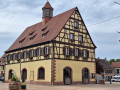
La Laub, former community centre and market hall (1665)
Source: Wikipedia (excerpts)

Reviews and comments

3.6 / 5
Based on 3 reviews

Reliability of the description
4 / 5
Ease of following the route
4 / 5
Route interest
2.7 / 5
CLO RITZ
CLO RITZ

Overall rating : 1.7 / 5

Date of your route : Apr 07, 2025
Reliability of the description : ★★☆☆☆ Disappointing
Ease of following the route : ★★☆☆☆ Disappointing
Route interest : ★☆☆☆☆ Very disappointing
Very busy route : No

We did not enjoy this hike at all, as it was entirely on tarmac and then on a cycle path alongside a busy road. Fortunately, there were two stables to take my mind off things, and what's more, the directions were partially incorrect. For those who really appreciate unspoilt nature with dirt tracks, fields, vineyards, forests and a little bit of mountain, I would not recommend this hike, which offers none of these things...

Machine-translated

Christophe Fevrier
Christophe Fevrier

Overall rating : 4.3 / 5

Date of your route : Mar 31, 2025
Reliability of the description : ★★★★★ Very good
Ease of following the route : ★★★★★ Very good
Route interest : ★★★☆☆ Average
Very busy route : No

An easy hike for a quiet Sunday. Not particularly interesting from a cultural or visual point of view.

Machine-translated

groumx
groumx

Overall rating : 4.7 / 5

Date of your route : Jan 07, 2025
Reliability of the description : ★★★★★ Very good
Ease of following the route : ★★★★★ Very good
Route interest : ★★★★☆ Good
Very busy route : No

very easy walk, ideal for a Sunday afternoon, suitable for everyone

Machine-translated

Other walks in the area

For more walks, use our search engine .

The GPS track and description are the property of this route's author. Please do not copy them without permission.