From Château-Larcher to the Airlait dolmen

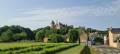
A pleasant walk on both sides of the Clouère, offering the chance to explore the Thorus plateau and the Arlait dolmen, to visit the Camp Alaric caves and Baptresse with its rich heritage, and to finish at the magnificent historic town of Château-Larcher. In particular, see its Lantern of the Dead, a former priory, its church (the former castle chapel), a manor house, etc.

Details

2937377
Creation:
Last update:
Last review:
  • Walking
    Activity: Walking
  • ↔
    Distance: 8.98 mi
  • ◔
    Average duration: 4h 20 
  • ▲
    Difficulty: Moderate

  • ⚐
    Back to start: Yes
  • ↗
    Ascent: + 269 ft
  • ↘
    Descent: - 272 ft

  • ▲
    Highest point: 407 ft
  • ▼
    Lowest point: 282 ft

Photos

Description of the walk

Park at the side of the D88 road near Croix Saint-Martial.

(S/E) Follow the D88 road with care towards the Croix Saint-Martial junction. Turn right and walk along the pavement of the D742 road for about a hundred metres before crossing it very carefully to take Rue Saint Martial for its entire length.

(1) Cross the D742 again at the pedestrian crossing (but take care). The route passes in front of the old hospice with its Mansard roof. Take Impasse de la Chapelle on the right and continue by turning onto the path on the left, just before the end of the cul-de-sac. The path soon enters a wood and runs parallel to the Thorus and La Clouère roads for some time. Continue straight on until you reach a four-way junction.

(2) Turn left and continue northwards. The path leaves the woodland to cross the Douce and continues along the edge of the woodland. At a T-junction, turn left. Cross a small road carefully, go straight on and soon enter a woodland.

(3) About 500m from the road you crossed earlier, turn right onto a path that leads quickly to the Arlait Dolmens. Retrace your steps.

(3) Continue to the right until you reach a large, almost right-angled bend to the right.

(4) At the end of the bend, directly beneath the high-voltage power line, turn onto the path on the left. Continue through the woods until you are walking alongside the Clouère on your left. At this point on the route, you will see the eight caves on your right, which make up Camp Alaric. Continue along the path until it joins a small road.

(5) Turn left towards the hamlet of Le Roseau, which you reach after crossing the Clouère. Walk alongside the hamlet and continue straight on, ignoring a path on the right just after the buildings. Continue to a junction near the hamlet of Roquillon. Turn left and you will immediately come to a crossroads (with a castle and a 19th-century gatehouse).

(6) Turn right and take Rue de Rocquillon until you reach Baptresse. At the next crossroads, turn left into Rue de la Chapelle and go straight on. About 250m past the last houses, you’ll come to a junction.

(7) Turn right onto the path leading to the banks of the Clouère.

(8) At the next crossroads, turn left and follow the path to the end, where it meets a large pond. Retrace your steps.

(8) Turn left (south) onto a path that winds its way back towards Baptresse between houses before joining a small road. Turn left and follow the small road carefully. At a fork, take the Rue du Pigeonnier on the left. Follow this road to the junction with the D742.

(9) Cross the D742 with care and continue straight ahead. After a left-hand bend, ignore a turn-off on the right and pass under the high-voltage power line. At the next junction (elevation 120), turn right.

(10) At the junction, turn right and pass under the high-voltage power line again. Ignore a turn-off on my right and arrive at a crossroads (elevation 119). Turn left towards Chez Roucher and pass under the high-voltage power line once more. At the hamlet, turn left and cross through the hamlet, keeping all roads on your right. The road gives way to a track and, a little further on, joins another track which you follow to the left for a few metres.

(11) At the fork, continue straight on to the Fontaine d'Écrouzilles. Retrace your steps.

(11) Turn left onto the flat track heading east. Follow it until you reach the D88 road (Calvaire de la Croix Brune). Follow the D88 carefully for about a hundred metres.

(12) Turn right onto the road leading to the motorhome service area and the stadium. Just as the road bends left to serve the stadium and its car park, continue straight on to the picnic area near La Clouère.

(13) Retrace your steps.

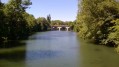
(12) Turn right and carefully follow the fairly narrow road towards Château-Larcher. Cross the Clouère via the Couture bridges, then head up towards the village. At the first house on the right, turn left into Place des Acacias. Follow it to the end.

(14) Turn left onto Impasse du Souvenir Français. Continue to the entrance of the cemetery and head to the centre to admire the Lanterne des Morts. Retrace your steps.

(14) Continue straight on for a few more metres, then turn left into Rue de la Mairie (the D88). Walk past the 12th-century church.

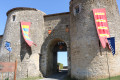
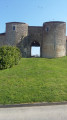
(15) Turn right onto Impasse du Vieux Château. Pass under the entrance gatehouse with its drawbridge, which leads to a large forecourt where the servants’ quarters were once located, and then to the site of the lord’s residence.

Turn back.

(15) Turn right. When you reach Place des Tilleuls, take the lane on the right which serves as a car park, allowing you to see other parts of the castle site. At the end of Place des Tilleuls, you will see the Mangin Tower on your right. Continue to the junction with the Route de Gencay (D742). Carry straight on along the pavement heading east.

(1) Turn right onto Rue Saint-Martial, which goes uphill. Cross the D742 carefully to take the pavement on the left-hand side. Continue to the Croix Saint-Martial junction. Turn left and return to the car park (S/E).


Waypoints

  1. S/E : mi 0 - alt. 390 ft - Side of the D88 road – Croix Saint-Martial
  2. 1 : mi 0.21 - alt. 341 ft - Crossroads
  3. 2 : mi 1.02 - alt. 374 ft - Crossroads
  4. 3 : mi 1.79 - alt. 381 ft - Crossroads near the - Les Dolmens d'Arlait
  5. 4 : mi 2.23 - alt. 358 ft - Crossing under a high-voltage power line
  6. 5 : mi 3.14 - alt. 285 ft - Path-road junction
  7. 6 : mi 4.06 - alt. 377 ft - Crossroads in Roquillon
  8. 7 : mi 4.7 - alt. 305 ft - Crossroads north of Baptresse
  9. 8 : mi 4.8 - alt. 292 ft - Access to the Étang de la Clouère
  10. 9 : mi 5.43 - alt. 374 ft - Road D742
  11. 10 : mi 6.14 - alt. 381 ft - Junction - Clouère (rivière)
  12. 11 : mi 6.88 - alt. 318 ft - Fontaines d'Ecrouzilles
  13. 12 : mi 7.38 - alt. 312 ft - Junction
  14. 13 : mi 7.71 - alt. 308 ft - Banks of the Clouère
  15. 14 : mi 8.27 - alt. 335 ft - Access to the - Lanterne des Morts de Château-Larcher
  16. 15 : mi 8.47 - alt. 335 ft - Access to the castle
  17. S/E : mi 8.98 - alt. 390 ft - Side of the D88 road – Croix Saint-Martial

Notes

The car park is located along the D88 road on the wide grass verge, just after the junction of the D68 and D742 roads where the Croix Saint-Martial stands.

This hike across varied terrain requires suitable footwear.

The route is not signposted but does not present any real difficulties in terms of navigation. Consequently, it is advisable to follow the directions in the description and on the map, whilst paying close attention to the landscape. The waypoints (with their GPS coordinates and the distance from the starting point) serve as aids for hikers exploring the route for the first time.

Hike completed by the author on 10 September 2019

Note: this hike was designed to include a picnic stop on the banks of the Clouère. Hikers wishing to undertake only a half-day walk may, at the point (12), continue along the road towards the point. The route is then 13.4 km long.

Worth a visit

Château-Larcher

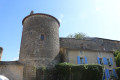
The most striking feature upon entering this charming village is its ancient fortified castle, whose truncated keep rises above the main street.

The 12th-century church, formerly the castle chapel, forms an integral part of the fortifications: panoramic view over the wooded Clouère valley.

In the middle of the cemetery stands a lantern of the dead, dating from the first half of the 13th century.

Nearby: the ruins of the Arlait dolmen bear witness to a vast necropolis (over 100 graves), built on this site around 3,500 BC.
Source: Vienne Tourist Office (excerpts)

Also worth seeing in the village:
The castle: only ruins remain.
The estate became part of the royal domain of France under Saint Louis, when he confiscated the fortress from Hugh I of Lusignan, who had rebelled against the King of France. The king had the castle razed to the ground in retaliation for the revolt against his mother Blanche of Castile and the Poitou family’s defection to the English prior to the Battle of Taillebourg in 1242.
Rebuilt, the castle suffered further damage during the Hundred Years’ War.
No sooner had it been rebuilt than it was devastated twice by the Protestants during the Wars of Religion.
Rebuilt by the Rochechouart family, who occupied it from 1504 to 1638, it was subsequently abandoned, as the family was summoned to court and preferred other residences more in keeping with the times.
During the Revolution, like many other castles in France, it served as a stone quarry, particularly for the villagers.
However, a few remarkable features are still visible today, such as the entrance gatehouse with its door flanked by two large towers, its terrace which is still home to a few dwellings in the former stables and servants’ quarters, the keep and an old tower separated from the rest of the castle by inner moats and a drawbridge, now made of stone (fixed bridge).
The keep is pentagonal in shape. It is built on a rocky outcrop and was likely erected to overlook the surrounding area. It was built in the 13th century. It was accessed via a drawbridge.

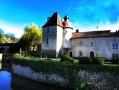
The Mangin Tower is situated in the centre of the village. Its foundations are thought to date from the 10th century. It was originally named Metgon, then gradually became known as Tour-à-Mesguen, before finally taking the name Mangin today. Its current form dates from the 15th century. It stands 13.30 metres tall. It has three storeys. It features numerous firing positions: arrow slits and embrasures.

The Chapel of Baptresse: the chapel is a small basilica topped with a Maltese cross. It was probably founded in the 4th century, after the death of Maxentius. It bears witness to the long history of religious occupation at the site, and a 2nd-century Gallo-Roman altar was discovered there. The altar has been moved to the Sainte-Croix Museum in Poitiers.
Destroyed by the Protestants during the Wars of Religion, this chapel was rebuilt shortly afterwards. Its architectural simplicity reflects the relative modesty of this former parish, as well as the fear of invasions and pillaging. The roof structure has been damaged by fire on several occasions. New stained-glass windows were installed in 2013. They were created by G. Levert.

The Hosanna Cross of Baptresse
Other types of cross (crossroads cross, etc.):
The Saint-Martial cross (1875),
The Jouarenne cross,
The Breuil cross (1928),
The cross at Les Chaumes (1938),
The Pichon Cross (1845),
The Parou Mission Cross (1923),
The 19th-century cross at Baptresse, at the entrance to the hamlet. The original cross has been in the chapel since 1830,
The Baptresse Cross located near the war memorial (1951),
The cross at La Brune (1875).
The dolmens
The manor house
Source: Wikipedia (excerpts)

The old hospice

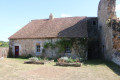
The former hospice, situated at the top of the village and built in 1784 by Abbé Gaspard de Cressac, features a beautiful Mansard roof and a chapel added in 1785. The building long housed nuns from the Congregation of the Sisters of Wisdom, who were responsible for caring for the poor and sick in the surrounding area.
This building, along with the chapel and other properties belonging to it (including a 43-hectare farm and woodland plots), were bequeathed by Abbé de Cressac to the local council for the benefit of the parish’s poor.
Currently, all these properties are managed by a joint administrative committee comprising local councillors and members of the de Cressac family. Used as a girls’ school until 1962, the hospice manor house was fully restored by the Poitiers social housing association in 1994, and rental accommodation was created there. The roofs and façade are listed as Historic Monuments.

The Hospice Chapel
What strikes the eye upon entering the chapel is an imposing altarpiece. It is made of wood with stucco decoration. The tomb-shaped altar, with its gently curved form, is raised above the choir, as is customary, by a step. At the centre of the altarpiece, the richly decorated tabernacle is flanked on either side by two volutes adorned with palm leaf motifs; the door depicts the Lamb of God on an altar, with a cross in the background.
The whole is surmounted by two finely executed angels who, with their right hands, hold a crown above a reliquary cross resting on the upper part of the tabernacle.
In the centre of the altarpiece, one can admire a 12th-century oil on canvas signed Ludovicus …, depicting Christ’s final appearance at the Sea of Tiberias. It underwent restoration in 2005.

The Thorus plateau is a small natural area of ecological, faunistic and floristic interest (ZNIEFF)
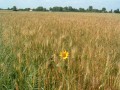
The soils of the plateau consist of shallow loam, rich in limestone pebbles, with low water retention. These soils are very selective in terms of vegetation. Indeed, particularly in summer when rain is scarce, the vegetation appears sparse and stunted. Given these specific conditions, a highly distinctive vegetation has developed, comprising juniper bushes, spireas and downy oaks. This area is of remarkable biological and botanical interest, as evidenced in particular by nine plant species that contribute to the rich plant heritage of the Vienne department:
Geneva bugle
the small-flowered bellflower
Venus’s hairgrass
the solid-bulbed corydalis
the blood-red geranium, a plant with a southern affinity that is quite surprising to find in a temperate oceanic climate
willow-leaved rock rose
the stubble sandwort: this species is endemic to France and, as such, enjoys official protection at national level; it is very rare in Poitou. In fact, it is found in only two other locations within the Vienne department.
Spanish spirea: this is a shrub native to the Asian steppes and is found, in the Vienne department, only on the Thorus plateau.
Prostrate speedwell.
Source: Wikipedia (excerpts)

The Arlait Dolmens
The Arlait dolmens are the remains of prehistoric stone tombs. Built around 4500 BC, they were reused around 2500 BC.
These three monuments, arranged in a triangle, are about thirty metres apart.
Source: tourisme-vienne.com website (excerpts)
Erected around 4500 BC, they were reused around 2500 BC. These three monuments, arranged in a triangle, are about thirty metres apart.
The Arlait dolmens are the remains of what was once a vast Celtic necropolis. Mr Brouillet (Société des Antiquaires de l’Ouest) stated in a report published in 1864 in the society’s memoirs: ‘the dolmens and tumuli of the Château-Larcher plateau, numbering in the thousands, may be regarded as burial sites’, and he added: “Almost all have already been excavated, and in all of them human bones, coarse pottery, flint tools, and weapons made of stone, bone and ivory have been found. It is indisputable that this entire region was, in a distant past, a major inhabited centre.”
A complete dolmen measured nearly 4 m long by 2.50 m wide.
In the 19th century, most of the plateau’s megaliths were broken up to pave the surrounding roads or were transported to the gardens of wealthy townspeople as ornaments. One remains in situ.
The municipality’s website

Reviews and comments

4.4 / 5
Based on 7 reviews

Reliability of the description
3.9 / 5
Ease of following the route
4.6 / 5
Route interest
4.7 / 5
User 28875407

Overall rating : 5 / 5

Date of your route : Apr 05, 2026
Reliability of the description : ★★★★★ Very good
Ease of following the route : ★★★★★ Very good
Route interest : ★★★★★ Very good
Very busy route : No

This route takes you through a wide variety of landscapes and past a number of points of interest. The village of Château Larcher, with its castle, old houses and ‘lantern of the dead’… is well worth a stop. The limestone meadows of the Thorus plateau offer a real change of scenery, and the Airlait dolmen is a truly peaceful spot.

Machine-translated

philouis
philouis

Overall rating : 4 / 5

Date of your route : Apr 26, 2022
Reliability of the description : ★★★★☆ Good
Ease of following the route : ★★★★☆ Good
Route interest : ★★★★☆ Good
Very busy route : No

A lovely walk with some great views, scenery and interesting heritage sites.
We started the route from the lake where we’d had our picnic.
Between points 1 and 2, as you begin the descent into the woods, don’t forget to take the path on the right, otherwise you’ll end up at Thorus.
At the power line, simply continue along the white path almost directly opposite.
The same applies to the caves.

Machine-translated

Moniquemarche
Moniquemarche

Overall rating : 4 / 5

Date of your route : Aug 09, 2021
Reliability of the description : ★★☆☆☆ Disappointing
Ease of following the route : ★★★★★ Very good
Route interest : ★★★★★ Very good
Very busy route : No

The description is sometimes far too detailed, whereas at key points there isn’t much to see.
Errors: directly beneath the high-voltage power line, turn left: wrong.
And on another occasion, it says to turn right when you should go straight on. Without the map, it’s impossible to do this hike without getting lost! A shame, as it’s a very interesting route.
Hike done on 6 August; on the plateaus, the path was poorly maintained, but as the summer was rubbish, doubtless few people ventured out.

Machine-translated

Lahontine22#
Lahontine22#

Thanks, I'm planning to go back there with some friends, so this time I'll make sure to look up. Enjoy your walks too.

Machine-translated

pgetrochon
pgetrochon

Thank you for your message.
The caves aren’t very easy to spot. You need to locate them on the map and look at the cliff face at that point on the right-hand side of the path. They rise above the forest and are therefore visible through the trees, which are quite sparse in that area. In ancient times, people used to take shelter in the crevices of the cliffs, slightly higher up, to protect themselves from wild animals.
Enjoy your walks

Machine-translated

Lahontine22#
Lahontine22#

Overall rating : 4.3 / 5

Date of your route : May 14, 2021
Reliability of the description : ★★★★☆ Good
Ease of following the route : ★★★★★ Very good
Route interest : ★★★★☆ Good
Very busy route : No

A varied walk: dry meadows overlooking the River Douce, woodland paths, a dirt track used by cyclists, a chapel, pretty old houses adorned with flowers... There are a few sections along roads, but they’re short. We didn’t find the “8 caves”, but the dolmen and the Citadel were definitely there. A lovely walk with a picnic. The village is really pretty.

Machine-translated

Roro86
Roro86

Overall rating : 4.3 / 5

Date of your route : May 08, 2021
Reliability of the description : ★★★★☆ Good
Ease of following the route : ★★★★☆ Good
Route interest : ★★★★★ Very good
Very busy route : No

A lovely walk combining varied scenery and cultural points of interest (hospice, castle, dolmen, church, lantern of the dead). Highly recommended.

Machine-translated

F.CLEMENT
F.CLEMENT

Overall rating : 5 / 5

Date of your route : Mar 15, 2021
Reliability of the description : ★★★★★ Very good
Ease of following the route : ★★★★★ Very good
Route interest : ★★★★★ Very good
Very busy route : Yes


A pleasant and varied route

Machine-translated

VIOT37
VIOT37
• Edited:

Overall rating : 4 / 5

Date of your route : Feb 13, 2021
Reliability of the description : ★★★☆☆ Average
Ease of following the route : ★★★★☆ Good
Route interest : ★★★★★ Very good
Very busy route : No

The weather is rough at the start of February, with various floods that only disrupt the route at the start of the campsite; we head back to the village to set off.
Right at the start of the route, I suggest replacing the path leading to Thorus via the road with the almost parallel path that leads directly to point 2.
I found the route description too detailed, which can be confusing, especially as the signposting is rather surprising.
The landscape is magnificent and the historical interest undeniable.

Machine-translated

Other walks in the area

For more walks, use our search engine .

The GPS track and description are the property of this route's author. Please do not copy them without permission.