Country:

 City:
City:


Before you start:
- The route has been downloaded to the app
- The vehicle is secure, and the keys are safe
Starting at W3W>>>
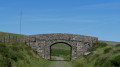
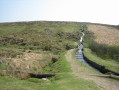
(S/E) At the start, head north-west. This open moorland features a well-trodden path that leads down the hill to the old railway track. The route will handrail this track, heading in a northerly direction, curving around Ingra Tor. The track passes over a wooden bridge and continues to the next bridge. The track will then start to sweep left over a river bridge. At this point, looking down and upstream, notice what appears to be another old track. This is the remains of what was the old steam rail line that replaced an older horse-drawn track. Steam engines could manage greater inclines, hence the horses took a more gradual path. Continue through the cutting, then as the moorland opens up, an old field. There are straight linear features to mark where the fields were.
(1) At the edge of the linear feature, head up the path, handrail up until the old rail track is in sight, and the linear feature will veer away to the right. Continue up to the track and turn right, heading in a south-easterly direction. As the rail track sweeps around the hill, there is a Stone Age settlement; there will be more further along this route. Continue, handrailing the track to an old rail bridge. The trees on the edge of Princetown will be visible. Option, being just off route, Princetown has public conveniences and cafes.
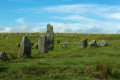
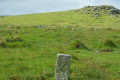
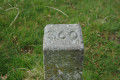
(2) Heading south off the track and down the embankment, keeping to the right of the depression in the land, there is not always a stream by the bridge, but keep to the west side, contour the hill until the road is visible. At the road B3212, Devil's Bridge (E) crossing, heading south on the east side of the river. It is important that the route is to the east of the river, as conservation work is in progress. rewetting the moorland. An attempt to retain more water on the moors by blocking the river, slowing the flow, and flooding the area, in the hope of re-establishing marshland. Staying to the higher ground, heading south towards Hart Tor. Taking a sighting of the tor and heading straight for it, the ground will level out. Around this area, look out for another Stone Age settlement and hut circle. There will also be short granite posts, see image, with markings 400, 200 etc, Once two have been found, look towards the Tor and to the left, there is a depression which was the target for the old rifle range. At Hart Tor, there is an easy route to the top on the south side.
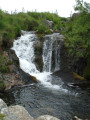
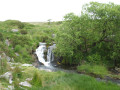
(3) From Hart Tor heading Southwest, see Black Tor to the west, the route leads down the valley. Maintaining a southwest direction will lead to the area of a stone row and a Cairn. The young river will be visible, appearing on the right. There will be a metal iron sheet approximately 12 feet by 15 inches, it has been placed across the river, intended as a crossing point. Cross the river and handrail the river downstream, it will pass a small waterfall and lead onto, and meet the Devonport leat. (B)
(4) Following the leat along the bank, near the edge of the woods, handrail the woods in a westerly direction. At this time, the mature trees have been felled, with new saplings planted. A the edge of the wood line, continue veering slightly north and up an incline, to meet the main road. Turning left and west handrail of the road towards the (S/E). Crossing the road when safe to do so. Returning to (S/E)
 Visorando Member
 Easy
Easy