Country:

 City:
City:


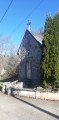
To get to Saint-Bresson in the Southern Vosges. From Luxeuil, take the RD6 to Raddon, then take the RD136 to Saint-Bresson. Park in the car park near the church, along the road towards the Chalot.
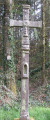
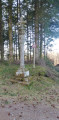
(S/E) Opposite the Chalot at the foot of the church, here is the first wayside cross. Continue along the departmental road for 200 m. At the crossroads with a second wayside cross, turn right towards Le Fahy (Blue Ring signposting), cross the bridge over the Raddon. At the entrance to the Champtruaux farm, note a new wayside cross.
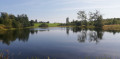
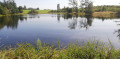
(1) At the hairpin bend, leave the tarmac road and take the path straight ahead (Arrow and Blue Ring). Cross a small stream via a small stone bridge. Turn right and head up into the forest. The birdsong mingles with the murmur of the stream. Further on, the path runs alongside a pasture and joins the track leading to it. Turn left and, when you reach a farm, turn left again towards the Étang du Breuchot. A wayside cross stands at the corner of the embankment.
(2) Continue along the pond. 200 m after a second, smaller pond, turn right (MTB route 44). Cross a small bridge and rejoin a tarmac road at a group of houses.
(3) At the large crossroads, go straight on along the stony path (marked for mountain biking). The path runs between two ponds and becomes grassy, winding through piles of stone gathered from fields to reach the hamlet of És Côtes. A wayside cross topped by a statue of the Virgin and Child stands guard over an old farmhouse, sadly now in ruins. You will nevertheless notice the remains of the typical façade of the pigsty.
(4) After the first house, turn immediately left onto the tarmac road. At a small cottage, note a wayside cross on the right. The road becomes a track, passes an old pond and leads to a small square. Turn right. Walk along the edge of a pond, turn left onto the embankment then right to descend to the hamlet of Ès Voivres and its old school dating from 1891, as evidenced by the fine cut stone gable. Here we see the architectural style imposed by Jules Ferry, with its large windows on two sides and the staff accommodation.
(5) Turn left onto the tarmac road. At the first crossroads, near a wayside cross on the left and a quasi-cave-like shed beneath our feet, turn right and then right again to reach the chapel that we had spotted from the road; it dates from 1924 and houses the Virgin of Lourdes.
(6) Return to the road and head up towards Chauversey and its wayside cross dating from 1611.
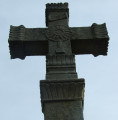
(7) Do not continue along the road but take the path up to the left (mountain bike route). When you reach a small tarmac road, opposite a cross with a small Virgin Mary in a niche, in a naive art style, turn right and follow this road. On the left, note the monumental 16th-century Montdahin cross, on which six figures are carved. In addition to Christ and the Virgin Mary, you will recognise Saint Peter with his key, Saint Paul with his sword, and two bishops. Follow the Blue Disc markings.
(8) A little further on, the hunters’ chalet with outdoor tables and benches is a good spot for a break. 100 m further on, take a short detour along the path on the right through a dying fir forest to enjoy a stunning view. From right to left, you can see: the Planche des Belles Filles (the three humps), the Ballon de Servance with its mast, and the Drumont stubs. Return to the road
(8) Continue to the bend. Leave the blue-marked path on your left.
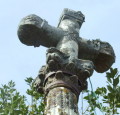
(9) Take the next path leading to the top of the hamlet of Effreney. Turn right and head down to the village entrance to admire a wayside cross with a rather finely crafted shaft, particularly the base of the cross featuring the heads of mythical animals.
(10) Retrace your steps to reach Le Béviau, passing by a new, very simple wayside cross.
(11) Turn right before the farm (blue markings) then left onto the stony path.
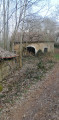
(12) At the right-angled bend, you can take a short detour straight ahead along a grassy path to the ruins of the Couvent farm
(13) Retrace your steps.
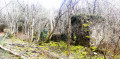
(12) Turn left until you reach the edge of the woods, then turn left and follow the edge of the woods along a forest track. On the left, at a place called Les Rangs du Bois, you will notice the ruins of a large building with a rounded extension, the purpose of which is unknown.
The path heads north through the middle of the forest.
(14) At a crossroads, do not turn left down the path (blue markings) but continue straight on to the hamlet of Les Vuillemots (waymark on the right).
(15) Turn left onto the tarmac road (RD136), passing a new wayside cross dating from 1669. After the bridge, turn left towards Les Jeannery. In the hamlet, note a wayside cross on the embankment to the left. Continue to the chapel, whose distinctive rose window adorns the keystone with a depiction of cherubs.
(16) Retrace your steps slightly and head down the path on the left (marked with Red Rectangles and Yellow Rectangles) alongside the stream. At the bottom of the slope, you’ll come to an old mill that has been converted into a residence.
(17) At the road, turn right, then at the D136 (decapitated wayside cross), turn left. On the right, note a beautiful cross. 100 m further on, take the village path on the right which climbs up to the hamlet of Le Carré.
(18) In the hamlet, do not follow the tarmac road but turn onto the path climbing to the right (marked with Red Rectangles and Yellow Rectangles), which leads to a bend in a tarmac road (calvary, 1751).
(19) Turn left, then immediately left again onto the path leading down (marked for mountain biking) to rejoin the main road. Turn right to reach the church. You will notice a final wayside cross (the 19th) behind the church, which you may not have spotted on the way there. Arrive at the Chalot car park (S/E).


 Tourist office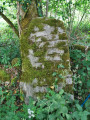

 Visorando Member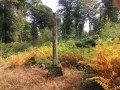
 Easy
Easy