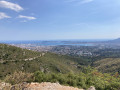
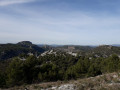
25/03/2024: the route ofthe GR® 51, which passes north between the Col du Taillan and the summit of Cape Gros, has been modified and now passes between the Col de Taillan, the telegraph and the summit of Capeu Gros. The IGN map has not been updated.


 Country:
 City:
City:


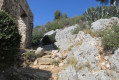
On leaving Ollioules (RN8), head towards Sainte-Anne d'Evenos in the Gorges d'Ollioules for 1 km. Park at the dog club (small car park) on your left.
(S/E) Cross the Reppe (small river behind the parapet) and go to the other side to start your walk. In summer, you will have no difficulty crossing. In winter, the Reppe is higher but still accessible. To help you, there is a crossing 25 metres downstream from the Reppe that will allow you to cross easily. Once you reach the other bank, turn left and walk up the Reppe for about 100 metres until you reach the lime kiln.
(1) Head north and follow the Reppe for 500 metres (small path) to the confluence with the Destel
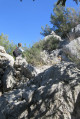
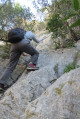
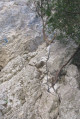
(2) Turn right into the bed of the Destel and follow it upstream. In wet weather, you can take the path on the left. In summer, you will walk in the river bed. After walking over pebbles and rocks , you will reach the start of the pools (natural basins). Chains and handrails are available to help you on your hike.
(3) Pass the chain vertically on the right (Passage du Dauphin) and continue into new large pools. This part is particularly challenging and justifies the "difficult" rating of the hike. It will require a little more energy and climbing in the pools themselves, thanks to artificial holds built into the rock. Progress is delicate and slow.
See Variants in the paragraph "During the hike or nearby below".
Reach a medium-sized pool that cannot be passed without climbing equipment.
(4) Escape and turn right (still on the left bank) into a gap or chimney that climbs steeply (on the map, at the first "l" in "les Cuves du Destel"). This climb is very steep and unmarked, but can be done quickly over rocks and small, non-dangerous scree, climbing with your hands.
(5) Find a trail, which fortunately is marked with numerous cairns that guide you to the top. Join the Broussan trail at Croupatier.
(6) Take the path on the right (yellow markings). Reach the junction with theGR®51and follow it to the right. Reach the telegraph junction on the descent at the hairpin bend on the right at an altitude of 232 metres. There is a picnic table where you can take a break.
(7) To the right of the picnic table, take the newGR®51, which climbs to the left towards the Chappe telegraph (signage in very good condition, supplemented by white and red markings, and sometimes old blue markings).
After passing a beautiful old wall at ground level that has been very well restored, you will reach the telegraph.
(8) Continue behind the telegraph to climb to the summit of Cap Gros (Capeu Gros), passing first by a boundary marker between the municipalities of Ollioules and Évenos. Follow theGR® to the second marker, which can be seen from a distance. This marker consists of a thick stone wall and a sign. The summit is very close; continue a few metres further north, leaving theGR® for a few metres.
(9) There is no marker to indicate the summit. Descend by the same path to the crossroads with the picnic table.
(7) Take the path to the west that descends behind the table into the bushes. The path runs along the hillside with a remarkable retaining wall, either on the left or on the right, depending on the bends. Do not be misled by the colour of the trail, which is sometimes red and sometimes yellow. Regardless, it will take you back to the lime kiln (S/E) by turning left at the end of the trail. Be careful, the descent is difficult.




 Visorando Member
 Very difficult
 Moderate
 Easy
Easy  Association / Club / Walk leader