Country:
 City:
City:


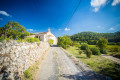
The walk starts in front of the town hall on Place Général de Gaulle. Opposite is Notre-Dame Church and right next to it is the porch leading to the post office. You will find parking behind it.
(S/E) Take Rue de l'Église, cross Rue Olivier de Serres on your left and Rue du Béal on your right. Continue straight on Rue de l'Église, which will soon turn left. You will soon see the cooperative winery on your left.
(1) Turn right onto Chemin de Gayassu, just opposite the winery, which is indicated by a small sign.
This path passes through farmland and after about 500 metres, you will see a riding centre on your right with a large solar panel that serves as a shelter for the horses.
(2) At the fork, take the path on the right (Chemin de Sous Ville).
Go around the equestrian centre on the right and after 400 metres, cross a canal fed by the Argens.
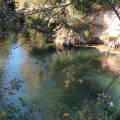
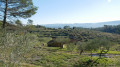
Continue straight ahead on this path surrounded by vineyards for about 1 km. On your right, you will hear the Argens flowing between the trees. When you reach the inclined plane on the Argens, you will see on your left the water intake for this canal, which has made it possible to irrigate these unproductive lands.
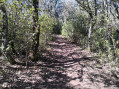
(3) Retrace your steps for about 100 metres. On the right as you return from the inclined plane, there is a path through the undergrowth. Take this path, which climbs slightly under a beautiful canopy of trees, and you will soon see several dry stone structures shaped like wells on your left: many springs emerge from the ground at this point.
Continue along the path uphill and just before a bend on the left, a green sign pointing to the right indicates "Apié 200 m".
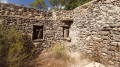
(4) Take this path on the right, which winds through the woods, and after about 30 metres, you will come to a fork. The left-hand path is marked "Sentier de l'âne" (donkey path). Take this path, which bends to the right again, leading to another path that climbs straight up to the west. At the end of this path, you will see a large enclosure wall, slightly hidden under the trees.
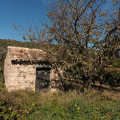
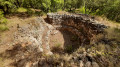
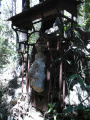
This is an enclosure containing an apié, which means "beehive" in Provençal. You can visit it and discover bruscs, which are old beehives made from cork oak bark and covered with a flat stone. This enclosure protected the bees from the wind and wild boars and was exposed to the east (the rising sun) to help the bees forage.
Leaving the enclosure, with the gate behind you, turn left and follow the small paths to discover a lime kiln that was used to transform the surrounding limestone into quicklime and then into slaked lime to improve the agricultural land.
(5) Return to the starting point via the same route (S/E).


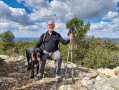
 A very pleasant walk that allows you to discover some old buildings. We returned via a southern route marked PR on the map. There are few people there during the week.


 Visorando Member

 Moderate