Country:

 City:
City:


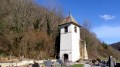
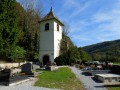
Parking at Bonnevaux-du-Bas, near the remains of the bell tower of the former priory. Yellow-blue markings.
(S/E) Return to the hamlet via the small tarmac road and, at the main road, continue straight ahead. At the intersection of the D280 and D280E, head towards Ornans and turn left before the bridge onto the gravel path that will take you across the Brême via two small footbridges. Enter the pasture through the metal gate, remembering to close it behind you. Cross the pasture diagonally, leaving the pond behind you and heading towards the opposite wooded corner, staying in the lower part of the meadow.
(1) There is a marker on a tree. Cross the stream and you will find a beautiful forest path that runs alongside the Brême stream. Stay on this wide path, ignoring a first path that descends to the right, then a second that climbs the hill to the left. The road becomes stony. You will pass in front of a pavilion and come to a marker post.
(2) About ten metres before this signpost, climb up to the left, heading towards Bois sur le Grand. The path climbs steeply in a straight line. You will soon reach a path running perpendicular to it. Turn left. You will cross a beautiful fir forest, passing large boulders that have fallen from the cliffs. When the fir trees give way to deciduous trees, ignore a path on the left and continue climbing on this beautiful, wide path.
(3) Be careful! At the top, immediately after some beautiful rocks, look for the signpost indicating to climb to the right, but continue climbing for about fifty steps on the same path (ignoring the small path on the right) to find a second signpost indicating to turn right and then take the wide path (on the right, of course). Continue to the signpost, ignoring the paths on the right and left, and follow the signs carefully.
(4) At the fork, at the signpost, turn right, heading towards Roche du Grand.
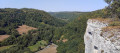
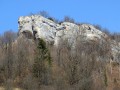
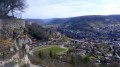
(5) About 50 metres from the cliffs, look carefully for the yellow-blue markings, which are almost faded, on a tree on the right and a barely visible fork in the path. (Hikers have piled up a few stones to create a small cairn). Continue straight ahead to the first unsecured viewpoint over the more modern part of Ornans and the upper Loue valley up to Roche de Hautepierre. Be careful, the viewpoint is not secured and the sharp limestone pavements can cause you to trip. Return to the cairn and take the small, barely visible path on the left that runs along the cliffs at a distance and joins a small rocky outcrop. Approach with extreme caution: this is the second and most beautiful viewpoint over the lower valley towards Scey-en-Varais, as far as Mont de Cademène and Rocher de Colonne. At the foot of the cliffs is the old Tacot viaduct.
Retrace your steps.
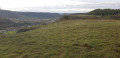
(4) Continue straight on towards the Fermes de Septfontaines. As you leave the woods, you will cross a meadow with beautiful views of the neighbouring mountains on your right and, opposite you, the luminous Roche de Hautepierre, which deserves its nickname of Roche du Soleil (Sun Rock). When this small, well-paved road crosses a path on the left that goes up into the meadow, continue straight ahead for about a hundred metres
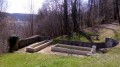
(6). When it is bordered by hedges and a barbed wire fence ends, look for a small path that descends the wooded hillside on the right. You will lose the markings, but continue down this beautiful path with its well-defined switchbacks to the clearing at the Fontaine des Vipères, ignoring the other paths. Go to Courbet's painting to compare the pretty view of the west passageway of the château, pierced by three arrow slits.
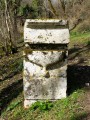
(7) Descend towards the fountain. With your back to the fountain, cross the clearing lengthwise to find a path that quickly forks. Go up to the left. At the second fork, take the wider path on the right. At the stone colonnade, continue straight ahead until you reach the small tarmac road. Cross it and continue along the path opposite to the village. Pass between the two no entry signs and turn right towards the viewpoint.
(8) You will arrive at the viewpoint and the ruins of the old castle. Continue towards the Chapel of Saint George, built by Othon, Count of Burgundy, in 1289 and rebuilt in 1500. Continue along a small lane to the left of the chapel to complete the circular route around the hamlet. You will pass an old cul-de-four. Go back between the two no-entry posts, then past the fountain and continue straight on to the calvary and turn right towards Roche des Pins.
(9) At the last house, go down the beautiful stone path on the right that runs along the cornices. 200 metres further on, you can leave the marked trail and take the small path on the right that runs closer to the cornices (despite the yellow and blue cross) to discover some crevices. You will rejoin the marked trail a little further on.
(10) You will come to a hairpin bend at the top of a small valley, where the hiking trails fork. Go up to the left towards the Septfontaine farms. At the meadow, follow the fence and continue straight ahead until you reach the small tarmac road. Turn around for a view of Mont Poupet. Then turn right and walk past the farms for about 300 metres until you reach the signpost.
(11) Descend to the left onto the gravel road towards Vallée de la Brème. The path quickly disappears into a pasture near an electrical transformer. Go through the small metal gate and follow the barbed wire fence towards Bonnevaux-du-Bas. At the pylon, you will find a path at the edge of the forest that descends into the valley and can be slippery. Follow the signposts carefully.
(12) After a few wooden steps, with the first houses of Bonnevaux-du-Bas in sight, you will reach a wider path which you will follow downhill to the right. At the edge of the woods, turn left onto the gravel road to return to the priory and your vehicle (S/E).
 The route includes cliff-top paths and unsecured viewpoints. The paths are rocky and slippery in places. Sturdy footwear is essential and walking sticks are recommended. The path overlooking the Brême can be wet in certain seasons.

 Visorando Member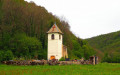

 Easy
Easy