Country:

 City:
City:


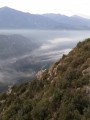
There is no ideal place to park your car, as you have to walk along a stretch of main road to reach a quieter track. We recommend leaving your vehicle in a small car park on the edge of the N113, opposite the campsite reception.
(S/E) Head west and follow the N116, directly on the road, preferably early in the morning to avoid heavy traffic. Be extremely careful! Continue up the road until you reach the start of a track on the right marked "Interdit sauf aux riverains" (No entry except for residents). Follow this agricultural track that runs alongside the N116 for about 800 metres. You will come to a small house with a shed in front of it, on the right-hand side of the road.
(1) Take the path that climbs up alongside the house. You will come to a staircase that leads to the terraces on the side of the Saint-Pierre massif.
Climb from terrace to terrace for about 100 metres, sloping to the left, until you reach the trace of an old irrigation canal. You can see the outline of this canal on the IGN map, but it is difficult to spot on the ground as it is so filled in. It is only after a few dozen metres horizontally, in the middle of the vegetation, that you will be able to see the unmistakable traces of this old canal on the ground. So you have to persevere! There are several traces of paths here, all leading to the canal, one of which has been marked with thick orange adhesive tape on the trees.
Follow this irrigation canal, known as Rocanso, heading south-west. This will take you to the Rocanso small pass, between the rock at 573 m and the side of the massif. The path continues along this old canal clinging to the escarpment for a few hundred metres.
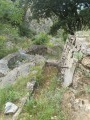
This canal ends at the Horts stream (a ravine, usually dry; photo). On the other side of the ravine, there is a path that continues the route: follow it for a few dozen metres to the south, descending towards the base of the rock, then turn sharply to the left, staying on the path to join the trace of the old path from Villefranche-de-Conflent to Les Horts. At this junction is the (probable) end of the old Jando canal (coming from the Rocs Llisos stream), sometimes called "Rec Nou". The old path from Villefranche-de-Conflent to Les Horts is easily spotted here, running along a low wall (photo).
(2) Climb over the low wall and take the path on the right, which climbs towards the summit of Pouméjane, passing along its south-eastern flank. You will soon find yourself overlooking a climbing site. The path crosses Rocanso and Les Coves, between the Horts and Rocs Llisos ravines. Reach the ridge (730 m) near (north) the summit of Pouméjane (735 m).
(3) At the fork, marked by a cairn on the ridge, the trail splits into three parts: take the right towards the bottom of the Horts ravine.
NB: the path shown on the IGN map, which follows the dotted line marking the municipal boundary, does not exist.
At the bottom of the ravine, in the dry stream bed, the trail crosses to the other side, then climbs up the side of Sant-Pere, through scree. You will soon find traces of the path, marked by low retaining walls above and below the path. Look carefully for any traces of low walls, which indicate that the path has been used.
(4) Higher up, you will reach a good mule track (degraded in places). Follow this track horizontally towards the northeast, almost to the foot of the Roc Campagna (formed by four peaks). Behind a large rock, where the trail disappears into the scree (the vegetation is relatively low here), you will find a marker consisting of a large arrow and a large painted dot.
(5) A few metres further on, further east, there is a distinctive marker made of orange (sometimes yellow) adhesive tape on the branches of bushes and tree trunks. Follow this makeshift marking for the rest of the route. Take the faintly marked trail heading due east. Descend abruptly for about 50 metres, then head generally north-east, almost on the contour line. Take particular care to stay on the trail, which sometimes disappears into the vegetation or scree.
Over approximately 750 metres, between the 1,000-metre and 900-metre contour lines, the route will join the cliffs that block the path, visible to the northeast.
NB: This part of the route is the most difficult, as the path is poorly marked and not clearly signposted (there are numerous adhesive markings, but they are not standardised; sometimes there are red or yellow paint markings). Over the years, vegetation and scree have made it difficult to see. In addition, unlike other parts of the hike, there are no longer any dry stone retaining walls on either side of the trail.
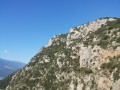
However, beneath the cliffs, this path joins an old Vauban path (now in poor condition) and you can then rediscover all the military genius of the beginning of the route, with, for example, some small marvels of construction, such as the multiple, and sometimes huge, retaining walls along the path, or the 13 massive steps carved into the rock or brought in as blocks. This path ends by skirting a rocky spur.
(6) Then return to the main Chemin Vauban at the tip of a hairpin bend on a small platform. On the Chemin Vauban, turn right and descend, passing three hairpin bends, and stop at the fourth. On the same type of platform as at point (6), there is a cairn indicating a new path that leaves the main Chemin Vauban and descends once again into the Sant-Pere.
(7) This is probably another military trail. It is well bordered by dry stone walls, although the whole structure is very dilapidated. The trail is not marked, but its path is well defined, so there is no risk of getting lost.
(8) Join the path leading to the hermitage and the Notre-Dame-de-Vie chapel, a few hundred metres below these remarkable buildings. Take the path on the right, marked with thick white paint and very well maintained by volunteers from the Notre-Dame-de-Vie association, which winds its way down the mountainside towards the Têt valley. It is impossible to go wrong as there is only one path. After about 20 minutes, you will return to the car park where you started (S/E).


 Visorando Member
 Extremely difficult
 Moderate
  Easy
Easy